



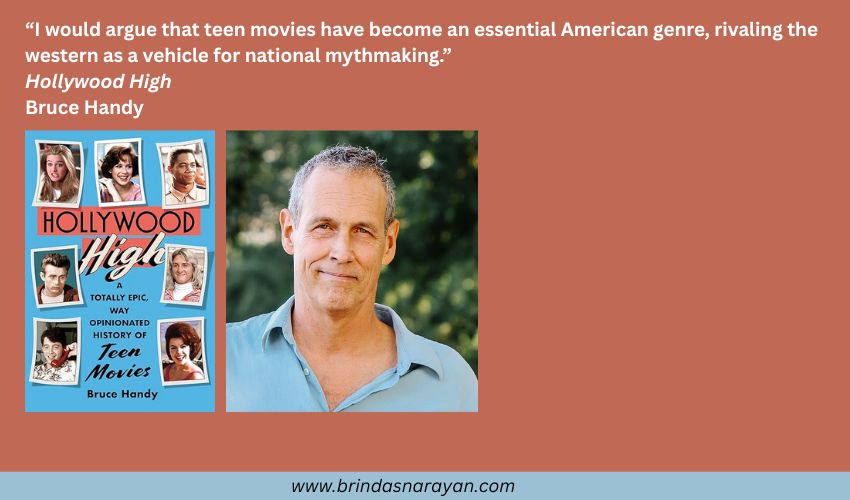
Tripping on Teen Movies With a Sharp Guide
I remember watching Rebel Without a Cause in a college class that was centered around the sociology of films. What I recall more than the film—with its portrayal of intergenerational clashes—was a notion that felt striking to my gauche, 18-year-old self: that films could refract extant social forces while also remaking them. It’s this riveting chicken-and-egg that Handy deftly explores in his personal (and also historical and cultural) trip down Hollywood movies that have shaped teenagers. And been shaped by them.
Not TikTok but Time Cards
To begin with, he reminds us that teenagers—in their contemporary angsty, hormone-surging forms—didn’t always exist. In the early 1900s, they were more like mini-adults, put to work on farms or in factories or inside homes. They were slaves or servants or apprentices or hustlers, with many departing parental homes at 14 or 16 to make their own way in the world.
Meanwhile, the middle classes wanted to imitate the upper classes, “whose youth had long been better educated and less gainfully employed.” Such desires were further stoked by educational reforms that ushered more teens into high school, a move that spawned consequences unforeseen by bookish do-gooders.
Rebellion with Backpacks
To reinforce how recent high schools are, Bruce serves up the stats. In 1920, about 25% of American teens were partially in classrooms; by 1930, close to 50% were attending schools. Depression forced more teens into schools. With fewer jobs, adults might have thought: why compete with teens? By 1940, 75% of teens were spending some time in high school. The thrust was to have all teens – across races, classes et al – share a uniform experience.
Packing so many adolescents into cramped classrooms and school hallways forged a new tribe whose tastes and values were determined by peers rather than by teachers and parents. They prompted each other to rebel against the structures that shepherded them. All this while contending with their own sexualities and identities, a privilege (if one could call it that) that wasn’t accorded to earlier generations.
Partying Rather than Producing
As Handy observes, till the emergence of rebel teens, “cool” moms or dads were not a thing. Neither were lifelong rebels like Madonna or Mick Jagger. Of course, much of the rebellion was fueled by allowances that enabled alcohol and cars and parties. As the historian Joseph P Kett notes, unlike ancient teens, modern teens “are essentially consumers rather than producers.”
Such teen consumers were described by Life magazine as far back as 1941. In its report on “subdebs” —high school girls from “good” families who were well off but not ultrarich—Life portrays them like an exotic species: “They swoop in and out of parties in noisy, cohesive gangs. They love open houses where there are plenty of phonograph records, cigarets and ‘cokes’… The world at large means nothing to any of them; the microcosm of their gang is everything. They speak a curious lingo of their own, adore chocolate milkshakes and swing music, wear moccasins everywhere…”
In “Teenagers: An American History (1996)”, Grace Palladino suggests that teens in high school “revolutionized the very concept of growing up.” As Handy puts it, schools morphed the parent-teen connection into a “labor-management-style relationship.”
Mickey As a Teen Titan
Such changes were naturally going to show up in the movies. And how! In 1940, a year in which Gone With the Wind bagged many Oscars, the biggest star wasn’t Clark Gable or Vivian Leigh, but 19-year-old Mickey Rooney. The actor played Andy Hardy in fifteen movies that centered around the Hardy family. By that year, he was a national sensation as a “car-crazy, girl-crazy, swing crazy” teen, depicting a shift in the culture that both indulged and feared their school-going adolescents.
Navigating Teenscapes with Andy
Andy, as a character, served as a guide to the American teenager and to this new cultural landscape. “But if Andy served as a role model for American teens, it was in part because he was reflecting them back to themselves; they had reached such a critical mass of shared experience that a role could be modeled.” Teen movies created a “feedback loop.” Their lives were inspired by movies, which were in turn, inspired by lives.
Unlike most protagonists, Andy Hardy had no pointy talents. He had oodles of “pep” – an elusive mix of energy and charisma. Archie Andrews of Archie comics was based on Andy. He wasn’t too rebellious, unlike James Dean in Rebel Without a Cause or Dustin Hoffman in The Graduate. According to Louis B Mayer, Head of Production at MGM, Hardy movies helped build America’s soft power. It wasn’t a coincidence that all lead characters were white, and all coloreds played subservient roles.
Andy’s family was supposed to represent the prototypical American family. As Mayer told Andy once, while remonstrating him for his off-screen libido, “You’re Andy Hardy. You’re the United States. You’re the Stars and Stripes.”
Mickey Rooney: Raised on Stages
The actor Rooney himself had never attended high school. As the child of two Vaudeville performers, he had grown up on stages, soaking up the limelight and applause from as early as the age of two.
His own childhood couldn’t have been more different from Andy’s. His parents were divorced early, his Dad was an alcoholic and a womanizer – a pattern that would seep into Mickey’s life. Rooney, accustomed to being a misfit, exuded energy, he was “raw.”
Middle Class Teens, Blue Collar Vibes
This was also a time when white middle-class teens adopted working class insignia, “like blue jeans and leather jackets”. “Race music” was gaining popularity. To capture the rising rebellion, beyond Andy’s contained mischief and stolen kisses, Hollywood created Blackboard Jungle (starring Sidney Poitier) and Rebel Without a Cause (starring James Dean). These two actors made white T-shirts sexy. Later, Martin Scorsese remarked that as a 12-year-old, he could intensely relate to James Dean: “The identification was total, even violent.”
Teenage Dreams with Retro Pangs
Passing decades, scarred by events like the Vietnam War, Kennedy and Martin Luther King’s assassinations, the Watergate scandal, injected a dose of cynicism and betrayal. Teen movies radiated a zeitgeist that seemed to suggest the past was better and that the present wasn’t so great. Movies of this ilk include American Graffiti (1973), directed by George Lucas, infused with cruising, drag racing and rock ‘n’ roll, forces that shaped the director’s own adolescence. Another was Grease (1978), set in the 1950s, depicting the cliques and high school crushes of an earlier time.
A Teen Boom At Hollywood
When the baby boom started receding in the 80s, teen movies came into their own, spanning genres like romcoms (Sixteen Candles, Pretty in Pink), musicals (Footloose, Fame), social satire (Risky Business), techno thrillers, crime drama, horror, sci-fi etc. By then, the film industry started attracting many more filmmakers and writers who had grown through their own high school experiences and who made films that spoke to their teenage audiences without any condescension.
One such writer was John Hughes, who even at middle age seemed keen on being like a teenager. More recently, as Bruce notes, Tina Fey did something similar with Mean Girls. Since then, it feels like popular teen movies need to be morbid in some way, like Twilight and Hunger Games. After all, teens are growing up through other crises including financial meltdowns, global pandemics, rising authoritarianism and impending climate disasters.
In the contemporary scenario, even boomer and Gen-X adults might hanker for earlier off-screen rebellions. A global teen hit that tugs teens off their smartphones and into theatres would elicit collective hurrahs.
References
Bruce Handy, Hollywood High: A Totally Epic, Way Opinionated History of Teen Movies, Avid Reader Press, Simon & Schuster, 2025