



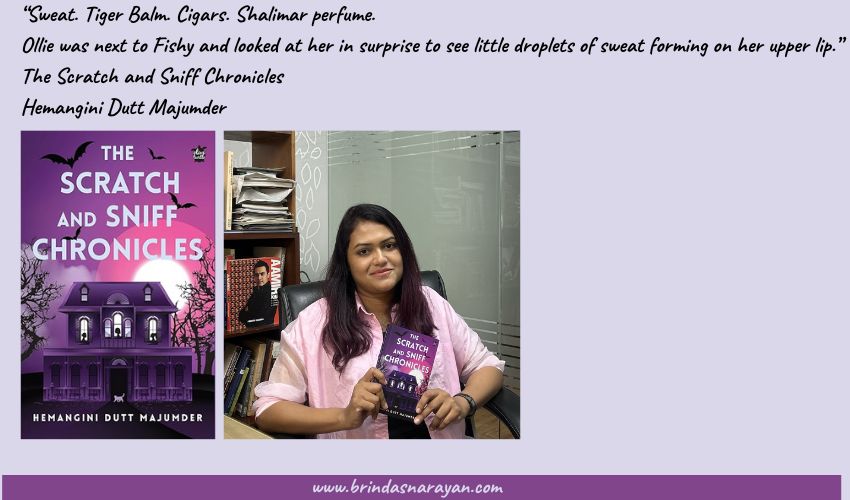
Something Smells Fishy: A Gothic Bengali Whodunit
In Edouard Manet’s Olympia, a nude prostitute stares at the viewer with a matter-of-factness that feels belligerent given that, till then, sex workers were rarely represented with such insouciance. The protagonist, Ollie, in The Scratch and Sniff Chronicles by Hemangini Dutt Majumdar, named after the painting, shares some of those devil-may-care traits, a rub off perhaps from her unorthodox aunt Fishy. Raised by her aunt, whose official Bengali name is Basanti, Ollie chomps through chips and sumptuous Bengali treats, with blithe disregard for her rounded curves. She’s refreshingly unshaken when a doctor diagnoses her PCOD and accompanying infertility. She savors the prospect of a childfree future. One of the hormonal offshoots has been an uncanny sense of smell.
In a Natural History of the Senses Diane Ackerman writes: “Smell was our first sense, and it was so successful that in time the small lump of olfactory tissue atop the nerve cord grew into a brain. Our cerebral hemispheres were originally buds from our olfactory stalks. We think because we smelled.” Such smelly ruminations come naturally to Ollie, who noses her way through various situations, turning her side-effect into a superpower. For instance, when Fishy enters a room, Ollie senses notes of “Tiger Balm. Hibiscus hair oil. Shalimar perfume. Cigars,” wafting through her brain. As a sommelier, she’s professionalized her molecule-detecting faculty, running a Wine & Spirits consultancy.
Besides choosing to raise Ollie after the tragic, early death of her parents – crushed by a falling piano – Fishy also adopted Laura, rescuing her from childhood servitude. As a sibling, Laura couldn’t be more different. She’s an architect, elegant and poised, attracted to women.
Neelbari is not just an old bungalow that belonged to Fishy’s family, and over which she fought a legal case with her glinting-with-evil step mom. It’s also, like any well-drawn setting, a character, with its round room and other singular features. Just as no human being is all surface, the house reveals itself in phases.
Injected with wry humor, the book comments on intergenerational changes. When Ollie watches two boys shoot a dance reel near a lamp post, she hears elderly walkers comment: “Bidyasagarer desh?” Or in other words, is this the same city where Ishwar Chandra Vidyasagar studied under a street light, apparently tying his hair to a lamp post, to tug himself awake? The two Aunties who critique Fishy’s parenting style and try get Ollie settled with a nice, boring boy are called the “Squares.”
The suave and shorter-than-her Danish Mirza, an unattainable cool kid at school and now a 10th Grade Chemistry teacher, falls hopelessly in love with Ollie. An occurrence that Ollie seems to treat with brusque disbelief. After a night together, Danish tries to unobtrusively sneak out of Ollie’s house, but he’s accosted by Fishy’s Tai Chi ladies, who slap him with fans and prevent his graceful vanishing. The family – Fishy and Laura – welcomes him, feeds him “radha bollobhi”, a lentil-filled poori.
Just when you think it might be headed to a happily-ever-after, Ollie ghosts him, perhaps wary of being used and rebuffed. Besides, she’s distracted. By chilling, terrifying events at Neelbari, a home she visits with Fishy, after her Aunt wins her case against Labanga Latika (the dancer step mom).
Fishy, too, thwarts female stereotypes. Though she seems to have had her share of suitors in her youth, she remains cheerily single. After working as a lawyer and parenting her two adoptive daughters, she teaches at a law college. She’s inexorably attached to Neelbari, her childhood home laden with memories, sighing with ghosts and the murmurs of unappeased ancestors. When the skeleton of a past lover is discovered, she recalls their attachment no doubt, but also his possessiveness. And her desire to end their tryst, rather than chain herself to a confined role.
Who then killed Fishy’s art tutor and ex-lover? In Fishy, Laura observes a chilling “lack of discomfort in the face of violence.” Could she have done it then? Or was the murderer Shankar, the stocky, wheeler-dealer priest that Latika Labanga had drawn into the house, soon after Fishy’s father’s death. The literal finding of a skeleton in the house leads to more murders and surprises. Relationships are not always what they were thought to be.
Combining an Agatha Christie-esque twistiness with a Wodehousian bemusement at the foibles of the “bhodrolok”, Majumdar cooks up a diverting noir read. And fortunately depicts atypical families – cobbled together by choice and circumstance rather than by old-fangled blood ties – with feisty women who buck the norm. At the end, we don’t care if Ollie settles into patriarchy or into an “Ollie-garchy” (the author’s pun, not mine). Perhaps, we might even wish that she lives as Fishy does, prizing autonomy over cloying social mores.
References
Hemagini Dutt Majumder, The Scratch and Sniff Chronicles, Oliver Turtle, Niyogi Books, 2025