



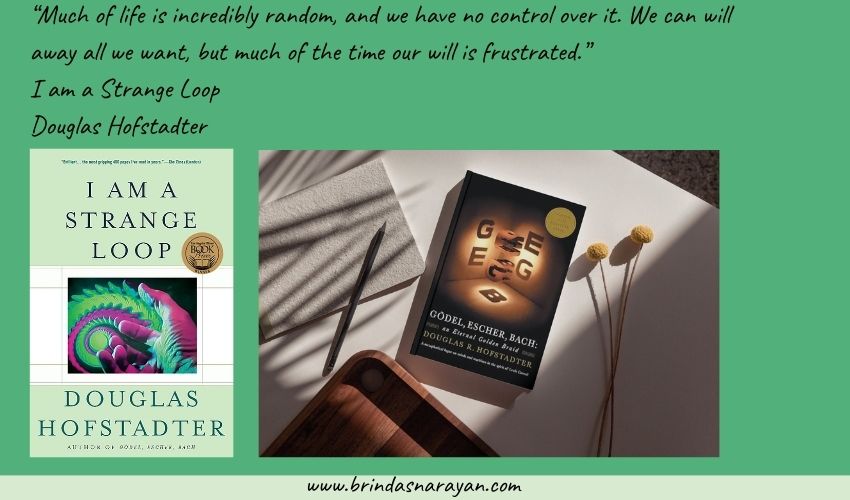
Thinking in Loops with Douglas Hofstadter
Tracing Loops Beyond GEB
When I was in college, it was a thing to have read Godel Escher Bach (GEB) and to pretend to have got it. But perhaps such nouveau adult pretensions might have countered Douglas Hofstadter’s central message. Which might have been, among many other things, that we may not really get what it means to get something.
More recently, an online talk by a mathematician stirred up that forgotten college read. As I wondered if GEB, an acronym endorsed by the author, would still intrigue a midlife me, I discovered that Hofstadter has since written I am a Strange Loop for readers who hadn’t quite grasped his bizarre, twisty and always enthralling cogitations. The second book emerged in a serendipitous fashion, feeding into his notion of the ways in which epiphenomena – a poem, an equation or a Bach symphony – are mysteriously engendered.
The Genesis of A Second Book
Invited by two young philosophers to contribute to an anthology on “self-referentialist theories” of consciousness, Douglas found himself writing an article that took longer than expected and was lengthier than planned. He realized too that his older self, having endured life’s peaks and valleys, could draw readers in by applying his “thinking about thinking” to personal situations.
That’s another reason to read this: Hofstadter divulges moving life experiences, more than he did in GEB. Besides, with all the recent blather about AI, his musings – even if written before Open AI’s eyeball-grabbing debut – seem more relevant than ever.
This then is a book about the entity we call “I”. As invested in form as he is in content, Hofstadter works hard to prettify his pages, and clarify his thoughts. Which slide easily from the lofty to the humdrum with a slickness that would elude many academics. Take one of his forthright maxims from this experience: tasks always take longer than you think they would.
Hofstadter’s Early Ponderings
Before interest in the human brain was as widespread as it might be now, Douglas was wrestling with its makeup. What does it mean to be intelligent or conscious or to think about one’s thoughts? Does a mosquito possess intelligence? Does a flush tank? Does AI, despite its canny posturing?
Hofstadter was thinking about thoughts partially because his younger sister, Molly, could never produce or comprehend words. And partially because he was entranced by his own brain and persistent sense of self.
All this from a very early age: when he was four or five, he was curious about what two twos would produce. When his mother said, “four,” he was plunging into three threes or rather three three threes and beyond the answer, he was flummoxed that joining two or three identical words or numbers could lead to something else. He was equally tugged in by mirrors of mirrors, by an infinite regression of images that many children might fleetingly delight in, but not endlessly tussle with.
At 16 or 17, he was seized by a strong feeling that “consciousness” is a mirage. Ten years later, when he encountered Godel’s theorem at a bookshop, he was hooked. He was onto something that would change his thinking (about thinking) forever.
On a Journey To Self-Knowledge
As an undergraduate student of mathematics at Stanford from 1961 to 1965, he learned to program on a clunky, old-fangled vacuum tube computer. “I simultaneously grew obsessed with symbolic logic, whose arcane symbols danced in strange magical patterns reflecting truths, falsities, hypotheticals, possibilities, and counterfactualities, and which, I was sure, afforded profound glimpses into the hidden wellsprings of human thought.”
On graduating from Stanford with a “Distinction”, he was intent on becoming a mathematician who would make a mark in the field. Soon, however, he confronted an unforeseen hurdle. As he puts it, some marathoners run into what is called the twenty-mile wall – a point during their runs when the pain becomes excruciating. Hofstadter observes that he hit a similar wall during graduate school at Berkeley.
His first two Berkeley courses – in algebra and topology – shattered his math dreams. He managed to garner good grades, but by memorizing and spitting out information without really processing images. “Abstraction piled on abstraction and the further I plowed, the slower my pace and the less I grasped.” This felt akin to the runners’ wall, and at that time, like a big blow.
He ruminates how our selves are forged by such setbacks. We set out as teens to be various things – dancers, gymnasts, doctors. Then we encounter obstacles and our own limits (as also our strengths). From thereon, we keep reorienting ourselves to shifting environs and a growing knowledge of the self. “We are all egocentric, and what is realest to each of us, in the end, is ourself.”
Dahl Inspires A Dietary Shift
His thoughts don’t just center on abstract theories. They trigger practical runoffs in his life. At one point, he was eating chicken and fish, but not mammals. When he was 21, he read “Pig” by Roald Dahl, where the protagonist Lexington watches pigs being slaughtered till suddenly the same ruthless, detached actions are taken on him.
At grocery stores, if Hofstadter saw a slaughtered pig’s head, he couldn’t help wondering about “who” that pig had been. What was it thinking or feeling? Dahl’s story goaded his switch to vegetarianism. Since his thoughts rarely halt at “ordinary” boundaries, he wonders about himself when he squashes ants and mosquitoes. All this to examine what a “soul” is in us.
Given to flip-flops like anyone else, there were times when he gave up on vegetarianism. Then he bumped into a reflective friend who had given up on meat for similar reasons and reverted to his meat-free ways. Now he’s mostly vegan, foregoing leather belts and bags.
Measuring the Unfathomable
This brings in questions of capital punishment. Can humans ever decide to snuff out other lives? Does a fetus have the same “souledness” as its mother? Hofstadter asks: “What gives us word-users the right to make life-and-death decisions concerning other living creatures that have no words?”
Two months after his father died in early 1991, his despondent mother wondered of what use a photograph of his father was. Hofstadter said, “that photograph is a soul shard of someone departed” – just as Chopin’s notes are glimpses of the Polish composer’s interior states.
He posits that a human “soul” evolves over the course of lifetime. But are there degrees of “souledness” and can we measure it? He assumes that a soul doesn’t have much heft at the moment of conception. In that case, do our souls expand as we age or diminish when our cognitive powers decline?
The Mind’s Secret Stowaway
He’s less interested in the physical substratum that fuels thoughts – in neurons, or the visual cortex, or the left hemisphere. Since we don’t always have to think of the microscopic or granular underpinnings to study larger forces, he’s curious about the brain as a system that produces a series of abstractions. “Is a thought really inside a brain?”
He coins the term, ‘thinkodynamics’ to describe the stuff that psychologists study – choices, responses, memories, emotions. Life is stitched up with predictables and unpredictables. When starting a new thought, we can’t predict its end, but we know that tilting our water bottles at a certain angle will cause water to pour out.
He envisions a ‘careenium’ – like a billiard table – consisting of simms and simmballs (which are clusters of simms). Any external pressure on the careenium results in some simms moving around and altering the structure/positions of the simmballs. The simmballs encode changes and are symbolic.
We can view the careenium from the reductionist perspective of simms or ignore them altogether and merely observe simmballs. Getting back to the question – “Who shoves whom inside our brains?” – meanings attached to simmballs push other simmballs.
Uneasy with Loops
We seem to be suspicious or even irrationally fearful of feedback loops, especially of those that involve ourselves. Some tribes fear mirrors, other folks are self-conscious about their social reputations.
Hofstadter himself played for several hours with video feedback loops inside a Stanford studio and encountered a host of unexpected epiphenomena. Many of which required the conjuring of descriptions he hadn’t expected to deploy like ‘galaxies’, ‘blackholes’, ‘cheese’ and ‘starfish’.
I am a Strange Loop is perhaps one of the more accessible reads to tackle the “hard” problem of consciousness – the confounding emergence of a self from a clump of inanimate matter. And moreover a self that thinks about itself, a meta-ability that we (maybe hubristically) presume is not possessed by animals.
A Nonexistent Self
The book also dwells on Hofstadter tragically losing his wife to cancer at 42, about how intertwined their selves were. He reaches a conclusion that the Bhagavad Gita might echo: that the psychological, narrative “I” is an illusion. That there really is no physical entity that can account for the experiencing and chattering self. He doesn’t think we have free will either. He believes that, too, is an illusion.
Even if we’re ambivalent about his assertions, we might agree with Wittgenstein: “It is the ‘I’, it is the ‘I’, that is deeply mysterious!”
References
Douglas Hofstadter, I am a Strange Loop, Basic Books, Perseus Books Group, 2007