



When Growing Up is Never Quite Finished
Chancing Upon a Book in Beacon
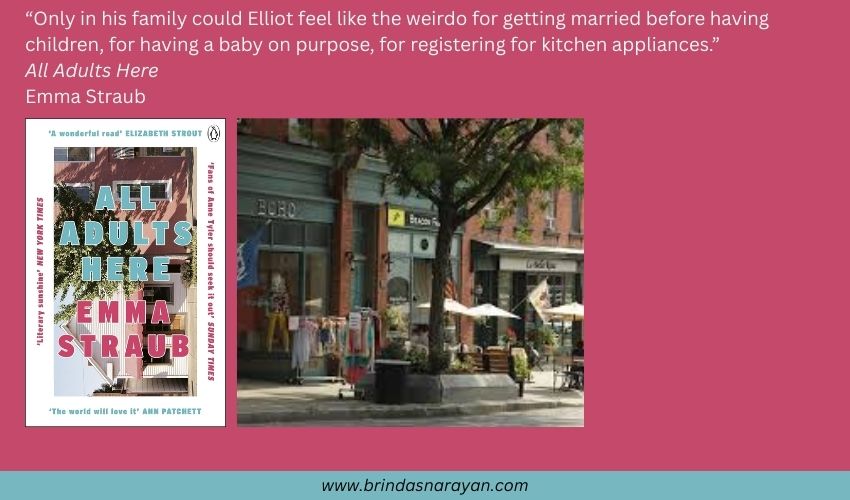
How does one stumble on a book? For me, it usually entails reading about it in a newspaper (we still buy old-fangled papers) or online or choosing it from a publisher’s promotional catalog (Thank you, Speaking Tiger!). All Adults Here was found differently. We were ambling through the cutesy, pedestrian-friendly Beacon, a small town in the Hudson Valley, proximal to New York City. With its cafes, restaurants, artsy businesses and galleries, the place seemed to radiate patches of hopefulness that might be less apparent in other parts of the nation. For one thing, its smallish library proudly blazoned an LGBTQ+ tolerance on its wall. As did its Main Street bookstores, one of which sparked off a Prison Books project, to dispatch reads to the incarcerated.
On our way to a park that overlooked the shimmery Hudson river, we trudged through a featureless stretch filled with clapboard houses. A dry grassy yard sported a Little Free Library – a birdhouse filled with books for passers-by to pick up. Despite a heat wave searing our backs, despite never hearing of the author or the title, I was tugged by the first line in a yellow hardback: “Astrid Strick had never liked Barbara Baker, not for a single day of their forty-year acquaintance, but when Barbara was hit and killed by the empty, speeding school bus at the intersection of Main and Morrison streets on the eastern side of the town roundabout, Astrid knew that her life had changed, the shock of which was indistinguishable from relief.”
Being Stricken by the Stricks
Many pages later, I can assure you that the windy beginning and hooky, dauntless voice delivered on its pact. So much so, I intend to pick up Emma Straub’s other works.
In a slightly loopy fashion (having recently read Hofstadter, I’m fleetingly obsessed with loops), when I started reading the book on the train ride back, the book mentioned a Little Free Library in Clapham, a fictional town set in the Hudson Valley, that mirrors Beacon. An unexpected payoff was that I could get under the skin of a place that we had just walked through.
The work revolves around the Strick family. Astrid Strick, who is 68 and has been a widow for a long while, unexpectedly falls in love with her hairdresser, Birdie. Coming out to her family as “bisexual” when she’s a mother and grandmother takes courage. Her revelation is spurred by the death of her frenemy, Barbara. Her declaration does not stir the already-offbeat among her kids and grandkids: like Nicky, the youngest or Porter, the middle one or Cecelia, her granddaughter. But the oldest and perhaps most mainstream in their family, Elliott, is horrified. With a wife and three-year-old twins, Elliott toes conservative small-town norms. Tied to the construction business, he’s bought a plot that he plans to covertly lease out to a large chain-type business, the kind that loyal small towners typically abhor. He reflects that in his family – where each member charts an idiosyncratic path – he has to apologize for being so run-of-the-mill.
When Adolescence Stretches Too Far
Nicky, the youngest, who acted in a movie at one time, seems primarily occupied in smoking weed while figuring out next moves. His French wife, Juliette – and I deliberately use ‘French’ as an adjective here, as does the author – exudes a sophistication in everything she does: in the cigarettes she smokes, in the clothes she wears. It’s an aura that keeps her American family enchanted but also jittery. Porter, the middle one and Astrid’s only daughter, springs in and out of an affair with her one-time high-school crush. Which feels like a relationship that ought to have ended at high school, but has dragged on for too long, since the veterinarian lover is married with two kids, and aggravatingly indifferent to betraying two women. In the midst of all this, she chooses to get pregnant by artificial insemination. Maybe she chooses motherhood as a gateway to her delayed adulthood. Or hopes to birth a being who will love her in perpetuity.
Bohemian Parenting Styles
Cecelia, Astrid’s grandchild and Nicky and Juliette’s 13-year-old is raised in a rather lackadaisical fashion. The parenting feels new-agey and light touch till it almost tilts into being out-of-touch. A disciplinary incident at Cecelia’s New York school goads her parents to dispatch her to Clapham, where she’s now being monitored by her Gammy (Astrid), with her Mom and Dad withdrawn from her new-school terrors.
Winning Over Mean Girls
Cecelia’s presence accords us a glimpse of Clapham’s schools. That feature a familiar “Mean Girls” gang – a meme and a reality in many American high schools – a glammed-up clique who deride others with judgy put-downs. Take, for instance, their treatment of August, the son of another bohemian couple, who starts wearing dresses and makeup. And prefers to be called a gender-neutral ‘Robin’ as a precursor to their coming out as a girl. At the final Harvest Festival Float that rides through town, “Robin was suddenly the most glamorous person in sight.” So glamorous that even the Mean Girls, who earlier idolized the vicious and stunning Sidney, shift allegiances to Robin. “Even the shallow could be accepting. It was oddly comforting.”
A Comic Take on Messy Adulthoods
The title All Adults Here is ironic. After all, even Astrid, at 68, doesn’t pretend to have all the answers. She’s too busy reinventing herself as she ponders her parenting missteps. At times, the smallness of the town feels stifling and its inhabitants might hanker for the redemptive anonymity of a big city. At others, it depicts what a community could be. Faltering and messy, no doubt, as families and adults often are. But also, at the end, an interconnected web that makes a novelist’s wry examination feel worthwhile. Would anyone want to read about cloyingly perfect folks and relationships free of the fractious micro-dramas that make up lives?
Though the themes examined can feel weighty – extramarital affairs, coming out, gender shifts – Straub imbues it all with a comic touch. I’ve discovered that she’s the co-owner of an indie bookstore in Brooklyn, New York called ‘Books are Magic’ that I’m marking as a “place to visit” for a future trip.
References
Emma Straub, All Adults Here, Riverhead Books, New York, 2020