



Beating Pots and Shattering Norms
Beating Pots and Shattering Norms
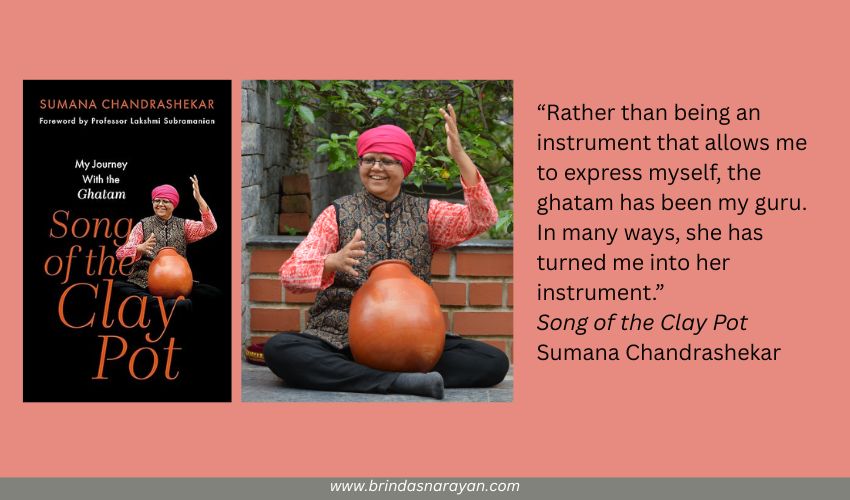
As one of the rare female Ghatam players on the Carnatic stage, Sumana Chandrashekar unveils behind-the-scene politics and hierarchies, the misogyny parading as tradition, the making and precarity of the instrument, with its journey mirroring that of women musicians. On the ghatam, her fingers are relentless: they surprise and command, interrupt and argue, or recede into murmurs and silence. She has a matching felicity with words, pounding out her lines with the rhythmic cadence of a trained percussionist.
Sidelined on Stages
She’s conscious that where and how she sits can affect her playing. With the ghatam weighing about 12 kilograms, she has to ensconce it on her lap while ensuring that her shoulders, arms and fingers stay unfettered. It’s not only about her body and the instrument, it’s also about her position on the stage.
With the mridangam accorded the superior rank of a pakkavadya, and with other percussion instruments relegated to being upa pakkavadya (secondary percussion instruments), ghatam players are often relinquished to an invisibilized second row behind the main performers. Shorn of eye contact with other musicians, they miss out on subtle cues and impromptu exchanges that make Indian classical performances distinct.
Hierarchies Among Instruments
The lionizing of certain instruments and the diminishing of others stems from arbitrary orderings, that can often be traced to a single dominant Text or Master, whose authoritative word remade Rules. In this case, a series created as part of a culture-codifying nationalist project tossed the ghatam into an inconsequential ‘miscellaneous.’
A fallout is that mridangam players covertly signal to ghatam players – about when to start, when to soften their beats or stop. This is often disconcerting and “demoralizing” as Sumana puts it. For subordinate instruments, “[r]estraint is a quality that is highly valourised.” As it is for women, in patriarchy.
Dismantling Archaic Orders
Photographs from earlier times depict that the pecking order was not always so. While there have been and still are attempts to subvert such hierarchies, an ossified past still endures. Some musicians like T.M. Krishna ensure performers are seated in a semi-circle, with equal weightage accorded to all.
Chandrashekar’s vigilant to how such ‘positioning’ also affects one’s writing. Whose point-of-view does she occupy when she embarks on her memoir? In other words, where does she sit? “Before starting to write this memoir, I had to first establish my vantage point.”
Learning With Her Body
Hers is a viewpoint not solely dictated by her mind, but also gleaned from her body. After all, as she observes, the body possesses a knowing and an agency of its own. “The mind is a quick learner, clever, sometimes cunning. The body learns slowly, is simple and honest.”
The body is marginalized, shamed, gendered, broken, ignored. “On the other hand, it is the same body that is resilient, that rejoices in different-ness, subverts status quo, questions power structures and embraces with compassion – just by its presence. Just by being.” The ghata (in Kannada) or the ghatam (in Tamil) is, constituted, like the human body : of a “belly, neck and mouth.”
An Early Interest in Pots
The pot had seeped into Sumana’s consciousness at an early age. Her maternal grandmother, Chayamma, hummed Carnatic tunes and narrated stories. There was one particular ditty that she sang while bouncing Chandrashekar’s baby brother, drawing out his delighted gurgles when his feet thumped the floor.
Kumbara Gundayya
ondu kaalalli mannannu hege tulidaaaa? hege tulida?
Potter Gundayya
how did he stamp the clay with one foot? Oh? how did he stamp?
Gundayya, a famed potter, was a peer of the spiritual reformer Basavanna. He not only made pots, but also played on them. A poem about him was memorized by all students in Mysore from 1940 to about 1970. He played so well, he shattered time and space, compelling Siva and the ‘whole world’ to dance.
An Unorthodox Upbringing in a Small Town
Sumana grew up in a densely-wooded Dandeli, in north-west Karnataka. When it was a quieter place, before it was besieged by tourists. It had always been a cosmopolitan town, with a healthy jostling across languages and religions. For instance, as she observes, its revered Tabla teacher was a Muslim man in his 90s.
Her own grandparents were offbeat. Her widowed grandma had trained as a violinist, a tennis player and a writer. Moreover, she had remarried. Chandrashekar’s father owned an eclectic music collection, ranging from Harry Belafonte to Thayambaka (chenda drumming of Kerala). Theirs was a gender-agnostic, avant-garde household, with all sharing chores.
A Dream Sparks Off Ghatam Lessons
In the summer of 2008, Sumana, who was already trained as a vocal Carnatic singer, had a bizarre dream. Her fingers were tapping her belly, summoning the “sounds of a pot.” At first, she rubbished it as a just a dream. But the dream persisted, the sounds and images recurring. She worried that she was hallucinating. She was already singing on stage, so why was this pot beating from her?
She asked her vocal Guru, Rupa Sridhar ma’am, who unexpectedly asked her to heed the message. Chandrashekar was already an adult. Could she find a ghatam Guru at this stage? She was swamped with other self-doubts. Till one evening, she heard Sukanya Ramgopal perform at Chowdiah. “Sukanya and her ghatam were in deep conversation – sometimes like mother and child; sometimes like sisters; sometimes like two dear friends.”
A few months later she summoned the courage to call Sukanya ma’am. And looks like her Guru too had expected her. On Sumana’s second day of classes, after playing for 20 minutes, when her arms and shoulders were aching, her teacher had tears in her eyes. She said, “For thirty-five years, I was waiting for a woman student. You are here now.”
Dealing With the Rigors of Riyaaz
Like most classical musicians, Chandrashekar could sit cross legged on the floor with ease. But constantly keeping the 12 kg Ghatam on her lap required “endurance.” Moreover, beating the ghatam to produce any sound needed energy at the finger tips. Often pain shot through her shoulders, arms and even skull.
Many musicians get calluses on ankles from sitting too long on the floor. Her mother was the first to notice how her hands had become so “rough” like a wrestler’s. Her fingers started cracking and bleeding with practice. Once when she went to class with these visible cuts, her Guru acknowledged them with a cursory “Hmmm” and asked her to dip her fingers in lukewarm salt water. She noticed then that the cuts on her Guru’s hands were deeper.
The Precarious Making of Ghatams
Instruments are manufactured by families or communities in specific regions or places. The ghatam used to be made in Devanahalli, Chennai and Manamadurai (in Tamil Nadu). In each of these places, only few families or even just one had the knowhow. But with development, lakes and ponds required to make such pots vanished, and with them the artistry and knowledge. Currently, ghatam-making has shriveled up in Devanahalli and Chennai. Luckily for the pot’s players, ““Manamadurai thrives.”
With the instrument’s future resting on one place and family, Sumana teamed up with others to get a GI tag assigned to the place.
Drumming Up New Rules
Chandrashekar always wears a cap or turban as, “[t]he hair on my head decided to leave when I was six.”
At Carnatic concerts, she prefers not to wear sarees. She chooses closed collar kurtas with pajamas and this has upset many. One Kannada TV channel refused to feature her vocal concert. Other performances too dropped her for sartorial reasons. Once when visiting a temple town with a senior guru and scholar, she was asked to wear a half-saree and keep her head bare. She complied with the first request, but found the second offensive and “humiliating.”
She cites an essay by Amanda Wiedman titled “Gender and the Politics of Voice: Colonial Modernity and Classical Music in South India,” which observes that male singers and performers are given much latitude when it comes to clothing and hairstyles. But women musicians are expected to don somewhat “lavish” silk sarees and keep their long hairs plaited or tied into buns. In other words, women should look like “a respectable family woman.”
In October 2015, a 24-hour bhajan session was being held at Odukathur Mutt in Bangalore. Her Guru planned to perform with her. As Chandrashekar stepped over the threshold, a man in his 60s, blocked her entry and angrily told her to “get out.” Upset and frustrated, she returned to the car and sobbed on the steering wheel. Just then, her Guru stepped into the car and said she too was not playing. She was equally infuriated at the double standards imposed on women.
In her 1997 book, Layne Redmond wrote in “When the Drummers were Women: A Spiritual History of Rhythm,” that banning women drummers was central to disempowering women in the West. This is possibly not just a problem for the West. Yet world over, women drummers will resist and emerge. As Sumana puts it, “But in the end, I will make my own road.”
References
Sumana Chandrashekar, Song of the Claypot: My Journey With the Ghatam, Speaking Tiger, 2025