



Unmasking a Complicated Genius
When Roth Felt Personal
Literature moves us most intensely when it expresses thoughts or feelings we don’t recognize in ourselves. Steven J Zipperstein experienced this kind of revelatory identification when, as an adolescent, he first read an excerpt from Philp Roth’s Portnoy’s Complaint. Of that 1967 encounter with the Partisan Review, Zipperstein writes: “I was an orthodox Jewish teenager, eager not to abandon the only way of life I knew but wrecked by reading the likes of Roth, whose confessional voice, explosive intelligence, and impatience with dishonesty to oneself all had the feel of a barrage of urgent letters addressed just to me.”
Chronicling an Obsessive Chronicler
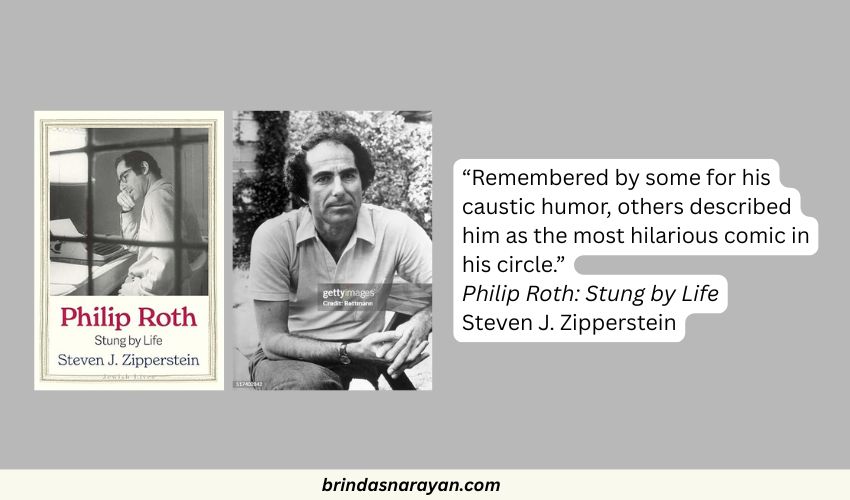
Currently a Professor of Jewish Culture and History at Stanford University, Zipperstein has retained that teenage fascination with Roth’s works, transforming his immersion into a riveting account of a writer who was peculiarly canny at both capturing and eluding himself. After all, Roth persistently deployed alter-egos in his stories and novels – Portnoy, Kepesh, Zuckerman – eking out large, overarching dramas from micro-scenes that constituted his family, his community, his place. Not just from the present, but also from the past. As Zipperstein observes in Philip Roth: Stung by Life, much was drawn from his childhood and especially from his angsty teenage years in Weequahic, Newark.
Resurrecting the Place That Made Him
Zipperstein picturizes this middle-class, Jewish neighborhood as it used to be then, with its sprawling 300-acre park and lake. Born in 1933, Roth was raised in a Newark littered with factories that made all kinds of things: paints, chemicals, drugs, beer, hats and jewelry. While insurance companies also spawned white-collar jobs, hard work, especially in physically strenuous jobs, was a characteristic of its inhabitants. As literary analyst Mark Schechner says of Newark’s residents: “To be a hustler was a term of high praise, as high almost as being a mensch.”
In the 1940s, Newark started developing cultural sites, theaters, restaurants, department stores. Along with its indigent neighborhoods, which
which smelled foul and lacked water and heat, it fostered a formidable elite, of which two figures were prominent. Bamberger owned the city’s large department store, donated to its Museum of Art and founded the Institute of Advanced Study at Princeton. “Longy”, an erudite gang leader and philanthropist, ran a criminal enterprise. He funded the Minutemen, a thuggish group trained to counter Nazi meetups.
Weequahic, at first out of bound to Jews, soon became 95% Jewish. As Zipperstein observes, “Roth, convinced of the need to fix his fiction as close as possible to reality, drew on his old neighborhood for the backdrop of an idyllic (if also exceedingly regimented) childhood, a tumultuous adolescence, the rise and decline of the American city, and eventually the site of a fascist takeover and the terrors of an uncontainable epidemic.”
Funny and Fiercely Observant
Gangsters gathered at its candy store, teenage boys huddled with girls in the basements of its wealthier homes, families were both protective and cloying.
The local school churned out an impressive roster of lawyers, doctors and other nerdy types. Into the 70s, it had one of lowest dropout rates in the nation, and produced the highest number of future doctorates. Though Roth absorbed “a culture with a tremendous respect for books,” he wasn’t a class-topper.
In Elementary School, many kids had grades that were higher than his. Even later, his average was a B-, at best. But he was known for his humor, for being the comic even on short walks to their Hebrew School. As a teen, he spent time hanging with friends, buying records, listening to music, as he stayed painstakingly attuned to his burgeoning sexuality.
Mining an Orderly Family
Since he remained a lifelong adolescent – with his string of romantic liaisons despite being twice married – he retained the rebellious eye-rolls and peevish distancing from his community. His father, Herman Roth, was gritty and diligent, with both qualities stretched to hyperbolic proportions. He could also be vitriolic, impetuous and meddlesome. All this, while being devoted to his family, as was his wife Bess, to her kids.
His mother was so fastidious about her housekeeping and cleanliness, that Philip and his brother wouldn’t use toilets in others’ homes, as they wouldn’t be clean enough. Yet, they were a happy family, a fact that might surprise readers of Portnoy’s Complaint. So much so that the author occasionally experienced fleeting pangs of nostalgia.
Exploring the Fabric of Jewish Life
Besides his frequent turning to domestic and family scenes, Roth explored the Jewish experience as few other writers have. While he only had a skimpy knowledge of Judaism, he knew the intimate textures of Jewish American life. For instance, the difficulties of being a good Jewish boy while battling one’s inner turbulence. Yet, for being one of the most famed writers from the community, his very presence created a schism. At one time, an overarching issue that divided American Jews was their admiration or abhorrence of the then-young author. This, when Roth was only 30, and had published just one novel and a collection of stories.
Roth As a Lifelong Provocateur
Though Roth spent most of his life isolated, dwelling as Steven says, like an “unchaste monk”, he continued to provoke critics and philistines, the erudite and unread. Besides his eyebrow-raising tangles with women, his works attracted caustic appraisals. As one reviewer put it, he “wrote nine novels about his own literary alter-ego Nathan Zuckerman,” and hence paid “outsized attention to the male ego at the expense of all else.”
Cultivating Potential Biographers
He wasn’t known to be humble. Even in his early 20s, he had a sense of his writerly talent and of the career looming ahead. He advised a girlfriend of that time to preserve his letters, because surely they would reap value in the future. Much later, like the famously hubristic Steve Jobs, he nurtured a group of potential biographers, despite fearing that the work would supersede his fiction.
Examining The Writer and His Writings
Stung by Life might dispel the author’s concerns. Zipperstein delves into the genesis of his works as much he probes the makeup of a complex, funny, intense, acerbic writer. Zipperstein not only engaged in long conversations with Roth before his death, he also dug into archives and interviewed more than a hundred people. He’s aware, like Roth, that getting it right is beside the point. In American Pastoral, Roth writes, “Getting people right is not what living is all about anyway…” Reading a work by a meticulous, literary scholar might be what living is about.
References
Steven J. Zipperstein, Philip Roth: Stung by Life, Yale University Press, 2025