



Studying Desire and Its Discontents
Radha Krishna: An Archetype of Illicit Love
Love, in Indian mythology and poetry, is typically of two types. In svakiya, or conjugal love, a married couple sustains an enduring romantic bond. But parakiya or an illicit love that defies social conventions, is usually considered to be more ardent. The relationship between Radha and Krishna is an unorthodox, intense tie, as are the bonds between the seductive flute-player and his gopis. Interestingly, it’s the taboo, clandestine type of love that suffers, intensifies and eventually destroys the “self.” “[Krishna] is both divine and human, mischievous yet profound, worldly yet transcendental. To love Krishna is to transcend the ego – to dissolve in devotion.”
Analyzing From Personal Experience
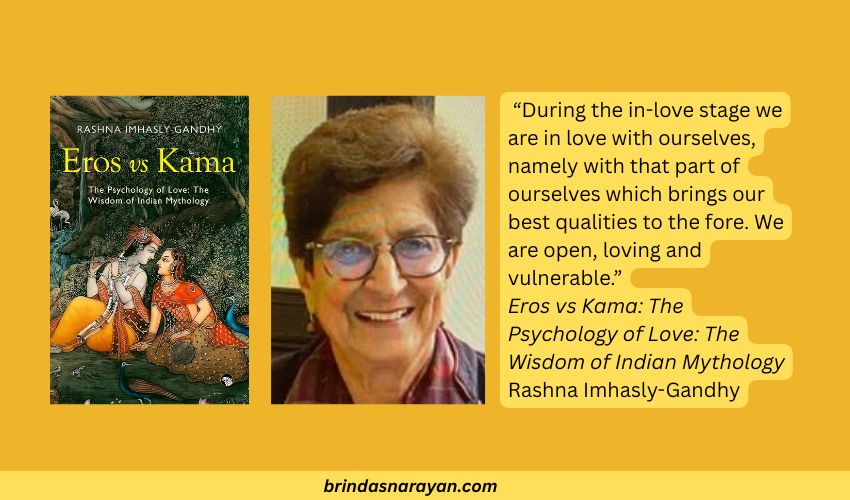
Rashna Imhasly-Gandhy too had experienced the upheavals of unexpected passion. At 19, when headed to Britain to meet a childhood sweetheart, she opted to halt at Switzerland and study German. In the multilingual, Alpine country, she fell in love with her German teacher. In Cupid’s throes, she felt seized by an otherworldly force. “In India Cupid is known as Kama, the Magician, the one who plays havoc in peoples’ lives.”
She married her teacher and lived on in Switzerland. Her Indian family was aghast. She may not have realized then that the attraction had been amplified by its forbidden nature. “The more forbidden those fleeting glances are, the more oblivious lovers are of the rest of the world, the more enticing the love spell becomes.” Romances, she suggests, flourish amidst strains. “The mundane, the stable, and peaceful co-existence play no part in it at all.” Excitement mounts amidst uncertainty.
Finding Passion and Purpose Among Peaks
Switzerland also stoked a different passion. Studying the works of Carl Gustav Jung, the Swiss psychiatrist and psychoanalyst, she was riveted by his theories on “individuation” and on the influence of archetypes. Since then, working as a Jungian analyst and transpersonal psychologist who merges Eastern philosophy with Western probes into the unconscious, she draws from Indian myths to help couples navigate relationship crises and individuals forge psychological cohesion.
Portraying the Early Stages: Falling in Love
Describing the first stage in a relationship, from her own experience and from couples she has worked with, she notes that love happens to you. Since it’s the unconscious that tumbles into love, it’s mysterious, inexplicable.
Soon after, one can only see positives in the beloved. “Under the influence of the love archetype, there is a special sense of connectedness to life again.” Thereafter, the stricken are willing to accept small signs – a phone call, a Text message, or even a glance – to sustain their elevated moods. They yearn for reassurance. If this doesn’t come, they wait. “One pines and languishes like a drug addict waiting for the next fix.”
But the Jungian process of “individuation”, wherein a person chooses to separate from a collective, to beget a more harmonious and authentic inner self, is sparked off by a wounding, a “moment of betrayal.” For some, this could involve feeling cheated in a relationship, or for others, a midlife crisis. From Jung’s perspective, such hurting can be cathartic, triggering a search for an optimal self. The process can involve detachment from a family, community or nation. The knowledge one seeks emerges from the unconscious, from parts of the self that have not been adequately attended to till the flashpoint.
Genesis of Desire in Hindu Mythology
Rashna uses myths to delineate psychological processes that can unfold inside partnerships. “Mythical figures are no more than personifications of the developing stages or energies within individuals.” Delving into the Shiva Puranas, she describes three Gunas, as “attributes of the same energy.”
Brahma – Rajas – is the creation of thought. Thoughts generate desires and when desires are fulfilled, by gaining a particular object, the state reflects Sattva or Vishnu. Tamas is “lethargy” – the feeling of not wanting to do anything. This is represented by Rudra, the destroyer.
Since Brahma is the original creator – of space, time and all the whizzy, gravity-bound or gravity-sucking objects, he is thought to have been in a yogic state, when he dreamt of Sandhya – the dusky, sensual goddess who intentionally represents a dangerous liminal state between day and night. Brahma gazed at her with such longing, and at the same time, birthed a young virile being, whose arrows pierced him and other sages. “So that was how desire first made its way into the world.”
After the Fireworks Fade
In the honeymoon phase, the partnership is seen as a route to wholeness. Slowly, reality sets in. The woman might contend with two jobs – an external one, and the one at home. The archetypal male might be fervidly building his career, so he lacks time for home and hearth and this too can spur frictions. New issues crop up. One has to repay loans, pay for children, handle their education and contend with in-laws. Instead of feeling like part of a union, separateness arises.
Folks, at this stage, might seek happiness in one’s career, or in children, or by embarking on an extramarital relationship. The energy that was “love” mutates into “rage.” Every word is significant, because it can heal or hurt. “Apart from the fact that the spoken word has a healing and transformative effect when responsibly used, it has the potency to stir up the negative energies of others when used irresponsibly.” People yell at each other or retreat into moods. Partners have to be wary about not triggering the worst in each other.
When Separations Are Healing
In relationships, a certain amount of conflict is healthy. Otherwise, one partner is wholly subordinate to the other, the effects of which can spill into other relationships. Those who are unwilling to accept their partners – warts and all – are snagged in a stage of immaturity. They repeatedly “fall in love”, but never really “love” a flawed partner, acknowledging that they too are imperfect beings.
Imhasly-Gandhy has encountered clients who would not accept deviations from pre-conceived gendered expectations. For instance, one client could not tolerate her husband crying during crisis situations. Another expected her businessperson husband to accord her a better lifestyle.
If a marriage is toxic, rupture can lead to a recovery of wholeness. This entails recognition that completeness resides in oneself, and not in any external person or entity. “Retreat is a way of introspection.”
Steep Complications of Triangular Tangles
Triangular relationships are poor solutions to such dilemmas. Typically, one partner embarks on an affair with an older/younger friend/relative and tries to recreate the “in-love” stage. This partner is then switched off from the primary relationship and the affair is rarely subjected to the mundane demands of everyday life. Sometimes, the partner who feels betrayed by the other can also introspect as Bert Hellinger puts it in Love’s Hidden Symmetry: “perhaps the separation was necessary because the soul required more space to grow, and the one who left was already suffering.”
When Heads are Swapped
Myths can help clients recast such tangles. In the myth of the “transposed heads”, there are two male best friends. One friend gets married and the couple happily live together for six months. Then the wife gets pregnant and the friend travels with them to her parental home. On the way, the bachelor friend and wife fall in love. When the husband discovers this, he heads to a Kali temple and beheads himself. When the friend enters the temple, he sees his fallen friend, blames himself and also cuts off his head. When the wife finally enters, she plans to hang herself after she sees the two bloodied bodies. But Goddess Kali appears and tells her that the men have only been temporarily killed. She asks the wife to join the heads back to the bodies. The wife does so, but mixes them up, attaching her husband’s body to the friend’s head and vice versa. Kali then asks her: “To whom do you belong?”
“Until she had solved the riddle – that she belonged to herself – she was as confused as the two friends who had lost their heads.”
Stepping Away to Find Oneself
Rashna observes in her practice, that in order for relationships to thrive, we need to go through a period of “exile”. Even if living together, there has to be a sort of distancing, for each of us to grow and change and relate to human beings who embody differences. Exile is not withdrawal, but a time for introspection. It allows us to determine who we are and to set boundaries that keep a healthy sense of self intact.
Even if love begins as infatuation, its more significant work is to reshape us. The myths in Eros vs Kama attest to that.
References
Rashna Imhasly-Gandhy, Eros vs Kama: The Psychology of Love: The Wisdom of Indian Mythology, Speaking Tiger, 2026