



Resurrecting an Iconic Writer’s Life
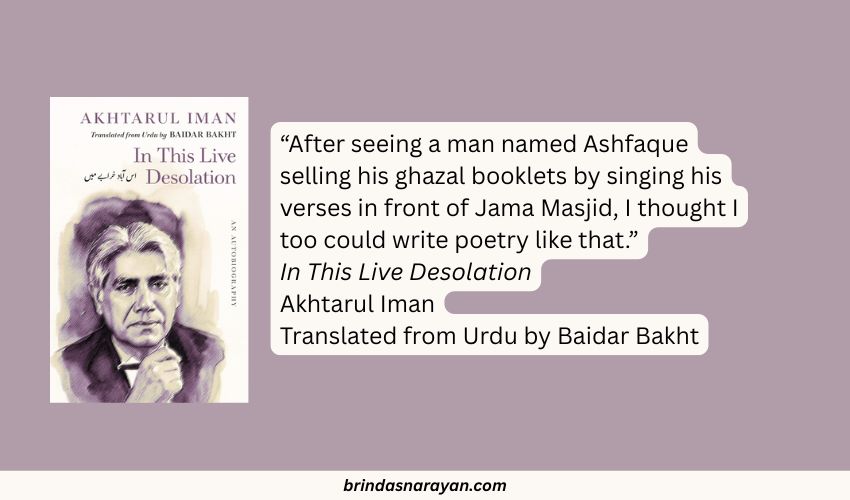
Readers of this blog post are unlikely to have viewed the 1965 film, Waqt, directed by Yash Chopra, starring Sunil Dutt, Raaj Kumar and Shashi Kapoor. But one of its iconic lines, penned by the Sahitya Akademi winning Urdu poet and screenwriter Akhtarul Iman (1915 – 1996), might be familiar to many: “Chinnoy Seth, jinke apne ghar sheeshe ke hote hain, woh doosron par patthar nahin phenka karte.” (Chinnoy Seth, those whose own house is made of glass, do not throw stones at others.) His biography, In This Live Desolation, not only depicts ordeals that lead to his writerly ways of being and looking, but also evokes the rugged textures of that era.
A Stranger In His Own House
Tugged through a series of villages by an itinerant Father, who worked as an imam and also exuded a paradoxical fondness of young female students, Akhtarul witnessed the fractious relationship between his parents: “Mother was illiterate and Father was flirtatious.” While his Mother slept at home, his Father occupied a small cell in a mosque.
Finding Awe in Small Moments
His volatile home life exacerbated by turbulent shifts drove Iman towards spaces that felt orderly: nature and his quiet observations of small scenes. When leaving one of the villages, he describes the despondence of leaving the deer and acacia trees and mynas and daiyairs.
Of course, he learned early that nature too seethed with terror and violence: “I have always had a phobia of snakes.” Once, after his Father had left him at an orphanage surrounded by forests, a little girl had vanished. Later, she was found beheaded by a hyena, a scene he absorbed in all its traumatizing gore.
Yet to nature it was that he repeatedly turned. Growing up introverted and solitary, he spent hours staring at fruit orchards or at fields filled with flowers. Or at people throwing coins into a pond. As he puts it, “At heart, I am a dreamer. I can lose myself for hours. I enjoy meeting people, but only for a little while.”
Unsettled By a Philandering Father
When his father took him to Jagadhri, a city now in Haryana, he heard from another imam that his Father had married again. He promptly reported this to his Mother, and thereafter whenever his Father visited, the fights were more wrathful. Once he tried to stand “between them.” Which resulted in his Father more or less ceasing his visits. Tired of her philandering and drunk husband, his Mother left for an Uncle’s house, leaving the child in the care of her negligent spouse. It was only inevitable then that Akhtarul followed her, leading him eventually to an Uncle in Delhi, who admitted him to a reformatory madrasa.
A Harsh School Births His First Novel
Moidul Islam in Daryganj, Delhi, admitted many kids who were disabled, disfigured or traumatized in some manner. Moreover, the institution was poorly funded and the place seemed to be just about held together, with students eagerly awaiting rare feast days to be properly fed. To compensate for such harsh environs, Akhtarul met some wonderful teachers there. So much so, he even wrote a novel though he misplaced the manuscript. A bout of pneumonia compelled his exit and he returned to his Uncle’s cramped house, which he loathed.
Choosing to Learn Against the Odds
Stumbling on a Muslim high school, he persuaded the Head to admit him. Though his Academic fees were waived, he was asked to give tuitions to pay for the Sports fee. Here again, a kind teacher motivated him and even made him the editor of the school magazine. He started participating in debates and writing poetry. Even if his life, in many ways, still felt chaotic – words, both written and spoken – were his lifelines.
Staying the Course Through College
Enrolling at the Anglo Arabic College, which almost had Ghalib joining as a Professor, Akhtarul was soon involved in a tragic accident. Embarking on a fun day by the Yamuna river with a friend and his cousins, Iman swam in the waters. The two cousins followed him, despite his frantic warnings about its depths. Unfortunately, both drowned. The next morning, their bodies floated up, their faces bitten by fish. From that day on, Akhtarul stopped eating fish.
Subtle Trades in a Neighborhood
Staying at Baradari, an area where silver was beaten into thin foil, he observed a neighborly give-and-take in his community. And the foibles of various people. Like Rehman Saheb, a draughtsman who hosted rowdy parties, or Abbu, a petty thief, who ran a paan and ciggie shop. Despite his criminal activities, Abbu sent Akhtarul free drinks since the latter educated adults in the community mosque. Observing that his thievery was fueled by circumstances that had robbed him of an education, Abbu appreciated Iman’s efforts to bridge the void for others.
Learning to Sound Like Himself
Striving from thereon through his BA and later an MA, Iman also tided through a disappointing first marriage. He fell in and out of love with women, often terminating his relationships for reasons that seemed unfathomable later. He remained similarly distanced from other poets, who wandered in parks, composing ghazals, feverishly devoted to various Masters. It was a detachment that helped forge his distinctness. He refused to align himself too closely with the Progressives, whose dogmatism was as intolerant as that of the ‘regressives’.
The Soft Scrawls of Rivalry
Working as a screenwriter, he contributed to several iconic films. Inside studios, he witnessed hilarious shows of “one-upmanship” between writers. Once, Saadat Hasan Manto brought an Urdu typewriter to the office and told another writer, “Writing on a typewriter is something else. Writing by hand is not fun at all.” When the other writer also brought a typewriter, Manto said: “It’s much more fun to write by hand.”
Though he later married a woman he loved, and fathered children to whom he was deeply attached, as his wife Sultana puts it in her Preface to the Urdu Edition, “Even in death, his face was calm, with a faint smile. It never seemed as if he had truly left us.”
Giving Script Writers Their Due
Narrated with a lyrical conciseness and translated with precision by Baidar Bakht, this text adds to our understanding not just of Akhtarul Iman, but to the felt experiences of that period. His story augments our film and literary history and confirms that the past has never been easy or idyllic. While cinema tends to glorify actors, books like this reinforce why due attention has to be paid to unseen, visionary writers.
References
Akhtarul Iman (Translated from Urdu by Baidar Bakht), In This Live Desolation: An Autobiography, Speaking Tiger, 2026