



The Story Alchemist Who Helps You Tell it Better
No Holding Back Tears
The audience, composed of children and adults, tilt their heads in anticipation. Ameen Haque strides on to the stage in a crisp, white kurta. In his echoing baritone, he starts reciting his poem, “Chup Raho.” The aggravating command, ‘Keep Quiet’, has been used, among other things, to silence children and banish male tears. Soon he has the audience chiming in with “Chup Raho, Chup Raho, Chup Raho.” The boys, in particular, are lit with smiles, at a grownup who’s according them permission to cry. A poem narrated by a deft storyteller can seed questions on toxic masculinity, on adulting or on the clamping of emotions in less than three minutes.
Growing Up in Quiet
Raised in Vidyanagar in Gujarat, Haque, the founder of Storywallahs, Story Monk and Storyteller, recalls how the campus town was sparsely populated in the late ‘70s. Students flocked to its educational institutions, and then scattered during winters and summers to hometowns or villages. During the hush of holiday seasons, parrots trilled and squawked across the large sports field that marked the center of the town’s activities. Apparently parrots were so many, their droppings fostered allergies.
Learning to Listen and Notice
As the youngest child of his feisty single mother, Adhila Haque, Ameen was shy and introverted, evolving into a keen observer and listener. He watched his mother efficiently run their strapped household, while juggling her teaching job at the Sardar Patel University. Striding on the road that surrounded the sports field, he watched cricketers and footballers thump balls with stirring ferocity. He absorbed everyday haggles that constituted commerce in their bazaars, or the book-laden swagger of academics who emerged from the Bhaikaka library.
Small Town Sans Strangers
The town was memorable for another reason. In a face-to-face world bereft of devices and television sets, everyone knew everyone. Haque would even bump into the nurse that delivered him, his elementary school teachers, or the local mithaiwala. Nestled among dense trees and the rough foliage of an erstwhile forest, the place fomented his life-long interests: people, books and tales.
Losing Himself in Clues
Zealously borrowing reads from a small lending library, he fled the certainties of Vidyanagar to romp with Enid Blyton’s Five Find-Outers or with Hardy Boys and Nancy Drew. His eyes ignite with a child’s glee when he recalls Indrajal Comics that featured Mandrake, Phantom and Flash Gordon. He and his friends had formed a Secret Seven club that could only be entered with an elusive password. He laughs at how “pink bubble gum” was the closest stand-in for strawberries described in those foreign stories. Later, as an adult, when he encountered real strawberries he thought something was “wrong with the fruit. After all, shouldn’t they be pink?”
He also soaked up poetry like Percy B Shelley’s Ozymandias. He was equally enthralled by the Ramayana and Mahabharata, being one of few students to pore over recommended reads.
As Intrigued By His Kin
Stories could also be found elsewhere, like inside his own family. As a curious child, he eavesdropped into adult tales. Of an uncle who had run away and vanished inside Bangladesh (then East Pakistan), of a grandfather who had pursued him and was confined – by the sudden hardening of Partition’s borders – in Pakistan.
Some accounts were whispered, others caught in snatches. Like that of his mother who had ridden to school in a horse-drawn tonga, donning a purdah, but who had insisted on higher education when it wasn’t kosher for women. Setting out from Kerala to Delhi, she garnered a Bachelor’s in Science, a Master’s in Agricultural Science and later, even after birthing three sons and contending with her husband’s separation, pursued her PhD. Her tenacity was to infect Ameen, who later recognized the origins of his diligence and grit.
Journeying Through Tongues
Despite being relatively tongue-tied at school, Haque was garnering another passion: for words and their origins. Spending summers in Kerala, he imbibed the musical rhythms of Malayalam, at home, gunshot phrases in Hindi and at his Kendriya Vidyalaya school, the bouncy cadences of English. This affinity for language led him to compose poetry, an activity that he still pursues, posting his compositions on social media.
Crossing the multilingual nation entailed long train journeys from Gujarat to Kerala to visit his maternal grandparents, aunts and cousins. “In those days, there were no phones, nothing. All you had was the window and your imagination. We spent time daydreaming, talking to people, listening to stories or watching someone tune their transistor.” At Kerala, he wandered the aisles of Higginbotham’s or A. H. Wheeler & Co., discovering crime novels in the 9th and 10th Standards.
Becoming a Ping-Pong Pro
His wasn’t just an indoor life. He also took to sports, playing cricket, football, kabaddi, Kho Kho and later, more competitively, Table Tennis, in which he became a State-level player.
Shedding Coyness On Stages
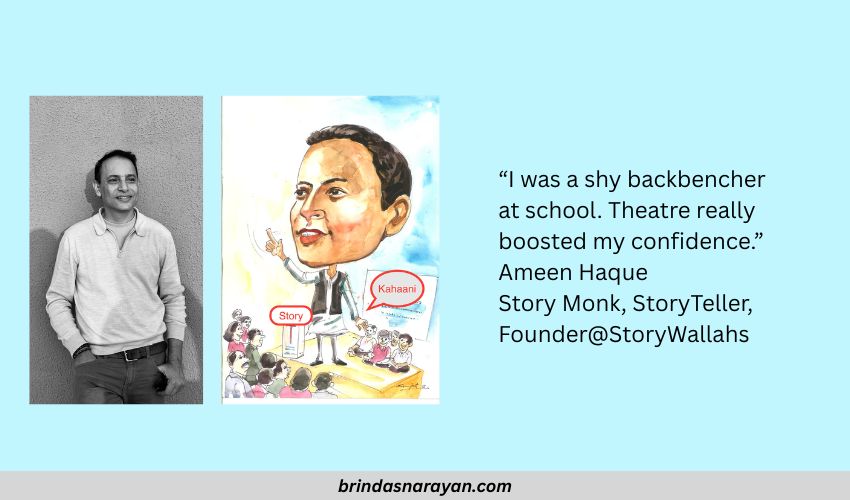
Games, in themselves, may not have dispelled his shyness. In his early years, Ameen tried to diminish his classroom presence, occupying the last bench and interacting minimally with others. Not knowing his father’s whereabouts filled him with confusion. Books felt like better allies than inquisitive friends. Spotting her child’s bashfulness, his educator mother prodded him towards elocution contests and debates and drama. He reveled in theatre, starting with a school play directed by an English teacher. “Theater is like a mask. You’re playing a tree or a king or a soldier. You’re not you. You don’t have a problem going on stage because your face and your identity is hidden.”
Taking a fancy to public performances, he also spoke at the school assembly. Often, he would weave elaborate tales, like “The Autobiography of a Shoe” that started with the footwear’s vanishing from outside a temple. Or of how a “full shirt pocket signified an empty heart.” He didn’t think his own narratives constituted material.
His Ammi was right. Theatre and public speaking boosted his confidence. Persisting with it through the 11th and 12th Standards, he joined a theatre group at university. He wasn’t keen on Science and since Literature wasn’t on the cards for a middle-class family, he chose to do a Bachelor’s in Business Administration. After an early stint in Sales & Marketing, he attended a Communications and Advertising Course at MICA, Ahmedabad.
Moving to Mumbai to work in Advertising, he continued to nourish his theatre roots, joining a group called Ankur, signifying a germinating seed. It was a commercial troop with a social conscience. For instance, they also enacted street plays on AIDs in red light areas. Since the group was a compact tightly-knit one, everyone had to play multiple roles: help with costumes, settings, procure chai for each other. When he shifted later to Bangalore, he continued to act in plays at Ranga Shankara.
Forging Enduring Brands
During his Advertising years, he worked on memorable campaigns, including General Motor’s launch of the Opal car. He was involved in adapting Mastercard’s global campaign to local sensibilities – “There are some things that are priceless, for everything else, there’s Mastercard.” He was at the agency when Cadbury Dairy Milk was propelled by Piyush Pandey’s “Kuch Khaas Hain.” Though he wasn’t part of that team, he imbibed the creative air. Global brands were being remade with an Indian flair. At Bangalore, he helped launch Aashirvaad Atta and scripted a TVS bike commercial, featuring MS Dhoni. He recalls attending a shoot with the legendary cricketer.
A Detour into Tale-telling
After gaining strategic, senior experience, he opted to quit and explore options. Around then, he attended a one week storytelling workshop at Kathalaya, run by its Founder-Director, Geeta Ramanujam.
Ramanujam not only narrated stories to children, but also trained teachers. Haque, who had always been a sucker for stories, was enchanted by the workshop. Engaging in a one-on-one with Geeta, he said: “This is fun, but what do you do for a living?”
Geeta said: “This is what I do.”
It struck Ameen that he might have stumbled on an alternate path. It was too early to call it an “ikigai” but he couldn’t help toying with what-ifs.
While mulling over this other future, he was keen on polishing his storytelling chops. He hung around Kathalaya as a volunteer for six months, “cleaning Geeta’s office and helping her with work.” Till he felt ready to strike out on his own.
The beginning felt hazy: “I wasn’t sure what we would do and where the money would come from.” Connecting with an ex-boss from Delhi, he offered to work with him part-time to fund expenses.
Kickstarting Storywallahs
To concretize a first step, he set up a small office in Jeevan Bhimanagar, hanging up a “Storywallahs” board and creating a website. The team, small to begin with, started with stories for children and teachers. Keen to leverage his corporate savvy, they tacked corporate workshops to the website.
He admits that early days were grim: “No work was coming.” Determined to stay busy, Storywallahs went to any place that would have them. They told stories to autistic children at The Spastics Society. On weekends, Ameen would mesmerize kids at Atta Galata. Children were often accompanied by parents or grandparents. After sessions, some adults would linger to chat. When they discovered his extensive corporate know-how, a few invited him to their organizations.
When Customers Come Knocking
Someone proposed he teach “Business Storytelling” at a new MBA institute that was transitioning midlife engineers into leadership roles. The teaching stint brought in a steady income.
An employee from GE landed on their website and requested a workshop for their leadership team. The session received much acclaim and another was requested. This time, Ameen said he would charge INR 30,000. They agreed. Another corporate called, asking for a workshop. Ameen proposed a charge of INR 33,000. They acceded.
This no longer felt like a chimera. Word of mouth surged. So did customer testimonials. Demand from the corporate sector ballooned. All along, Storywallahs kept up with narrating stories to children. While they did some teacher training on a non-commercial basis, they chose not to aggressively sell to schools. Since then and over the years, their business storytelling has “gone through the roof.”
Deeper Lessons at Retreats
After nearly thirteen years of establishing a formidable brand in Storytelling, Ameen has returned to his beginnings in poetry, theatre and writing. He runs a five-day retreat called “The Storyteller’s Way” for individuals keen to spark their creative journeys: “We look at poetry, we look at ads, we look at stories, mythology, we write a bit. It’s not a writing retreat, it’s a storytelling retreat. We work with personal, narrative, business stories and the hope is that through width, we’ll get to depth.”
Retreat participants to date have included writers, poets, screenwriters, business leaders, homemakers, HR or L&D leaders and coaches: “They come because they want to figure out how to work with stories.” These retreats are held four times a year, twice in the Himalayas and twice in other enticing locales like Kolhapur and Goa. Each retreat only admits up to 15 participants at a time.
The Legacy Continues
Storywallahs, which currently consists of seven members, still teaches (at workshop settings), coaches (primarily CEOs or senior leaders) and consults with corporates. Some teammates teach at business schools like IIM or ISB and participate in storytelling festivals.
Exploring Mono-Acts
Ameen, personally, continues to tell stories and write poetry that he posts online. He does spoken word performances for his Hindi poems but leaves the English ones for readers to savor in silence. He’s also gearing up for a longer solo performance at NCPA, where he will be telling the story of Kabir or presenting verses from the Bhagavad Gita in Urdu.
He also researches and writes about the roots of creativity. And about the makings of greats in various fields like Mohammad Rafi, Lata Mangeshkar or Sachin Tendulkar. He realizes that in all these fields talent alone does not suffice. What propels them to stand out? He incorporates some of these lessons into “The Storyteller’s Way.”
At the end, he observes that artists create art for themselves. “Others may like it, but you are its first consumer and beneficiary.” And just as the act of making pots has to feel joyful to the potter, the act of writing poetry must move the poet.
Boomtown for Story Tutors
For others who want to embark on a journey like his, he observes that this is a great time. “Today the market has grown and you can slice it in different ways. Brand storytelling is one school. So is Data Storytelling. Or Fiction Writing or Mythology or Poetry. There’s also Storytelling Through Photography or Art. Everyone wants to be a storyteller these days, starting from the host of a kitty party who wishes to post something memorable on Instagram.”
Reaching for the Truth
Conscious of how stories can be associated with exaggeration or deception, he’s personally tugged by authenticity. He’s even had politicians reach out to project certain narratives and the team has refused. At one time, a fast food company wanted their help with obtaining an FDA nod. The project did not resonate with their ethics. Repeating the adage that “with great power comes great responsibility,” he refrains from using stories for unscrupulous ends.
The question that he considers with each story is, “Why am I telling it? What is it adding to the world?” It’s a question he urges his trainees to ask, turning his own life into a story worth telling.
References
https://www.storywallahs.com/