



Cooked in Layers: Slicing Mumbai’s Food History
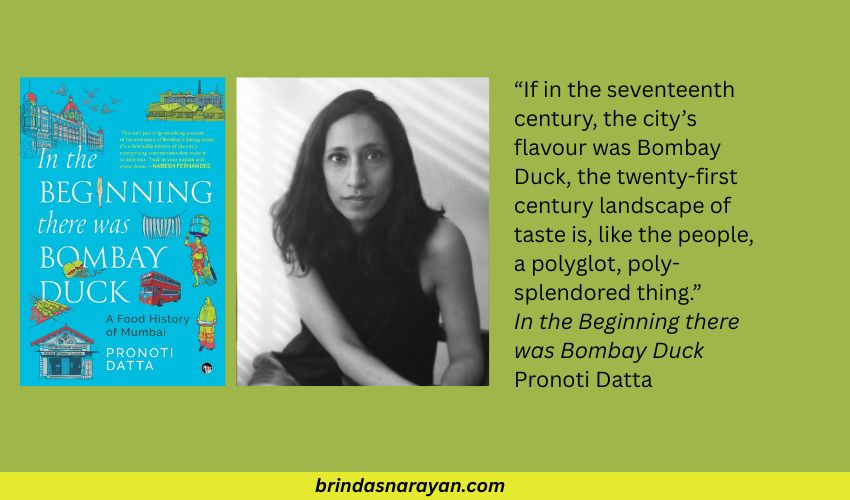
Bombay or Mumbai can be sliced and diced in myriad ways. In the Beginning There Was Bombay Duck by Pronoti Datta does this with food, evoking the city’s history and its mélange of communities and cultures. She combines stories of particular restaurants, their iconic founders and storied chefs with scholarly legwork, making this a fascinating read for academics and lay readers. Curious foodies might be enticed by the “anti-recipes” tucked into the last section, whose origins mirror their constantly morphing environs.
Exhuming The Scents of a City
Starting from the time of the Portuguese Garcia d’Orta, when the island was stitched up of fisherfolks, forests and fruit-filled orchards, the work traipses through its Udipi, Chinese, Iranian, Gujarati and Sindhi influences to name a few. It resurrects the distinct stench of the drying Bombay duck – not a waddling bird, but a lizardfish – known by many names, including Bombil, boomla and bummaloe. Word origins are often fishy but Bombay Duck might be an anglicized version of Bombay Daak, the train that carried the smelly produce to other parts of the nation.
Portuguese Flavors on Indian Tongues
The British had even been averse to acquiring Bombay because of the peculiar stink, though they were later handed the city as a dowry when a Portuguese queen married Charles II. But even later, the Portuguese left a distinct trail on the island’s tastes, through well-tutored Goan chefs.
As Datta points out, when the city later changed from Bombay to Mumbai, taking a more chauvinist and parochial turn, the vada-pao was flagged as a signature dish. The pao had been taught to its Goan bakers by Portuguese colonizers, a fact that the Shiv Sena might have conveniently neglected.
From Roadside Eateries to Fine Diners
From the fisherfolks and tribes, to the elusive Pathare Prabhus (a Maharashtrian community whose foods aren’t as widely available at hotels), from khanavals that fed laborers from specific castes or regions to snooty dining spots at the Grand Hotel or The Taj Mahal Palace Hotel, the work showcases how the city ate and overate.
A droll anecdote involves the Italian Mario Bonaveglio, who started the Lido Room and a club called the “Little Hut.” Food rationing rules had been imposed on eateries during the war, but Bonaveglio defied the authorities’ diktat to serve only one main and one side per patron. As Datta puts it, he “was too generous with food.” The fun-loving Italian was even arrested for his magnanimity. Years later, Anil Dharker, the restaurant reviewer for the Times of India would write in 1998, that the Lido Room had preserved its historic patron-centricity at all costs.
Ogling Celebs and Sophisticates
This was also the city that spawned celebrities. At the famous Gaylord restaurant, started in 1956, Rajesh Khanna was occasionally spotted at a table. His crazed female fans would kiss the bonnet of his car, leaving their lipstick marks on the vehicle when it was parked there.
The Taj opened its air conditioned restaurant in 1933. The editor of the Current captured its contradictions best. Its European maître d’hôtel was discerning enough to “separate chinchilla from cat’s fur, jewellery from junk, the girlfriend from the bit of fluff.” On the other hand, its Goan waiters bungled, serving “prairie oysters when pernods are ordered.”
Natives Outwhite Their Rulers
Since colonial times precluded Indians from fancy clubs, some like the industrialist Sir Cowasjee Jehangir started their own. Vengefully rubbing it into white supremacists, the club even bore a sign: “Asian Club: Not for foreigners.” Some Britons like Willingdon liked mingling with well-heeled and princely natives. But forbidden by his peers from ushering them into clubs, he founded his own, spawning the Willingdon’s Sports Club. It was there that an Indian member, Devi Prasad Kejriwal, made a special request. Eggs Kejriwal, a fried egg with green chillies and cheese on buttered toast, was birthed in response.
Bun Maska at Irani Cafes
As Datta puts it, Mumbai is characterized not just by its kaali-peelis, Bollywood and vada pao but also by its Irani cafes. Whose beginnings involved the chancy mingling of big and small forces.
After the 1896 plague, Iranians who used to sell tea and snacks on the streets, bought up corner plots which were avoided by Hindus, because they were considered “bad luck.” The cafes, with their trademark red and white checked tablecloths and vintage posters, also played a critical socioeconomic role, offering a dining experience to the middle and working class. They popularized the “chai and bun maska” (buttered pao). Unfortunately, in the contemporary city, many of the erstwhile Irani cafes have shut down, their numbers diminishing from hundreds to a few dozen. To memorialize the past, chains like SodaBottleOpenerWala are deliberately recreating cafes with trademark tablecloths and posters.
Flipping Dosas, Not Rotis
Mumbai has also absorbed migrants from within the nation. Each community inevitably imported its dietary preferences. After all, to those from the Kanara coast, from places like Mangalore, Udipi, Karwar, the basics are constituted not by roti and biriyani, but by idlis, dosas and thaali meals.
One of the first Udipi eateries was founded by A Rama Nayak, who had arrived in Bombay at 12, to elude his family’s impoverishment. Training at first with a home cook who made meals for single men, he then moved on to Gopalashram, a Saraswat lunch home in Fort. In 1942, he started Udipi Shri Krishna Boarding, forging a “brand” that embodied a South Indian comfort food. Many young boys from the coastal region came to Bombay in this manner, starting out as dishwashers and cleaners and later buying restaurants or establishing their own.
While Udipis still thrive in areas like Matunga and Fort, they too are struggling with rising rents and labor deficits. For a city constantly in the making, early ways of cooking and eating are at risk of diminishing or completely vanishing. For that reason too, a work like this is a necessary means of retrieving older relationships with food, not merely to fuel nostalgia, but to actively interrogate the present. While toting up modernity’s gains, we shouldn’t lose sight of its losses.
References:
Pronoti Datta, In the Beginning there was Bombay Duck: A Food History of Mumbai, Speaking Tiger, 2025