



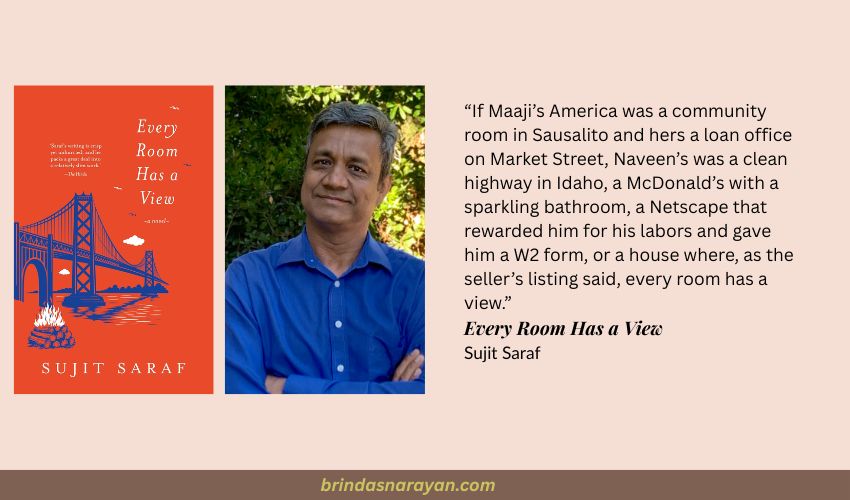
Crafting Views of Their Own
Have you ever wondered about the texture of an alternate life? The colors of everydays, the shapes of afternoons and evenings, the flight of time in a different place? For instance, how would your life have felt, if you had lingered in Silicon Valley before its lava eruption of dotcom ventures, before its heady tech startups had started emitting their sweet, numbing vapors? That’s a “What if…?” I have occasionally toyed with, turning the cloudy thought this way and that, as one might a rainbow-emitting glass bauble.
Reading Every Room Has a View was particularly gratifying, because it offers up one among myriad possibilities of the Indian American experience in the technophilic El Dorado. Swiveling around the past and present ruminations of Usha, whose husband has just died and whose corpse overlooks their vaunted view of the Golden Gate Bridge and Alcatraz, the narrative jostles regrets with flattened desires, the comical with the profound and dissatisfying presents with misremembered pasts.
Willing an Audacious Exit
How does death remake a person? In Naveen’s case, he looks more elegant and handsome. But Usha’s appreciation of his refined mien is quickly dispelled by his bizarre will, read out by his lawyer friend, Jeff. Naveen, who hadn’t exhibited any zealous religiosity while alive, or even strong tugs to the homeland – to which he never seriously intended to return – insists on being cremated in a traditional Hindu fashion. Which involves not just relevant pandit rites, but also being burnt on a pyre.
Usha, just now widowed, is bewildered. While theirs had always been a somewhat aloof, abide-with-each-other-for-convenience relationship, the newest demand seems to emerge from hidden depths. Firstly, what behooved her husband to pen a will in his mid-50s, given that his death was sudden and unexpected? Moreover, such a ridiculous wish, to be executed in a place where the very act would draw the approbation of locals and authorities? Weren’t Indians supposed to keep their heads down in this country and just do their work? Why this law-defying desire to turn his death into a beachside spectacle?
Stepping Into an Arranged Future
Beyond the manner of death, this is a time for Usha to reckon with her own life. At 25 in Delhi, she had all the redemptive features of a prospective bride: a BA in Home Science, a willingness to relocate. After a brief dalliance at college, she resigned herself to parental machinations. Tucking her fierce intelligence out of sight – all those college debates on Kantian ethics and the Goddess of wisdom – she readied herself for a life that wasn’t going to be logical or easily contained. She wondered if some horrific future awaited her: “dictatorial mothers-in-law, husbands who drank, families that sank slowly into the cruel indignity of the middle class.”
When she finally met Naveen – whose family was from Meerut – she was relieved. Even slightly taken in by glimmers of his American-ness. During their six-month engagement, his father suddenly died. Yet the wedding was held as planned, but the venue shifted from Meerut to Delhi, with no attendees from the groom’s family.
Remaking Roots in America
After marriage, she started liking him. He was one of those rare nice men, a virgin too, something that Usha – with her fleeting affair – wasn’t. Moreover, she had “leap-frogged the whole color pyramid” by marrying a boy in America. In the new country, she could trash her Fair & Lovely tubes and turmeric pastes.
At first, she loved America: its vast parking lots, its wide roads, “the free ketchup in McDonald’s.” “What a country, what a happy place to live in!” Like many immigrants, the couple wrangled with staying versus returning. Usha was keener to return, Naveen keener to stay. But they were both ambivalent. Naveen told her the joke about all Indian engineers who plan to return after x+1 years. In year x, it was always next year.
Ups, Downs and IPOs
Naveen rode the Valley’s peaks and troughs, its inflated promises, its occasional busts, its get-rich-quick and change-the-world brags prancing on a twisty kaleidoscope. He joined Netscape with his closest friend, Mahesh. Their pulses raced with murmurs about IPOs, stock options, vesting and early retirements. They slogged impossibly hard in casual clothes. The money he made at Netscape – less than he dreamed of – fuelled his apartment with a view.
Maaji Imports Old Ways
In the meanwhile, their son, Ajay, arrived. And with him, Maaji from India. Naveen’s mother seized the baby with “an Indian sort of love” – a black spot on the forehead, massages, oil and flour and turmeric to usher in a vaunted fairness. Besides her color prejudice, she ushered in notions of the pure and impure. And of Punya, the religious currency that one can accrue for good deeds and words. “Usha chafed under the reign of purity and Punya.”
As Ajay grew into a successful 16-year-old headed to Carnegie Mellon, the marriage frayed. Not so much with bitter fights or harsh tirades, but with tiredness, with love giving way to a “partnership, or perhaps a project in which they were joint managers.”
Close, But Out of Reach
Now with Naveen dead, Usha hardly seems to know her reticent son, whose interactions are compact and transactional. Who chose to learn Indian classical music sans any parental pressure to pursue scripted paths. For his father’s cremation, Ajay willingly submits to shaving his head and to fasting (or quaffing permitted foods), as if the codes of a traditional India are braided into his DNA. But later, at the beach, when Ajay confidently fends off cops, Usha takes pride in his easy American ways, his second-generation swagger.
Stirred Without Blending In
Usha herself seems to come into her own when she starts working at a loan processing center. It’s not the job so much, as the forging of an identity that’s not tied to her husband or son. Maaji too finds her own reprieve at a community center in Sausalito, where she can hang with other like-minded aunties. Eventually every character finds their own ‘America’, a slice of self carved from the pumpkin pie. To Naveen, the window view might have denoted arrival, or making it in the foreign country. It was a view that Usha and Maaji were indifferent to. His death releases them from that cherished glass pane, allowing them to gaze at what matters most to each: at who they once were and who they have now become.
The Dead Has the Last Laugh
While the last rites progress in an almost comic fashion, Saraf sketches the absurdities and contradictions that mark diasporic lives. The pandit, outfitted in jeans and a T-shirt, carries his paraphernalia in a backpack. Despite Maaji’s skepticism, he seems learned in the mandated verses. Keeping with the Valley’s emphasis on speed and the impatience of all moderns, he abbreviates the 13 days to a punchy one day. Since he has to be gifted a cow, he deftly suggests that the animal can be hired from a woman he knows. Perhaps, in desi fashion, the pandit gets a cut from the farmer lady. To mark its presence, the hired heifer pees in the elevator and drops dung on their hardwood floor.
Regardless of how he had lived, Naveen might have been elated by the circus surrounding his death. Perhaps he was one of the fortunate few who died laughing.
References
Sujit Saraf, Every Room Has a View, Speaking Tiger, 2025
Sounds really interesting. You’ve provided such a lovely cameo of the book, Brinda😍