



Conjugating Selves in a Foreign Language
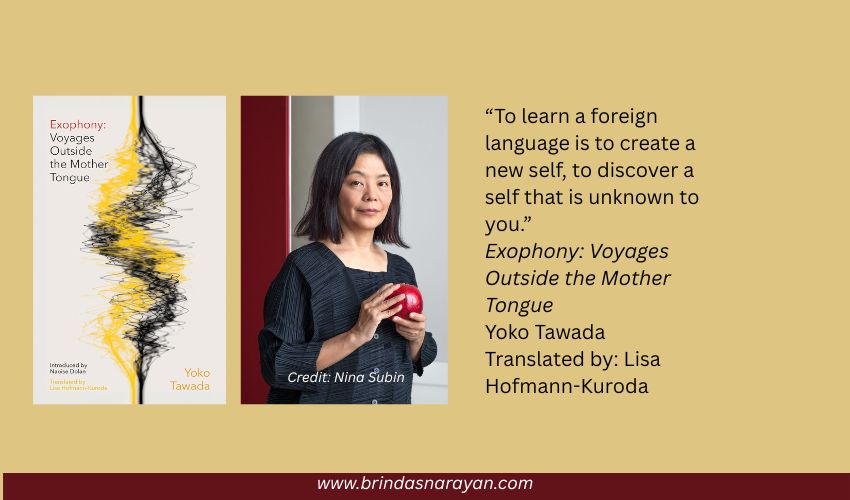
If you are wavering about learning a new language, Yoko Tawada’s attentive, expansive essays in Exophony can prod you into action. As she puts it, a new language is akin to gaining “a new self,” one that is unshackled from its familiar moorings to explore forbidden thoughts and aspects of the psyche.
When you learn a foreign language, you can be creative about expressions, because you don’t take anything for granted. You create new associations and meanings that may not strike native speakers. You can also play with words, rather than simply use them in a functional manner. While studying foreign languages, she recommends jotting things down in a diary, since in the foreign language, you can express stuff that feels awkward in your mother tongue.
Crossing Borders, Exploring Tongues
Tawada should know. A deeply bilingual and feted global writer, she grew up in Japan and moved to Hamburg in 1982. However, she had started learning German in Japan, as a student, which also gave her a peculiar relationship with the language. She was a fluent writer and reader in German, but less deft as a listener. Writing in both Japanese and German, she’s acutely aware of how her universe of two cultures and two languages has elevated her works, which include novels, poems, plays and essays. As a former writer-in-residence at MIT and Stanford, she’s even slated to win a Nobel in Literature.
Linguistic Exile as a Gift or Curse
The experience of “exophony”, which Yoko describes as “existing outside of one’s mother tongue” might feel commonplace to many Indians. But her ruminations as a reader and writer highlight dimensions that may not strike most multilinguals. She’s aware, naturally, that exophony is not always a rapturous state, inhabited by choice. After all, colonizers imposed languages on subjects. As do powerful nations on hapless immigrants.
Colonial Pasts, Exophonic Presents
When she visited Dakar in Senegal, she was struck by how the Senegalese wrote mostly in French, and only occasionally in Wolof. Though Wolof books had emerged as a resistance movement in the 70s and 80s, many writers also chose English for its global reach. While French readers might be open to Senegalese voices, she reflects on how the Japanese public typically rebuffs foreigners writing in Japanese. Such intolerance, stemming from xenophobia, has been challenged by writers like Hideo Levy and David Zopetti.
She dismisses the manner in which competence in a foreign language is assessed with reductive binaries: good/bad, skilled/unskilled. Such descriptors fail to capture the complex associations natives and foreigners have with languages. If gender can be riverine, so can one’s linguistic smarts.
Kleist and Japan’s Obsession with Hygiene
Yoko’s attuned to how literary works travel across bizarre currents. An academic conference in Berlin on Heinrich von Kleist, a German poet and writer, organized a panel consisting of writers from France, Hungary and Japan because Kleist’s collected works have only been published in these three countries.
Tawada was invited as the Japanese Kleist scholar. She dwells on Mori Ogai, one of Kleist’s translators and how his relationship with the German language had been starkly different from hers. Ogai had learned German under compulsion because higher university courses, at his time, were always in European languages. Being skeptical of the Enlightenment and of Westernization, he may not have meshed well with Japanese counterparts in Germany either, where he later went to study the science of “hygiene.”
In his short story, “A Great Discovery,” his protagonist delights in discovering that Europeans also pick their noses. Ogai must have sniffed the racism baked into concepts like “civilization” and “hygiene.”
Japan’s current obsession with cleanliness originates partly from an inferiority imbibed from early encounters with the West. As Tawada puts it, “To this day, you will not find another country that has roads and airports and floors as clean as Japan’s. It’s even gotten to the point that people make themselves sick because they are too clean.” It’s akin to women becoming too ‘mannish’ to fight misogyny.
When Brevity is Not the Soul of Wit
She’s dismayed at how Ogai translated Kleist’s works, often lopping off his extra-long sentences, which changes not only the way the author was saying something, but also what he was saying. “There is no objectively correct length for a sentence. The length of a sentence is one of its modes of expression.”
Reveling in In-Betweens
Tawada herself doesn’t feel the pangs of nostalgia when she thinks of Japan or her past. She adapts remarkably well to different places like Germany and California. “I never felt the need to idealize the place where I was from.” She believes in forging new communities in any place she goes to, by learning the language or by using interpreters.
When it comes to language learning, she’s not drawn to accumulating more and more languages like useless badges or ribbons. “To me, it’s the space between languages that’s most important, more than the languages themselves.” She’s so taken in by such in-betweens or liminal spaces, she terms them “poetic ravines.”
Sometimes, even if you just write in one language, you can weave in not just words, but structures and ways of speaking from other languages. Like the German poet Paul Celan, whose work Tawada adores: “Even if you never set foot outside your mother tongue, it is still possible to create multiple languages within it – so that concepts such as ‘inside’ and ‘outside’ become irrelevant altogether.”
The Myth of a Soul Language
Tawada abhors folks asking her what language she dreams in. Or what her real or soul language is, implying that a true self emerges when she sleeps. One of her novels – Night Bioscope or Bioskop der Nacht – revolves around a girl who dreams in a language she can’t understand. Later, she discovers that her dream language is Afrikaans, a version of Dutch different from the one spoken in the Netherlands. Never having been to Cape Town, Yoko decided to visit the place to complete her manuscript.
In Cape Town, she was struck by the news being flashed in 11 different languages. She could only understand English and Afrikaans, but the same images were accompanied by so many diverse and opaque sounds. South Africa, after Independence, decided to designate 11 languages as “official” unlike Senegal that adopted just French.
Sustaining our Shared Riches
Multilingualism, as Tawada writes, is not a burden carried by countries. She does not subscribe to harsh assimilative instincts imposed by nations on immigrants. While kids ought to learn the majority language at schools, they should be permitted to sustain their languages too. When she heard that Austrians were planning to deport all foreigners who could not pass a German language exam, she was outraged: “Exophony is a right of all immigrants, but not an obligation.”
As a bilingual herself, Tawada finds she has to practice both languages every day, or they erode. When she puts in this daily effort, she can express herself more richly than if she were using one language at all times. “When we value multilingualism, new unforeseen possibilities might open up that do not and cannot exist in a society of solely monolingual speakers.”
Translating from the Unknown
When she taught a creative writing class, she wanted her students to become more sensitive to the ways in which they used and related to language. She titled her workshop, “Translating From a Language You Don’t Know.” On the first day, she wrote a Kanji letter on the board, and asked them to write about it. The letter represented ryu for dragon. Of course, her students couldn’t read it and that was intentional. For one student, it reminded her of a festival and the anxiety evoked by organizing for festivals. Another wrote about the angst that accompanies being “unable to read.”
The second day, she had them listen to sounds from Japan on a cassette and write about those sounds. Some were bird sounds, whale sounds and even language sounds. The idea was to float about among foreign sounds and write what came to mind.
The third day, they went to Stuttgart and she asked them to write about the “view” from their train windows. Observing the view in this way compelled them to notice new things.
Fluidity as an Antidote
In an age of intensifying nationalisms and hardening boundaries, we should draw lessons from Tawada’s fluid approach to borders and language. As her translator, Lisa Hofmann-Kuroda puts it about the author: “It is as though Tawada’s immersion in German, a language so rich in compound words, has given her the freedom to rewrite the rules of Japanese – and of reality.” If only folks with her sensibility and voice have a louder say in the makings of our world.
References
Yoko Tawada, Exophony: Voyages Outside the Mother Tongue, Translated by Lisa Hofmann-Kuroda, Dialogue Books, 2025