



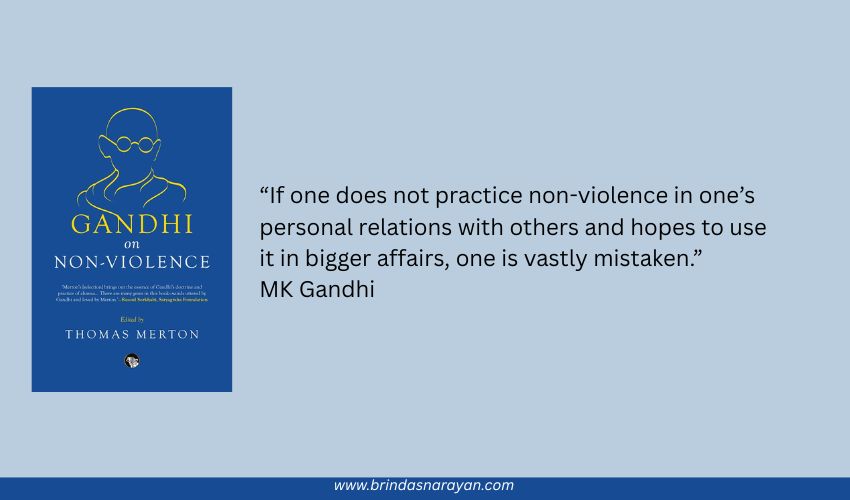
Adopting Non-Violence As a Practice
Reading about Gandhi today feels more relevant than ever, given that we live in an age where violence is treated as an almost inevitable, or even necessary response to any attack. Gandhi’s formulation of a tenacious non-violence derived from a deep, personal transformation that possibly hadn’t stopped till Nathuram Godse’s bullets hit their target. Some of the Mahatma’s “Experiments With Truth” are well-known because they were published by the leader himself, in candid accounts, in an age before the American academic, Brene Brown, advocated for expressing vulnerabilities.
Dieting Before It Was a Fad
To begin with there was his diet. His vegetarianism was not merely an outcome of his upbringing. Rather, he was influenced by a small circle of thinkers in the UK that included the poet Percy Bysshe Shelley. His personal but also politicized fasts were only an extreme form of an everyday ardor. He mainly ate raw foods – nuts, fruits and vegetables – since he believed that even “fire” and hence cooking was a form of violence. He was also demonstrating that humans were more similar to animals than we might like to believe in our over-intellectualized, acculturated states. Eating as animals do – directly off tree branches – would strip us off one more foisted difference.
Blurring the Political and Personal
Each political demand was accompanied by personal sacrifice. During the Salt March, he eliminated salt from his diet, almost as if he were engaged in a calculative tit-for-tat with the Higher Force. Because surely the British didn’t give a hoot about his diet, saltless or otherwise.
A Flawed Father and Husband
In our consumerized societies, his life feels like an anomaly in other ways. He died with deliberately few possessions: “a pair of glasses, a pair of sandals, a bowl.” It was a rebuke to the materialist West that a political leader from the East could demonstrate in the way he lived and died, that what really mattered, was not what you accumulated, but what you achieved with every iota of personal strength. But such provocative simplicity also had costs. For instance, when he placed Kasturba’s jewels in a public trust, did he really have her consent in a patriarchal time? Was it fair to dispossess her, even if the cause was seemingly loftier? Did he impose his idealism on his kids, with disastrous results on at least one of them? After all, the historian Ramachandra Guha confirms that Gandhi’s role as a father and husband often fell short, on many fronts.
Then there are his controversial and decidedly problematic experiments with celibacy. As a woman, I can’t help wondering if Kasturba Gandhi was on board with his experiment and if she wasn’t, could this have led to unstated frissons in their relationship? His experiments with his grandnieces cannot be condoned even by the standards of his era. The scholar, Tridip Suhrud, suggests that Gandhi’s actions, at this time, were symptomatic of the leader’s psychological and spiritual struggles in the face of ongoing communal violence.
Hacking The Self Through Life
But even if he had not been conscious of implicit biases, he was constantly on a path to self-improvement. He demonstrated a zeal for lifelong learning when such a quality was not imbued with its contemporary cachet. His learning was not merely theoretical. He examined himself, others, the world, texts, especially religious ones. He did not confine himself to Hindu texts, but studied across religions, plunging into Buddhist, Jain and Christian tracts. In letters he exchanged with Leo Tolstoy, the Russian author had suggested that Christians needed to revert to the non-violent ways of Jesus.
Conversing With All Sides
Gandhi believed that shunning violence required freedom of speech. After all, with no outlets for thoughts, pent up frustrations are likely to foment violence. At the same time, he might have been disturbed by the polarization prevalent today. He would have been the first to champion the expression of dissenting views – regardless of political affiliation – to award a fair and judicious hearing to all.
Questioning Materialism as a Goal
Already attuned to the ecological rapaciousness of industrial societies, he had advocated a different model for India, one uniquely forged in its villages and centered around local economies. One that treated the planet as a sacred terrain – to be cared for and healed – rather than merely extracted from. As Ananda Coomaraswamy wrote, “East and West are at cross purposes only because the West is determined, i.e., at once resolved and economically ‘determined’ to keep on going it knows not where, and it calls the rudderless voyage ‘Progress.’”
Forgiving Others and Oneself
In the end, Gandhi’s belief in human fallibility – in himself and in others – might be one of the more vital lessons to carry forward. To assume that none of us are inherently evil or good, or saintly or demonic, but that we’re all invested with an equal capacity for both. The key is to never permanently label or give up on the enemy or oppressor or perpetrator or victim. As Hannah Arendt put it, “[Non-violence] recognizes that sin is an everyday occurrence” that “needs forgiving, dismissing…” on an ongoing basis.
Gandhi demonstrated that one can’t publicly advocate for non-violence unless one also practices this in one’s micro-interactions. As the leader himself suggested, we can keep trying: “We may never be strong enough to be entirely non-violent in thought, word and deed. But we must keep non-violence as our goal and make steady progress towards it.”
References
Thomas Merton (Edited by), Gandhi on Non-Violence: Selected Texts from Mohandas K. Gandhi’s Non-Violence in Peace and War, Speaking Tiger, First published in 2016, Reissued in 2025.
Ramachandra Guha, Gandhi: The Years That Changed the World, 1914-1948, Alfred A. Knopf, 2018
https://lareviewofbooks.org/article/destroyed-by-truth/