



Meeting Apparitions in Monuments
A Historian Who Digs Horror
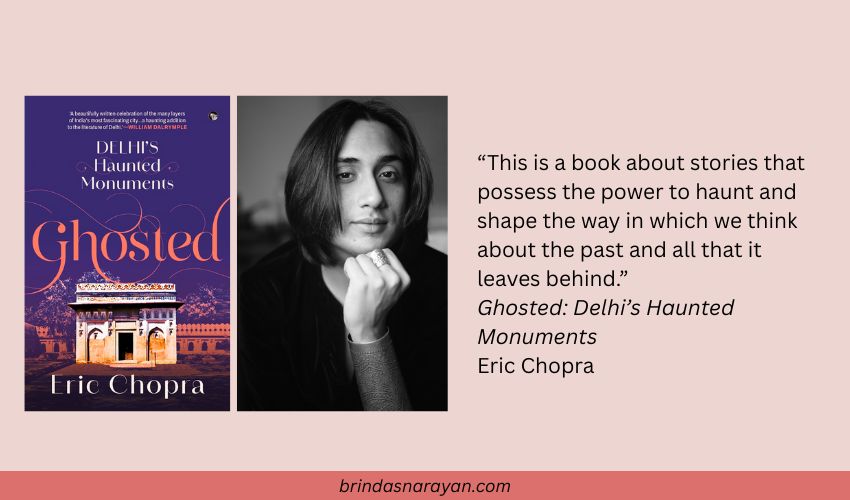
In “Ghosted”, Eric Chopra plumbs ghost stories, haunted tours and even TV shows to depict not just what transpired in the past, but to “reveal how history lingers, which of its fragments endure, and who and how we choose to remember.” As a historian, he’s careful to sift through multiple contested versions of events and characters and wise enough to inject all with varying degrees of probability. More significantly, he does not dismiss or denigrate these tales with an academic’s sneer. Rather, he grants them a deserved reverence, as one would another religion’s or culture’s beliefs.
Where Delhi’s Ghosts Sigh
Delhi, the nation’s capital and one of the epicenters of history, has been a city constantly in the making. That capacity to regenerate itself has also led to an accruing of layers, some dwindling with the onslaught of constructions and modernity’s violence. Others cling to monuments and ruins, where inevitably stories gather, like murmurs from the past. Chopra concludes, after his own scholarly and physical forays to various sites, that the most haunted locales are those whose histories still resonate today. Succumbing to the tropes of horror films, most are relatively deserted. Clearly, ghosts don’t dig touristy light-and-sound shows.
A Mystery of Twin Graves
The tomb of Jamali-Kamali, located in Mehrauli, is one such spot. As an aside, Chopra argues that Mehrauli deserves the label “Old Delhi” more than the Central and North parts of the city. After all, Mehrauli was where it all started with the Tomars in the 11th Century. It is believed that Jinn, who are “made of smokeless fire” and are as varied and complex as humans, reside in the tomb’s niches.
The tomb itself, unlike its proximal mosque, cannot be entered at will. A guard has to let you in. With an eye on how this could be frustrating, amusing or mystifying, Chopra enters the vault and gazes through a jalli at the two graves. Inside, he’s shot through with rasavadana, a mélange of emotions. Not just rapture but also terror.
According to Chandrakant, a researcher with India’s only “registered parapsychology society”, in an interview on Red FM’s 93.5, he said he’d felt very disturbed at Jamali-Kamali. He heard a spirit say a distinct haaan, when he tried to speak to it.
Exhuming a Past Situationship
While Jamali is well-known to historians and Delhi-buffs as a Sufi saint, poet, world-traveler and courtier, during the Delhi Sultanate and Mughal eras, Kamali remains a mystery. Unknowns of this sort naturally invite conjectures: was he Jamali’s friend, student or lover? Or even Kamali’s son, Hayati?
Love-Hate Dynamic Between Saints and Rulers
As Chopra notes, the Sufis and Sultans had an uneasy relationship. Many Sufis wanted to stay distant from political machinations. Some Sultans abhorred Sufi threats to their authority. A few Sufis predicted the demise of a regime, while others straddled both realms: spiritual and political. Even then, Delhi “was as much a city of polity and power as it was a city of mystics and miracles.”
The Sufi’s Falling Out and Revival
Jamali learnt Sufism under Sama’al Din. When Nizam Khan, later known as Sikander Lodhi, became the Sultan, he had a strong relationship with Jamali. The Sultan used to even write verses and share his poetry with Jamali. The latter had a broad, multicultural worldview, having traipsed through Turkey, Yemen, and Southern Spain among other places. He penned two books, whose translated titles are Mirror of Meanings and Spiritual Journey of the Mystics.
When Sikander died in 1517, Jamali could not strike a rapport with the new Sultan, Ibrahim Lodhi. But then Babur from Central Asia defeated Ibrahim and Jamali forged ties with the new ruler, who even invited him to a feast in Agra. Pondering his own death in 1528, he commissioned a mosque and tomb and expressed a wish to be buried in Mehrauli. Though he died in Gujarat, his remains were brought to his old city.
Giving Cheer to the Queer
Interestingly, Jamali-Kamali, if they were lovers (there is not enough evidence yet to confirm this), have also drawn in the queer community. After all, this community has been unfairly excised from history. The photographer, Sunil Gupta, created a series of pictures of gay couples against ancient backdrops, to reclaim such histories. One was set against the Jamali-Kamali tomb. The designer Karan Torani made a menswear line called “Jamali Kamali.” Other artists and writers and poets have also been inspired by the monument or its lore to create poems or stories centered around this mysterious, beguiling pair.
Intriguingly enough and as if to cement the leader’s syncretic viewpoint, Gandhi, just three days before he was killed, visited the shrine of Qutb Sahib.
Where Walls Have Jinns
Firoz Shah Tughlaq inherited the throne at a precarious time. His predecessor, the infamous Muhammad bin Tughlaq had famously shifted the capital to Daulatabad and then back again, overtaxed his people and overextended his military. Firoz was attuned to the power of symbols. Enamored by Ashoka’s pillars, he even had two hoisted back to Delhi – “on a forty-two wheeled cart pulled by over thousands of men” – and had one affixed on the Firoz Shah Kotla (or fort).
Later, at this very Kotla, Bhagat Singh and Chandrashekhar Azad met in 1928. Some of Partition’s refugees were hosted in its grounds.
Today, the Kotla draws visitors not because of its rich, tangled history but rather because Jinn are thought to inhabit its crevices. People come with coins and letters and pleas that they stick to walls, in the hope that these prayers will be answered.
Darbari Jinn As A Commoner’s Refuge
Here the Jinn are perceived as benevolent and divine. Even the pillar has been transformed into a wish-fulfilling column called the “Lath Wale Baba”. Earlier folks flocked with arziyans (letters/applications) or with locks or threads, that they tied to railings, which is typically a practice at the site of Sufi saints. Some even placed copies of ID cards or passport-sized photographs. Some offerings have been banned by new rules.
Intriguingly, the Jinn at the Kotla are thought to hold a Darbar (meetings) after folks leave, and decide which pleas will be heard first. It’s like the common people are replicating our Kafkaesque bureaucracies and their intractable officers. If real people won’t solve their problems, spirits might step in.
A Ghost Who Lights Up
The Jinn aren’t Delhi’s only ghosts. Wading into the Mutiny Memorial, we encounter the headless ghost of a British officer. Apparently, the phantom asks for directions and for matches to light his cigarette. This was even depicted in Aaj Tak’s Vardaat series (2014). But as a clever watchman interposed, if the ghost wishes to light a cigarette, how can he smoke without a head?
Some hauntings are more recent like that of Malcha Mahal that held a self-proclaimed royal and her children, who had landed at the Delhi Railway Station and demanded accommodation. And some stories more gruesome, like those surrounding the Khooni Darwaza.
Look For Stranger Things Around You
The book doesn’t just bring history to life. It shows us that the past never dies, and we – as inhabitants or citizens – ought to heed its warnings. Rather than binging on Stranger Things on Netflix, reading Ghosted might prompt a haunted tour of your own city.
References
Eric Chopra, Ghosted: Delhi’s Haunted Monuments, Speaking Tiger, 2025