



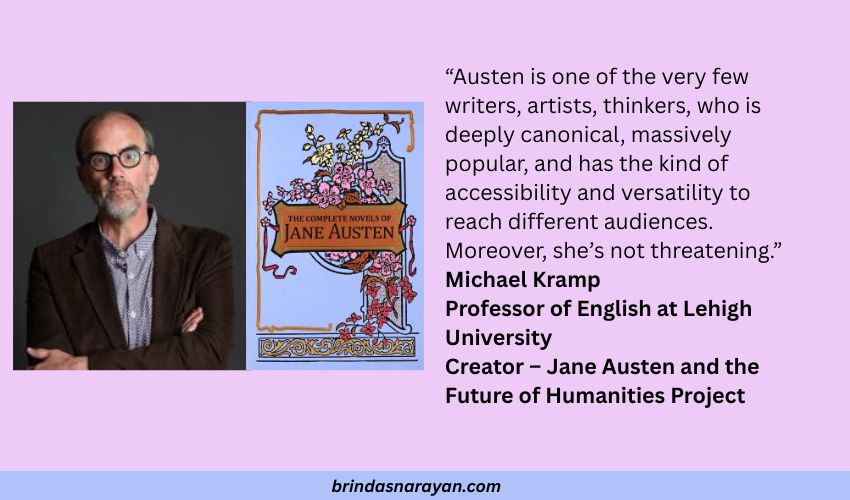
An Austen Scholar Shares His Lessons
Captivated by Austen Forever
Michael Kramp was 18-years-old when he encountered Jane Austen’s works in a literature course. Taught by Dr. Claudia L. Johnson, an eminent Austen scholar who currently teaches at Princeton University, the young Kramp was entranced by the manner in which Austen probes cultural issues and uncovers complexities in human relations. As the youngest of seven kids, Michael was attuned to the messiness of families, and the constant remaking of communities.
Moreover, as a first-year student trying to navigate the social tangles of college – the cliques, the homesickness, the pressure to belong – he found a strange reassurance in Austen. The author helped him detect layers and abide with muddles: “It was refreshing to encounter a writer and thinker who was encouraging us to recognize that things weren’t as simple as they appeared. And who seemed to reward being complex and thinking in complex ways.”
For many others, such enchantment with an author’s oeuvre might have ended with that course or with their time at college. For Kramp, it sparked a lifelong engagement with a writer who is canonical and popular, whose appeal cuts across geographies, languages and age groups. And whose books still sell in 2025, evidenced in a surge of 78,000 copies in the UK market. Currently as a Professor of English at Lehigh University, Michael’s scholarship centers on Jane Austen, Masculinity Studies, and Critical Theory.
Austen Beyond the Ivory Towers
Since this year is also Austen’s 250th birth anniversary, Michael chose to extend his Austen expertise and teaching in new directions, creating a podcast, a YouTube channel, and a documentary film. This was partly inspired by the general malaise affecting academic humanities – declining student numbers, budget cuts, faculty layoffs and department closures—and a paradoxical growth and vitality in public humanities, in museums, libraries, theatres and book clubs.
Kramp sensed he could transmit his excitement about Austen to larger audiences, by appearing where they already were: on Spotify and YouTube. And maybe reinject academia with a much-needed purpose by conveying some of that public enthusiasm for books, plays and films.
On Team Emma For the Time Being
About picking a favorite among Austen’s novels, Michael admits that his own preferences have shifted over the years. Some works have felt more relevant at particular life stages, but he’s lingered in an “Emma phase” for a longish period, almost 20 years. Just returning from a graduate seminar where he was teaching Emma, he recounts why the work still grips him. It’s “masterfully written,” but that aside, it charts a “community in transition”.
Documenting shifts that were rippling through Britain after the French Revolution, it details the collisions of class, of ‘new money’ versus ‘old’, the emerging status of women, the arrival of strangers in close-knit communities. For instance, 17-year-old Harriet Smith, embodies the curiosity and unease invoked by a newcomer’s appearance. Kramp says, “Emma shows us how characters deal with the dilemmas of modernity.”
Impressively, all these changes are depicted in a self-contained place, Highbury, which is in Austen’s words: “a large and populous village, almost amounting to a town.” Michael observes, “It’s so tight, so well-planned. Everybody has their place to the point where, when Frank Churchill has a haircut elsewhere, everybody has a fit, because why would you leave?”
Cherished Characters in Austen’s Universe
Dwelling on Austen characters of whom Kramp is immensely fond, he cites Catherine Morland, the heroine of Northanger Abbey, who is marked by her capacity to keep learning. As Michael puts it in his podcast, she starts out as unpretentious, naïve and given to fanciful flights of imagination. As she stumbles, in various ways, from ignorance to knowledge, she also discovers the perils of such knowing.
Another favorite is the amicable Charles Bingley in Pride and Prejudice, who might be a foil to the aloof and proud Darcy. “I love the way Bingley just wants to be happy and have a good time.” As a trader who has just come into wealth, he’s also eagerly exploring what money can do.
Austen Myths That He’s Keen To Bust
In terms of common Austen misconceptions that he’s keen to dispel, he says the first revolves around her reputation as a romance writer. He’s quick to add that he does not intend to denigrate romance writers in any way. But Austen herself is not a romance writer. Her works are “a comedy of manners, or domestic novels that resolve tensions in a classical comedic form.” They carry elements of romance novels, but that description does not do justice to their entirety.
While marriage is often a resolution to some problems her characters face, she does not develop “sensual moments of desire and passion,” typical of the romance genre. She’s captivated by culture, by tensions within families and communities.
Another untruth revolves around her personal life. Belief has it that Austen was obsessed with her own love and marriage. This has fueled much speculation about whom she loved, rejected, or flirted with. To Kramp, this obscures the fact that the most significant person in her life was her sister Cassandra. Both Austen sisters exchanged many letters that reveal how close their bond was. As Michael puts it, “Austen had a very close, intimate, lasting relationship with Cassandra that was rooted in a great sisterly love.”
An Austen Project As a Solo Act
As far as executing this project, Kramp is really a one-person crew. He conducts the interviews himself and films the conversations. He’s keen on leveraging his singular strengths as an Austen scholar and filmmaker. He’s hesitant to outsource aspects to graduate students who may not possess similar skills or commensurate passion. Aware that he’s talking to folks who have intensely engaged with Austen in various ways, his involvement ensures that their stories are treated with dignity and respect.
In terms of interviews that have really stayed with him, one was a conversation with Dr. Claudia L. Johnson, the professor who ignited his lifelong interest in Austen. Another was a conversation with Sam Brooks, an award-winning playwright and journalist in New Zealand, who has created a queer, Māori version of Emma titled Em. Encounters with experts who run Jane Austen’s House – currently a museum in Chawton- in Hampshire, England have also been striking.
In terms of responses to his project so far, he says people have been really excited and supportive. A lot of folks are curious about “What’s next?” Right now, since he’s handling the nuts and bolts on his own, he’s figuring out how to move faster. He’s already gathered many interviews that he hasn’t yet uploaded online.
His Evolving Lens on Austen
Michael says while he always knew that Austen commanded a large global following, he did not realize how long-standing her popularity was. For instance, when he interviewed Dr. Usha Mudiganti, a faculty member at Ambedkar University in Delhi, she mentioned the series Trishna based on Pride and Prejudice. He hadn’t realized how long ago that series had been made, and how well-liked it was then. He’s discovered, too, that there’s Austen scholarly activity in Iceland. In March of 2026, he will be visiting Brazil and Argentina. He intends to make a second trip to Argentina after that, “because there’s just so much happening there.”
Why Austen Cuts Across Boundaries
One more reason for Austen’s acclaim is that she can be taught to high school students as well as in graduate seminars, she appeals to homemakers and adult learners. She’s relevant in diverse settings. As Dr. Mandakani Dubey of Ashoka University put it, “A 12-year-old can read Jane Austen and be touched.” As Michael puts it, this could also happen to a 92-year-old. Even Shakespeare might not possess such age-agnostic allure.
How Austen Teaches Us to Talk
Kramp also believes that Austen offers us exemplars of difficult conversations. At a time of extreme polarization across nations and the erasure of civil discourse, such conversations seem more necessary than ever. For instance, he observes, in Pride and Prejudice, folks from different classes and upbringings, with different goals and motivations talk to each other. “These exchanges don’t always end well or always sound good, but one of the lessons from Pride and Prejudice is that difficult conversations actually work.”
Can Men Love Austen Too?
As a masculinity scholar, he thinks the issues faced by men and young men in particular, are much deeper than those that can be addressed by just reading Austen’s novels. In general, men are falling behind across nations, in the US and in India. They’re not attaining the same levels of education as women. They’re losing the advantages they once wielded inside patriarchal structures and they’re unable to cope with more equal settings.
As an example, in one of his undergraduate classes, one of the men made a comment on Austen’s work. And a young woman said: “Stop talking, you haven’t done the reading.” And that, observes Kramp, is what’s happening between genders right now. Women are really smart, are working extremely hard and are unwilling to tolerate gibberish from those who haven’t put in the work.
Why The Humanities Still Matter
Humanities teach you to interrogate situations and to bridge previously unconnected topics or concepts. Moreover, Michael cites the words of Dr. Robert Newman, the former president of the National Humanities Center, who observes that the humanities goad you to be “the teenagers of everyday life.” As Newman puts it, “We’re not comfortable with things. We’re always asking why. We’re kind of the pains in the ass of society.”
The CEO of Blackrock, Larry Fink said that folks who major in the humanities tend to be critical thinkers who can add value even to the finance sector. The Blackrock COO, Robert Goldstein has said that in the age of AI, students who major in English or History tend to be better at leveraging Gen AI because they can spot the ambiguities and gaps in responses. As Kramp says, “We help students prepare for a life of complexity, change, uncertainty and innovation.”
References
https://wordpress.lehigh.edu/dmk209/podcast/
https://www.youtube.com/@JaneAustenandtheFutureofth-s8y