



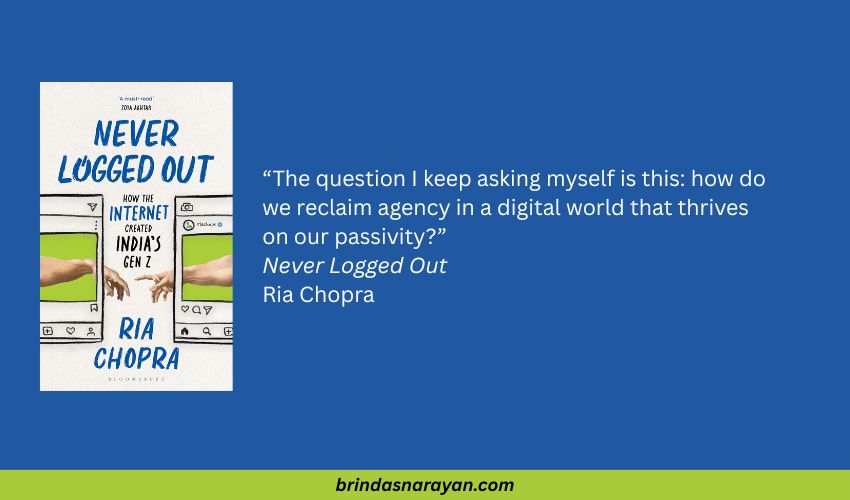
India’s Gen Z: Growing Up With The Internet
Indian GenZs, typically defined as those born between 1995 and 2012, have a singular relationship with the internet. Their childhoods were spent largely offline, mirroring that of preceding generations, consisting of free play, books, films, TV and music. As they burgeoned into angsty teens, the internet had evolved from less appealing websites into more beguiling apps.
Being Late to Insta
The author Ria Chopra was 14 when she joined Insta in 2013. She was devastated to learn that @riachopra had already been seized by a namesake. In her universe, where rules were set by other 14-year-olds, owning your name’s handle was paramount. Clearly, she was lagging behind and consigned to a lower rung on the coolness ladder. Choosing @riachops, inspired by Priyanka Chopra’s “Piggy Chops”, felt like settling for a consolation prize.
Buffered by an Offline Childhood
With the hindsight of a mature 26 years, she has no remorse about being late to the online party. Rather, she’s grateful that she – along with her Indian peers – did not get online at an earlier age, unlike say, the kids in New York or San Francisco. After all, by now, the adverse effects are well-documented for the early starters: ADHD, brain rot and mental health tussles. As Chopra puts it: “My personality, my ways of seeing and engaging with the world, were formed offline; they were simply enacted online.”
In the Good Old Days
Besides, in those early days, the internet felt largely like a force for good. Chopra had even started out googling rocks. Accessing websites required willful action: “We didn’t doomscroll; we explored.” The early 2000s had child friendly spaces, like Club Penguin, which simulated the mechanics of unstructured play. Even Insta, Fb and Snapchat were different, their use imbued with more purpose. They were not as profit-hungry, not designed primarily to evoke envy.
That dynamic was to change soon. Mean remarks and judgy comments started proliferating. As Chopra observes, online identities don’t merely mirror offline frictions, they amplify them.
Getting Online in Stages
She dwells on Gen Zs wading through three phases: first being entirely offline, grounded in reality. Then using it as a tool to work and play. And now as a space where they reside, as a way of being. This gives them a unique edge to leverage their pasts to reshape their presents. While she rightly critiques the manner in which her generation is often unfairly disparaged, she does concede that they are marked by certain traits: “Loneliness, stunted social skills (some of us graduated during the pandemic on Zoom), hyper-individualism, financial recklessness, twisted ambitions, beauty that is only grid-deep, and so on.”
When Everything is Seized
But even in her teen years, the internet wasn’t as all-consuming as it might seem now. Comparing her then to her now, she’s aghast at how much of what is currently happening is hoarded online. Earlier, there were Fb messages, but a lot of the drama was offline. Stuff happened that didn’t require a digital capture. “Now, though, all the big life events for roughly the last decade of life have been memorialized in some form online.”
The Internet Never Forgets
Such ongoing documentation affects not only our contemporary identities, but also interferes with our yearning to forget. Human memory is importantly fallible, allowing us to soften memories and preserve a certain narrative of the self. Such reconstruction is stymied by static digital reminders.
When helping a friend recover from a breakup, Chopra and her friend went over the latter’s Insta to delete all images and mentions of the ex. In the process, they wondered at how Taylor Swift kept it going, night after night, in the midst of publicized romances and breakups. Given, especially, that her songs intentionally revealed her vulnerabilities and drew from her own experiences.
The internet fosters connections, no doubt. And bestows many riches. But the constant enactment of digital identities also reshapes us. Chopra acknowledges when examining her own digital history, that both salubrious and unhealthy parts of her past are online. Since she once dated someone who liked Manchester United and hence tried to learn a bit about the English football club, she can never teach the algorithm to stop nudging her with Manchester United stories and trivia.
Controlled by Ratings
In a 2023 article for The Indian Express, Chopra talks about how her ratings-led generation tries to constantly optimize cultural experiences: watch the best movie, read the best book, visit the best restaurant. As a result, they’re being constantly led by others’ tastes and judgments. The same ratings-obsession extends to relationships.
Moreover the manner in which partners are rated can feel borderline kooky. In 2024, TikTok released something called the “orange peel” test. Girlfriends were urged to request their boyfriends to peel an orange. Reactions were captured on video. If they did it pronto, without the slightest resistance, they had passed. If they peeled it and even fed it to their girlfriends, they were granted bonus points. For those who said, “Do it yourself” or “Not now”, they were deemed unworthy of the relationship. This trivial task (and crazy ask) was used to “red flag” the unsuspecting partner.
Other similar tests included “the bird theory”, wherein, the woman was asked to suddenly spot something – like a flower or cloud shape. If the partner did not evince immediate interest, it was considered serious enough to break up.
While loosening earlier strictures about class, caste, religion, ethnicity and so on, Gen Z absorbs how relationships should be conducted from peer performances on social media. There are treatises galore on red flags and green flags, on love languages and attachment styles. Problematic old rules are being substituted by problematic new ones.
“Our relationship with culture shouldn’t be of optimization, but of openness – an openness to finding out more about ourselves within the pages of a non-bestselling book and the frames of a three-star movie and the bites of a non-five-star dish.” It’s an openness that ought to extend to imperfect partners, precluding a ceaseless chase for an optimized one.
As bell hooks puts it in “All About Love: New Visions”, love will not give you persistent highs or perpetual bliss. Love pushes us to change ourselves. This process involves struggle and pain. But, in the end, the idea is to be “better together.”
Too Many Influencers
In 2025, Mint reported that India has over four million influencers, “from less than a million in 2020.” While being a creator is one of the most desired Gen Z vocations, only the top 1% make a lot of money. Moreover, fame fades quickly. Just like yesterday’s stars, today’s creators will vanish into obscurity, only at a much faster pace. Such fame has to be relentlessly sustained while dealing with its unhealthy side effects.
The Downsides of Fame
In April 2025, an influencer called Misha Agrawal died of suicide at 24. Chopra observes that at least once a week, creators face intense stress. This is for the following main reasons:
-
- Payments are uncertain. They have to often chase brands and agencies.
- Female and queer creators get dissected and hit upon unlike straight, male creators.
- They are uncertain about how to respond during touchy political situations. What stance should they take? Should they have an opinion at all?
Chopra herself, who has an impressive digital following, has stopped weighing in on each and every issue. She believes that people who really need to be persuaded of what is right or wrong are policymakers and not “people who make reels.”
New Forms of Intelligence
She argues that old methods of assessing intelligence fail to capture how Gen Z with their clever, cheeky, collaborative, visually rich memes (for instance) are newly and differently intelligent. Perhaps, this is a collective intelligence, produced as a group. And it’s not less rich, but it’s not measured by and cannot be subjected to old-fangled tests.
She quotes David Weinberger who wrote in 2012 in Too Big to Know: Rethinking Knowledge Now That the Facts Aren’t the Facts, Experts are Everywhere, and the Smartest Person in the Room Is the Room, that intelligence no longer lies in me, or us, or them, but in a whole environment, in a “room.” Being personally smart is less important than leveraging networked knowledge and “distributed cognition” (a term coined by cognitive anthropologist Edwin Hutchins in the 1990s).
Gen Z’s Edge in the New Era
In an age where information is at anyone’s fingertip, what is more valuable is our “foresight” about the future. Local research labs are popping up even in India, to conceive what the future of knowledge will look like, especially with AI. Chopra argues that Gen Z might be specially equipped for such a time. “We’ve grown up in the network. We’ve learned to triangulate, to sift signal from noise, to detect patterns from memes and markets alike. We are fluent in the micro and the macro. Our humour is laced with references to five different sources at the same time. Who else could find the patterns in the madness?”
Regaining User Control
As Chopra puts it, we started out with a fairly decent internet experience – blogs that we liked, communities that we wished to hang with – to a current, less appealing phase, when many of us feel like our attention is being frittered in wasteful directions. But we can direct it as a community to a healthier end, which is already happening with Substacks, podcasts, YouTube interviews, free Coursera courses et al.
Fueling the Curator Economy
NYU professor Clay Shirky’s response to Nicholas Carr’s “Is Google Making Us Stupid” is to apply better filters. After all, the internet does have an abundance of incredible material, available for free. The education system has to teach students to sieve the fine from the dross, and to access what serves their purpose. Maybe this will fuel a “curator economy” where certain people – like academics or writers or experts – can recommend stuff that’s worth spending time on.
Seeing Ourselves Online
In large part, Chopra confesses, “Personally, though, I love the internet.” It’s brought her friends, new knowledge, movies, books, ideas. Of course, she’s not naïve enough to succumb to the syrupy sentiment, “the internet, actually, is neither good nor bad, but what we make of it” given that there are large profit-making organizations helming the network, and given that most of us have a very small impact in its makings. She resonates with Sherry Turkle’s take in Alone Together: “We have to love technology enough to describe it accurately. And we have to love ourselves enough to confront technology’s true effect on us.”
References
Ria Chopra, Never Logged Out: How the Internet Created India’s Gen Z, Bloomsbury India, 2025