



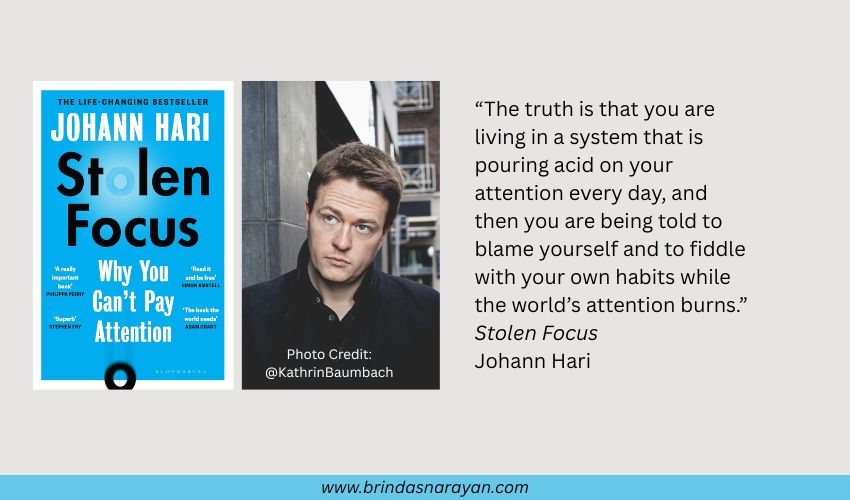
Reclaiming Another Vanishing Resource: Our Attention
Roy Baumeister is a well-known social psychologist who studies willpower. When Johann Hari interviewed him at the University of Queensland for Stolen Focus, Hari was shaken when the self-control guru admitted that his own attention was shrinking. If even an expert, who is examining a closely-related topic, senses that his brain is succumbing to seductions, surely we all need to, at the very least, audit our minds.
A first step is to keep up with current literature on attention spans. Provided, that is, you still have the attention to read a book. Hari’s journey to diagnosing our distraction malaise was sparked off by a shift in his godson, Adam.
At one point, when Adam was little, he idolized Elvis Presley. Johann promised to take Adam to Graceland when he was older. Unfortunately, Adam grew up too distracted to finish school and was completely screen-addicted by the age of fifteen. To tug the kid out of his online fog, Hari decided to act on his earlier pact. Both flew out to Presley’s museum-house in Memphis, Tennessee. On the condition that Adam wouldn’t check his phone till pre-agreed hours each night.
They landed in the OG Graceland, inside the place where Adam’s one-time hero had spent formative years. Unfortunately, Johann realized that the tour wasn’t going to be conducted by human guides, but by IPads with recorded actor voices. So much for keeping Adam screen-free. Still, as a curious Hari walked around various spaces that contained Presley’s objects – his jumpsuits, his music, his cars – they arrived at the famed Jungle Room. Stepping on the plush green shag carpet, Johann observed that others – for instance a middle-aged couple – were sucked into their IPads and hardly looked around. They preferred swiping “Left” or “Right” on screens rather than swiveling old-fashioned heads to look at the room. To share the irony with Adam, Hari looked around for him. The kid was, dismayingly, on Snapchat, equally oblivious to Presley’s memorabilia.
Later, at the Heartbreak Hotel, by a guitar-shaped pool, Johann ruminated on why he was riled with Adam. Partially, he had to admit, his anger was directed at himself. After all, over the years, his own attention had frayed. Could he really blame Adam for giving in to larger, systemic forces? But what were those forces, exactly, beyond the obvious one: technology? Stolen Focus is an account of Johann’s journey across the world, to meet a wide range of experts – like social scientists, philosophers and technologists – to discover what exactly is happening to us.
Distractibility, he reminds us, is not a modern phenomenon. Even medieval monks used to carp about their shrinking focus. Yet recent data is alarming. According to studies cited by the author, college kids in the US shift between tasks every 65 seconds, and keep at a particular task only for 19 seconds. Adults at workplaces are not much better. They switch every 3 minutes. Too few get a complete uninterrupted hour each day. Perhaps AI has stepped into corporate (and unfortunately, college) screens at just the right time. But its users might be too attention-deprived to detect hallucinations, or to use it in a manner that does not corrode their own thinking.
After pretty much concluding that our collective attention is dropping, is there anything we can do stem this? Not just at a personal level, but at a social one? Here are some takeaways:
Lobby For Regulations that Curtail Attention Hacking
Many have watched The Social Dilemma (2020) on Netflix. We’re being surveilled, manipulated and seduced. Yet we passively ingest addictive content – Insta Reels or WhatsApp Forwards or YouTube Shorts – like we have no choice. We should insist that policy makers or technology leaders stop making us the “product” and change their business models to subscription-based ones. Or think of other ways to rack up revenues. Even if you don’t care about yourself, think of the impact on kids.
This is no longer about having the attention to write polished prose or compose a sonata. It’s life and death, because one of the significant causes of car accidents are drivers distracted by mobiles.
You Don’t Have to Stay On Top of ‘Breaking’ News
Another factor for the rising overwhelm over the past 130 years is the sheer volume of information coming at us. And how quickly it alights on various devices. Prior to the advent of cellphones, most of us stuck to scanning morning papers and then laying them aside while we got on with our respective jobs. Unless your job requires you to stay abreast of news as it unfolds, it might be optimal to return to those pre-internet habits. And it might make more sense to read old-fangled newspapers – paper ones – rather than apps that tug you back to screens.
Perform Important Tasks During Uninterrupted Times
Keep your phone in another room, or inside a lockable case, while you engage your deep work muscles on significant tasks – intricate Excel models, creative presentations, journal articles, book chapters. Multitasking is a myth. As Professor Earl Miller, Professor of Neuroscience at MIT, notes emphatically, our brains cannot handle more than one or two thoughts at a time. Constantly switching between tasks damages us, as Hari puts it, in the following ways:
The Switch Cost Effect:
Each time you shift between tasks, you lose 23 minutes before you regain the focus required to plug back into the earlier task. This leads not only to a drop in productivity, but also to a drop in the quality of your output.
Screw-Up Effect:
Errors increase when you juggle tasks in this manner. Then you waste time correcting your mistakes. Or you risk sending out buggy code or an error-filled output.
Creativity Drain:
Coming up with your own unique insights and forming associations between disparate ideas requires your brain to be in a pleasant mind-wandering state. But that kind of semi-vacant state will elude you if you’re responding to emails and texts while working on something else.
Diminished Memory Effect:
You will retain less if you’re simultaneously tugging your mind in multiple directions.
Monitor Your Sleep, Exercise and Diet
Johann naturally intuited that sleep is linked to our attentional capacities. It’s also a lot more critical than folks realize. Keeping your phone away from your bed, or far enough away that you can’t look at it might be advisable. But Hari was surprised that diet, too, had a role to play. Net-net, ultraprocessed foods shrink your focus.
Read Novels or Long Form Articles
In general, there are widely reported reading declines across societies. This is no longer benign. This affects our ability to perform other tasks well.
Preferably read paper books. Studies have shown “screen inferiority” is a real thing. When two groups were given the same materials to read, the ones who read paper versions remembered more and comprehended the material better.
Soon, societies will be also be stratified by attention divides. “Elites” will possess a focus that is denied to the scrolling masses. Till tech companies mend their ways – right now, that feels like never! – seize your focus before it’s swiped away.
References
Johann Hari, Stolen Focus: Why You Can’t Pay Attention, Bloomsbury Publishing, 2022