



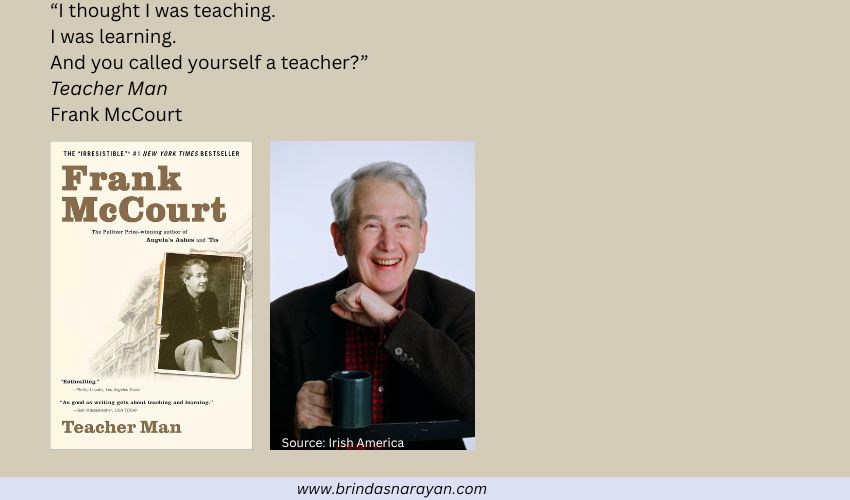
Reading “Teacher Man” in the age of AI
Though I’m not a teacher, I’m both curious about and fascinated by the promise and betrayals of education. Somehow the recent Teacher’s Day triggered a desire to reread Frank McCourt’s Teacher Man, a book I had bought many years ago in Austin, Texas, when my own kids were being strung through various education systems. I had read Teacher Man then, but perhaps the first reading was colored by the fidgety apprehensions of a parent, who’s never sure of what should be done or not to teach one’s own kids. This time around, I could enter the book as one might a theatre, to watch McCourt’s impish and imaginative cavorting in some of the toughest classroom environments in New York City.
Moreover, education as an enterprise might be facing tough questions when knowledge and skills are – theoretically, at least – at every student’s finger click. Despite cheery and blithe “Happy Teacher’s Day” messages floating on WhatsApp statuses and Instagram, teachers might contend with a complex mix of emotions: fear about their redundancy when AI chatbots can personalize lessons, excitement at the prospect of leveraging technology to reach students who might have felt impenetrable earlier, uncertainty about guarding against student overdependence on technology, relief at the idea of flipping classrooms or dismay about an algorithmic blandness seeping into sessions.
Sometimes, when the present is shifting seismically and the future feels blurry, the past feels like a scaffolding. Not to hang on to at all costs, or even to venerate in any way, but to draw insights from. What was teaching like in the past, before mobile phones or the internet? Teacher Man is but one account, but narrated with a candor and verve in McCourt’s distinct voice.
For those unfamiliar with the author, he penned the Pulitzer-winning Angela’s Ashes, a heartbreaking account of surviving war and poverty in the 1930s and 40s in Ireland. Teacher Man recounts his 30 years in New York City’s public high schools, as well as a brief stint at the elite and hyper-competitive Stuyvesant. When many commentators suggest that we need teachers to draw out or nurture ‘human’ qualities in students, in order to outshine or partner with machines, one might wonder what this really translates to. Though McCourt started teaching in 1958, Teacher Man might offer some enduring and heartfelt ways of reimagining classrooms.
Here are some of my key takeaways from this book:
Teens Were Always Angsty
Those who conclude that the contemporary adolescent landscape feels more fraught than ever – AI, social media, uncertain job markets, existential threats looming over our planet – will be disabused of imagined ‘better teens’ in past eras. McCourt observes that even in 1958, movies and papers dwelt on adolescent despair. Teens engaged in gang violence, assaulting each other with baseball bats and chains and knives. Some of this bloodshed and juvenile gloom was echoed in movies like The West Side Story and The Catcher in the Rye.
Classrooms Can Feel Hostile
Despite garnering a teaching degree from NYU, McCourt felt unprepared for real classrooms. He wondered when the kids would see through him, and rightfully conclude that he ought not to be there. “I often doubted if I should be there at all. At the end, I wondered how I lasted that long.”
Hilariously, on his very first day, Petey threw a baloney sandwich at Andy. McCourt said, “Hey” and then asked Pete to stop throwing sandwiches. Other students couldn’t help commenting – with a biting sarcasm – that the sandwich was already thrown, and hence that was a dumb, superfluous thing to say. NYU hadn’t taught McCourt to deal with flying sandwiches. So, he followed his gut instinct: “I ate the sandwich.” All thirty-four students gaped at him, speechless and saucer-eyed. Unfortunately, the Principal peered into his class just then and reprimanded him for engaging in an act – eating in class – that was forbidden for students. The Princi told him to stick to teaching. Fortunately, McCourt did not succumb to such stick-in-the-mud diktats. “Instead of teaching, I told stories.”
Lessons Spun Into Tales
Even after that first class, he admits to often second-guessing himself inside classrooms. Should he be telling kids stories from his own life as they seemed to prefer, or should he be transmitting more serious stuff to these would-be carpenters and painters and dock workers? Should he be educating them in the classics, in the Victorians or Romantics or postmodernists or structuralists, given that many seemed disinclined to pursue academic paths? Should he give in to their whims and just talk about himself? Thoughts like this kept whirling around his head: “I argue with myself, You’re telling stories and you’re supposed to be teaching. I am teaching. Storytelling is teaching.”
Forging Chemistry with Students
McCourt constantly studied his room of teenagers. He would fathom who was wearing which mask. For instance, he realized soon enough that Joey was the “mouth.” Joey’s role was to derail McCourt, to take him off topic, so that the class could loll about, while the lesson was long forgotten. Despite being cognizant about this, McCourt did find himself getting drawn into his favorite topics like Ireland and St. Patrick’s Day.
“So, mister, did you go out with girls in Ireland?”
“No, dammit. Sheep. We went out with sheep. What do you think we went out with?”
He knew he had made a faux pas because he soon received parental complaints about using dammit in class. He was wary of his students but also inordinately fond of them: “You think of the day ahead: five classes, up to one hundred and seventy-five American adolescents; moody, hungry, in love, anxious, horny, energetic, challenging.”
He struck a chord with some batches and withstood others. In retrospect, he felt he was too harsh on himself in the early days. “You’ll go blind reading Joey and Sandra, Tony and Michelle, little agonies and passions and ecstasies.”
Despising Grammar and Rules
Teachers are human. They’re not going to love every aspect of their own subjects. McCourt despised the teaching of grammar as much as his students despised learning it.
He eventually arrived at how to explain grammar to them. It was, he concluded, “The study of the way language behaves.” This being McCourt’s freewheeling classroom, the conversation quickly veered from grammar to being in jail (Sing Sing) for robbing a grammar book.
Discovering Talent in Excuse Notes
Most parental notes in his class were forged by students. McCourt couldn’t give a twat. He knew too that most working class parents signed these notes without reading them. “If they could read those notes they’d discover their kids are capable of the finest American prose: fluent, imaginative, clear, dramatic, fantastic, focused, persuasive, useful.”
Students wrote such brilliant excuse notes, he could have produced an anthology of “Great American Excuses” or “Great American Lies.” In these notes, many suffered from imaginative terminal conditions, or had family members dying in dramatic ways; others were delayed by toilet mishaps and drainage overflows, indicative of the crowded tenements they inhabited.
McCourt created a class to study “The Art of the Excuse Note.” He gave them an assignment to write “An Excuse Note from Adam to God.” Lisa Quinn wrote, Eve was bored lying around all day, so naturally she seduced Adam. “She was also sick of God sticking His nose into their business and never allowing them a moment of privacy.”
The Principal and Superintendent popped in and McCourt thought he was going to get ticked off, but the Superintendent praised him and added a positive note to his file. Apparently he had captivated the class in a manner that few other teachers could.
Reading Recipes as Literature
One day, he just had them read cookbook recipes aloud. Soon they were singing and reciting recipes. They found poetry in cookbooks. And clear communication and tangible instructions, “without pain-in-the-ass English teachers digging for the deeper meaning.”
Abjuring Mark Twain or F. Scott Fitzgerald for cookbooks and handwritten family recipes led to three intense days of classroom discussions. More than anything else, they had fun. As McCourt asks: “Why not? What the hell. What are schools for anyway? I ask you, is it the task of the teacher to supply cannon fodder for the military-industrial complex? Are we shaping packages for the corporate assembly line?”
At the end, McCourt had taught 33,000 classes, touching 12,000 student lives. He died in 2009 and when his obituary was published in The New York Times, a few of his students wrote letters to the editor. As one of them put it: “While it is true that the world has lost a wonderful writer, the loss of this wonderful teacher is the greater loss by far.”
Will AI bots generate similar sentiments? Maybe they will, and that to me, feels strangely sinister. Teachers, like romantic partners, used to invoke a range of messy feelings. Should the machine become a substitute object of adolescent affections, especially a bot that can manipulate such obsessions to unhealthy ends? These are questions that McCourt would have relished toying with while prodding his snarky, gum-chewing students to find their own answers.
References
Frank McCourt, Teacher Man, Scribner, New York, 2005
https://www.nytimes.com/2009/07/22/opinion/l22mccourt.html