



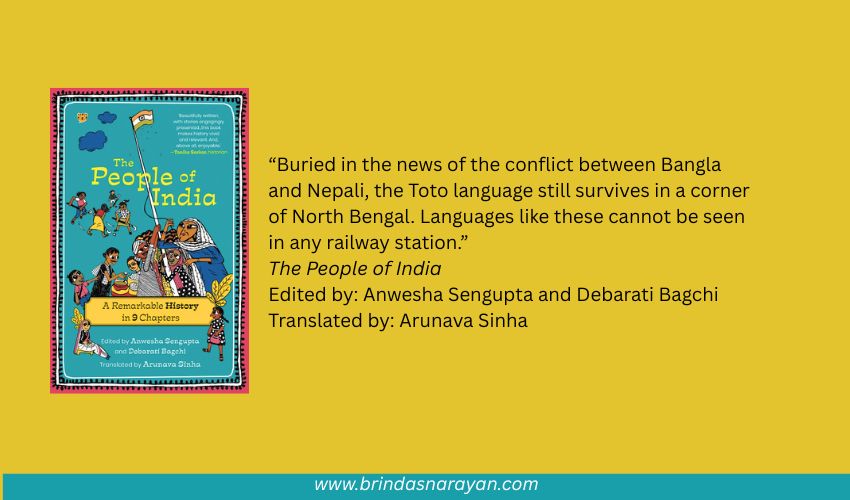
A History From the Bottom-Up
Between 2022 and 2024, Anwesha Sengupta and Debarati Bagchi wrote a series of nine history books in Bangla, targeted at middle-school readers attending Bangla-medium schools, to redress distortions imposed by authoritarian regimes. The series, called Itihase Hatekhori which translates into “First History Lessons,” intends to foster empathy for diverse populations that make up our country, and for their particularized experiences.
Ranging from the arbitrariness of the Radcliffe Line to the politics of language, from the history of foods to the makings of attire, the book raises important questions on the ethics of war, on the ownership of rivers and or even on a bromidic act that many engage in: drinking chai.
Gandhi Fasts While India Burns
While conflicts between Hindus and Muslims had brewed for years, reasons for such acrimony were not always religious in nature. Sometimes, Muslim peasants protested against ruthless Zamindars. At other times, fights were actively fomented by the British for trivial reasons. Leaders like Maulana Azad, Gandhi and Nehru often tried to settle these disputes.
But after 1935, conflicts escalated when the British introduced separate electorates. Declaring that Muslims would vote for Muslim Leaders and Hindus for their own, they widened schisms between the communities. When they finally decided to divide the country, Gandhi was so aggrieved by the decision, he embarked on a fast on August 15th 1947. He had also undertaken a vow of silence when others might have been cheering or celebrating.
Capricious Borders Dice Lives
Earlier, in June 1947, the British government had been wondering about how to execute the Partition. Government employees and assets would need to allocated between two countries. A boundary had to be drawn, maps agreed upon. For this, ten specialist committees were created. Two bureaucrats, one Hindu and one Muslim, led all committees and also communicated with the two parties – the Congress and the Muslim League.
Cyril Radcliffe, a lawyer from the UK, had been summoned to oversee the process. Teams working under him did not really visit the physical terrains being carved out. In many places, they chose rivers like the Padma and Mathabhanga and Ichamathi as boundaries, but waters change course. When they do, should borders shift with them?
Tiny Decisions With Elephantine Fallouts
These decisions unfolded in other whimsical ways. Take the case of an elephant Joymoni, in Bengal, which was supposed to move to East Pakistan. The distance was definitely feasible for the animal. But its mahout wanted to stay put in India. How could the elephant cross over on its own?
At the end, even a year later, in June 1948, Joymoni remained in West Bengal. Two men were dispatched from East Pakistan to claim the elephant. But the West Bengal district collector refused to part with the animal unless he was paid for the food that had been fed to the elephant since Partition. After all, those costs had been borne by his State and amounted to 1900 INR, a significant amount. Since the emissaries from East Pakistan could not pay that amount and insisted on taking the elephant with them, the infuriated Collector threw them in jail.
Heart-Wrenching Evictions
Then there was Nasir in Assam, a rice farmer who opted to stay in India. In 1964, the Police arrived and asked him to leave. But his home and fields were here, and he considered himself an Assamese more than anything else. He had no truck with India or Pakistan. But he was forcibly sent across the border to Mymensingh in East Pakistan. Later, he would walk to the border and gaze at the fields that he had tilled many times. His eyes would fill with tears. “The fragrance of the paddy would remind him of the terrible pain of being evicted from his own land.”
The Radcliffe line ran through actual homes and fields, slicing through lives with an arbitrariness that continues to resonate into the present day.
Partition’s Bright Side
Were there any silver linings? Many women were forced into workplaces, because they no longer had male members to support them. Just like the World Wars brought many women in the West out of their domestic confines into typically male bastions – like into engineering roles – “Partition also brought a ray of sunshine to the lives of women.”
Forging Internal Language Borders
Though India currently has 28 states, mostly divided by language, there’s nothing neat or sacrosanct about these divisions. As an example, many people in Jharkhand and Purulia (West Bengal) speak Santhali but they live in different states.
Power Differentials and Language Orders
State languages themselves have emerged as the official form because a particular dialect gained power from the confluence of historical forces. Like in Bengal, there are and were many types of Bangla. The Calcutta version dominated because the city’s residents were the first to become clerks under the British. Then in 1800, missionaries set up a printing press in Srirampur. Many Bangla books were produced from Calcutta, further cementing the superiority of the Calcutta version. While also giving Bangla a primacy over other languages like Odia and Asamiya.
When the freedom fighter Bipin Chandra Pal came to Presidency College, Calcutta, he felt inferior because he spoke a Sylheti Bangla. Pal wrote that newcomers to the city very quickly tried to learn the new words and the new accent, otherwise they felt embarrassed and were considered misfits.
In 1905, when the British wanted to divide Bengal into East Bengal (which had majority Muslims) and West Bengal (which had more Hindus), many Bengalis opposed the division. After all, they were united by language, culture and in many other ways. Tagore even asked Hindus and Muslims to tie rakhis on each other’s hands, as a symbol of friendship and of sibling bonds. He wrote, “Amar shonar Bangla, aami tomay bhalobashi” (I love you, my dearest Bangla).
Love for Bangla Supersedes Religion
Of course, Bengal was divided and Dhaka became a new, shiny city, revived from the obscurity to which it had fallen. The Bengals were united again in 1911. Till they were riven apart once more in 1947.
Pakistan made the fatal mistake of declaring that Urdu would be the official language across regions, imposing it on East Bengal, where no one spoke a word of it. On February 21st 1952, students were killed when they marched up to the Assembly, insisting on the recognition of Bangla. They were known forever as the language martyrs and immortalized in a poem written by Abdul Gaffar Chowdhury.
Though Bangla was recognized thereafter, the people in that region were not appeased. Sheikh Mujibur Rahman led a movement for the establishment of Bangladesh, which came into existence in 1971. Tagore’s Amar Shonar Bangla became their national anthem.
Potti Sreeramulu Sparks Off India’s Linguistic States
When India was newly independent, at first the leaders did not want to carve out linguistic states. But strong demands emerged from various regions, sparked off by a thrust to separate Telugu speakers from Tamil speakers, led by Potti Sreeramulu. He fasted to protest against the indifference of the nation’s leaders. When he died after 56 days of fasting, the Telugu people intensified their agitation. Andhra Pradesh, and thereafter other language states were created.
Ongoing Language Dilemmas in Assam
There have been complex tussles in Assam between Asamiya and Bangla. This partially originated with the British who had brought many Bengalis into Assam in administrative positions and later to cultivate fields. These conflicts have carried on post-Independence and are possibly never settled to the satisfaction of all. In a 1961 riot, 11 Bengalis died so that Bangla had to be declared the official language in the Barak Valley, while the rest of Assam could use Asamiya. More marginalized languages like Bodo have also felt ignored, in the process.
Tea’s Origins in China
Apparently tea was discovered in China by Emperor Shen Nong, when some leaves accidentally fell into a cup of hot water and he loved the smell. From there, the idea spread to other parts of the world. Of course, this might be just a legend or a made-up story. But tea was drunk in China as early as 1600 B.C. and then spread to Japan and Korea in 6th and 7th centuries AD. Then to Vietnam and only later to Europe, around 1607.
Catharine of Braganza, a Portuguese princess who married Charles II brought it to the UK. In the middle of the 19th Century, it arrived into elite homes in India and diffused into ordinary kitchens only later in the 20th Century. Tea shops popped up in various corners of cities like Calcutta.
The Bittersweet Whiffs of Indian Chai
Some Indians like Prafulla Chandra Roy opposed tea, claiming it had many ill effects. But the British were keen on propagating it and even handed out free cups from mobile vans. Earlier the British used to import tea from China, but this trade collapsed when the Chinese insisted on payments in silver, which the British did not wish to part with. At that time, a Scotsman accidentally stumbled on tea bushes in Assam. Of course the tea taste was different from the Chinese tea the British were used to sipping – after all, tastes vary by region, soil, temperature, humidity and whole host of other factors. Eventually the Assam tea was approved by a Tea Committee and soon the growth of tea was scaled up to ship huge quantities to the mother country.
Scouting for more land, the British also set up tea estates in Darjeeling. Such sprawling estates also needed labor, mostly imported from Chhotanagpur in Bihar, where there were many desperately poor people.
Tea gardens had a hierarchy of owners, managers, supervisors and workers. All owners and managers were British. Supervisors lured workers with all kinds of false promises. Migrants had to trudge long distances under harsh conditions. Inside the gardens, workers not only had to work excruciatingly hard, they faced dire threats: “The slightest mistake led to punishment.”
Laborers moved with families and eventually women, because of their nimble fingers, were assigned the hard leaf-plucking. Yet, there was a huge wage gap between men and women. Even now, women pluck tea leaves with baskets on their backs and they’re paid less than men who work in factories. The women are classified as “unskilled” whereas the men fallen into a “skilled” category.
Workers have risen up against tea garden owners in 1950 and beyond. “So many stories of these workers are blended into steaming cups of tea; just as there are many accounts of their being oppressed, there is an equal number of tales of their rising boldly in protest.” Even today, workers do not get paid well enough or receive adequate schooling and medical care. Hence they migrate to larger cities into other jobs as domestic workers, salon assistants, construction workers. The British might have left India but freedom still eludes many.
References
Anwesha Sengupta and Debarati Bagchi (Translated by Arunava Sinha), The People of India: A Remarkable History in 9 Chapters, Speaking Tiger, 2025