



Tristha Ramamurthy Rewrites the Education Rulebook
From a Small Shed to Lofty Campuses
Tristha Ramamurthy was only five years old when her mother started a school in their guava orchard. Till then, Sabitha Ramamurthy, had been a homemaker. Noting a sparsity of schools in Kacharakanahalli, when the area was relatively bucolic, she kickstarted National Junior School in a small shed with six kindergartners from the neighborhood. The goal, at first, had been to merely serve their area.
Around then, Tristha’s father, K C Ramamurthy, an IPS officer who later rose to the position of an IGP in the city, bumped into Dr. Gopalkrishna, founder of the acclaimed National Public Schools (NPS). On hearing that Sabitha had set up a school, he offered to share technical knowhow, forging a successful partnership that has endured to date.
Thwarting put-downs and disbelief with a panache that rubbed off on her daughter, Sabitha stuck with it. Even as their school mushroomed, she was inspired to start other institutions – both K-12 and higher education spaces across domains like management, technology, the sciences, humanities, social sciences and engineering.
The Original Role Model: Mom
As a student of NPS, Indiranagar, Tristha watched her mother morph into a confident educator and entrepreneur. “Not many women were running higher education institutions, so she was often the only woman in the room,” she recalls. Relying on her intuition as a parent and pedagogist, Sabitha was firm about her guiding tenet: “I will do whatever feels right for the children.”
Watching her mother, little Tristha thought teaching was magical. Even as a kindergartner, her favorite game was “Teacher – Teacher.”
A Turning Point at Age 10
At the age of 10, she recalls a momentous attitude shift. Compelled to attend a function at B.R.Hills, where her father was a chief guest, she was seated with her Mom in the audience. Three hundred children from tribal villages, who squatted cross-legged around them, performed patriotic songs and plays while passionately expressing plans to better the nation.
Belonging to a relatively well-heeled family, Tristha admits to being a brat then. Donning Converse shoes, she had balked at attending the event with an eye-rolling: “Why are we going for this?”
Watching kids from resource-starved environs so fired up about contributing to the country, something shifted in her. If they could harbor such agency and idealism, what was stopping her? “That was a very important switch,” she says. Since then she has always been conscious about leveraging her privilege to serve larger communities and her nation.
Rewriting Desi Rulebooks
While garnering her Bachelor’s at SMU in Singapore and a Master’s in Education at Stanford, her childhood resolve stayed unshaken: “I felt like no country needed me the way India does.” In the meanwhile, she eagerly lapped up lessons on learning. Hearing folks denigrate the Indian system for its rote-based, old-fangled approach, she sought to change the narrative.
Curious, Creative, Constantly Tinkering
As an early entrant in Stanford’s Design School, when it was still being run out of a trailer, she absorbed its human-centered, empathetic approach to problem solving. She delved into Project Zero at Harvard, founded by the philosopher Nelson Goodman in 1967, to promote learning through the arts. And into the Reggio Emilia approach, that originated in an Italian village, to foster the potential of all children.
Reading the Hyperlocal Room
Returning to India, brimming with ideas and a fresh-out-of-college brio, she bristled to make a difference. By then her parents had cemented a formidable umbrella brand in CMR. Choosing to spend her first year imbibing the local context, she studied the nuances of K-12 learning in the OG institute kickstarted in an orchard. She was struck, at that point, by the fierce familial bond between the staff and students: “The school wasn’t just a school. It was a second home.” She also observed that the emphasis was on transmitting content rather than on building skills – an aspect she was keen on changing. Besides soft skills – often a make or break at workplaces – were not being sufficiently emphasized.
Ekya: Built With Little Voices
At 23, surging with a founder’s self-belief, she opted to kickstart a new brand. Searching for a name, she pounced on the Sanskrit “Aikyam,” meaning ‘unique’ and ‘together.’ Testing it out among a bunch of third graders, she had them vote on the easiest English spelling. “Ekya” drew the most votes, embedding a child-centeredness into its makings.
Winning Over the First Cohort
Pouring her global takeaways and her family’s hard-earned wisdom into a new South Bangalore campus, she personally guided the first cohort of parents. She was young, no doubt, but she dressed up to look older, choosing sarees or formal wear. Her passion was visible, but she was also nervous, maybe terrified. What if no one signed up? She had chosen, after all, to pretty much go it alone. She could have called it Ekya-CMR or Ekya-NPS, but it was just Ekya – a new enterprise, set to prove itself from scratch.
In the past, she had watched her parents slog, staying up nights to lay foundation slabs. She had gleaned her father’s meticulous planning and time management and her mother’s community orientation. All this was layered with her own ideas. Fortunately, around 120 parents seemed to buy into her vision. Hiring a prudent mix of experienced and new teachers, Ekya started schooling its little entrants.
Multiplying the Ekya Magic
Having expanded since then to running six Ekya schools – with a seventh to be launched soon and more in the offing – she admits to failures and lessons along the way. Gleaning the discipline and execution focus of her parents, she was willing to wrangle with messy and thorny situations. After all, in education, outcomes are both subjective and take time to bear fruit. One needs to wait for an entire academic year to test out new learning approaches. “The patience game was a learning, because nothing happens quickly.”
Ekya’s Edge: Six Foundational Pillars
All along, she’s been able to make it work, because right from the inception, she had articulated six foundational pillars that would prop up her schools: culture, curriculum, instruction, assessment, environment and professional practice. “If these six things are in place, our schools will function well.
Crafting An In-house Curriculum
Their curriculum from kindergarten to Grade 8 is formulated in-house by a qualified, central team. They research best practices in each learning area and benchmark across countries – like the US, Canada, Singapore and Australia. They test their approach multiple times and refine it based on student and teacher responses. Diverse learning areas are integrated, creating porous boundaries between subjects, to make the experience seamless for students. Tristha consciously accords her teachers autonomy to adapt the curriculum for specific students or classroom situations.
Determined to remain board agnostic, students in Grades 9 and 10 study for specific boards – CBSE, ICSE, IGCSE and IB.
Sustaining a Distinct Culture
Since culture is another pillar, Ekya’s “Culture Champion” ensures that classroom and school practices tie into their central vision. For instance, every morning, each student is personally welcomed into their classrooms by a teacher with a fist bump, a high-five or a hug. At school assemblies, they set out “Intentions for the Day.” They hang Affirmation Boards in every classroom, where students affirm each other – “Thank you for sharing your pencil” or “Thank you for helping with Maths.” Every class builds a “Social Contract” that determines how students will treat each other. Social Contracts and Affirmation Boards also extend into Staff Rooms. The thrust is on students and teachers to stay aware, compassionate and engaged.
Tristha was one of the first in the education space to conceive of such a centralized model, but she has seen several schools mimic it later. It’s a model that’s not only enabled their scaling, but also driven consistency across the minutiae of schooling.
Training to Tackle Teacher Shortages
In terms of challenges, she says she’s also affected by the global shortage of teachers. Ekya has largely addressed this with their in-house professional development team. Besides offering courses for aspirant teachers in their higher educational institutions, they ensure the ongoing training of current teachers. “We do about 60 to 70 hours of teacher development each year for all teachers.” All new entrants are coached by veterans or experts who sit in on their classes.
Selecting Educators Who Embody Their Ethos
Their recruitment process is very rigorous and Tristha personally meets with each new entrant. When she meets “starry-eyed” folks who want to quickly usher changes, she warns them that the work is not always “exciting” or “inspiring.” She trusts folks who are willing to put in the grind, and will endure through unrewarding situations: “It’s hard, tough, boring and hairy. If you can stick it out, you might see change.” Their teachers, as a result, are a standout in the market, and “get poached a lot,” she laughs.
When Alumni Return With Thanks
Most gratifyingly for Tristha, alumni return to the schools and express their gratitude for the application-oriented learning they received at Ekya. They often found themselves in real world situations where they were able to problem solve in ways that others struggled to. Another alum observed that Ekya had introduced Python into Computer Science classes much earlier than at other schools. While she didn’t sense the value then, at a workplace she was very appreciative of her heads-up over others.
Inside the Sauce: What Makes Ekya Tick?
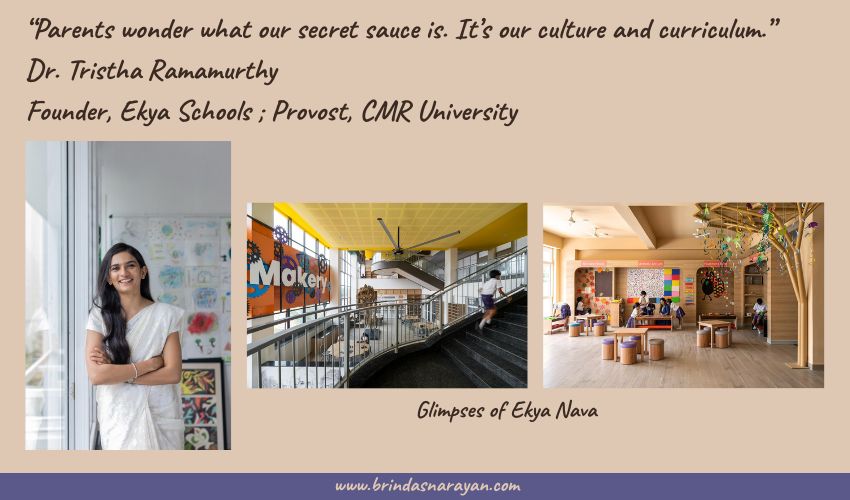
Parents often observe that there’s a “secret sauce” at Ekya, which Tristha believes is their “culture and curriculum.” She points out however, that running an educational institution is as complex as performing an intricate surgery. Perhaps more since so many diverse minds are being impacted. She also admits to parents that they might not be perfect, but their intention is clear: “We will always work on creating what is best for students.”
A Model Worth Spreading
Besides the Bangalore schools, they’re planning to expand into other geographies. Their build-out is completely self-funded. They don’t raise external capital and have accumulated zero debt. Because they have a long-term vision for the enterprise, they chose an asset-heavy model, wherein they own all the buildings and campuses.
Innovation by Intention: Reimagining Schools
They’re also planning to launch purpose-based schools. Currently the schooling landscape in India encompasses traditional and alternative schools. Usually traditional schools are large, and deft at handling board exams and mainstream pressures. Alternative schools tend to be smaller and cater to parents who seek creative pathways.
While ensuring outcomes on par with traditional schools, Ekya has always been a progressive school. With a spike in homeschooling and microschools, she’s observed that new-age parents seek options that diverge from traditional models but are not entirely offbeat. She senses a large middle ground that hasn’t been sufficiently tapped, a space she plans to enter with themed, purpose-based schools. The core curriculum, carefully crafted by their central team, would be adapted for these schools.
Ekya Nava: Where Kids Think Like Designers
They have already launched Ekya Nava, their first purpose-based school, centered around creativity, innovation and design. With its lively colours, collaborative zones and casual seating, it looks like a Google office. It features a Maker’s space (known as the “Makery”) and design labs.
Right from the K-12 level, students will imbibe design-thinking frameworks and the tenets of entrepreneurship. They will be tasked with a design challenge every semester. They will have demo days and pitch days incorporated into their timetables. It’s an ideal springboard for future entrepreneurs and creative professionals. “We want kids to become changemakers,” she says. She also envisions producing doctors who might play in a band, or engineers who paint murals. She views this as Version 3.0 of schooling.
At the Helm: From Vision to Daily Ops
She currently oversees 7000 students across 13 K-12 institutions. And 12,000 students enrolled in higher education. At this stage, while Tristha’s parents serve as sounding boards for strategic decisions, she and her brother are primarily responsible for the Ekya and CMR organizations. Her brother handles the infrastructure, while Tristha runs the academic and operational aspects.
A Doctorate Amid the Mayhem
In the midst of running these enterprises, Tristha earned her PhD from King’s College London. Her dissertation revolved around the social standing of teachers. She zeroed in on this topic after hearing things like, “If you don’t study, you’ll end up as a teacher.” Besides policy level changes, she advocates for parents, students and all stakeholders to affirm teacher efforts.
She didn’t stop with the Doctorate. Embodying the lifelong curiosity she hopes to instill in her students, she recently completed the Owners President Management Program at Harvard.
Managing A Calendar in Constant Flux
On a typical day, she usually heads to the Head Office at Banaswadi. Sometimes, she visits campuses, to attend special events or to meet with parents and students.
She claims she’s able to pack in so much because of her incredible team. “A lot of people have been there from Day One and they’re very mission-aligned. They know the nuances of how we function and I can trust them to head in the right direction.”
She works with an open door policy. The central team is constantly in touch with heads of schools, who are mostly people who have grown with the organization, who get the culture and overall values. “It’s a high intention, high mission team.” For their Universities, a Vice Chancellor oversees all their institutions.
Start with Why Before the Wow
Her advice to anyone who is planning to get into the education space? She says folks primarily need to have clarity as to why they are entering the sector. “You must clearly chart your North Star and your goals.” They also need to appreciate that education requires patience. If they expect quick changes and immediate results, this is not the sector for them. She cautions: “Don’t treat it like a startup.” After all, as she observes, the same student will be with you for 16 years. You can’t enter this sector with the intent of exiting early.
Yes, She Does the Boring Stuff Too
At this point, she says her role is to identify global trends and ensure that the institutions are headed in the right strategic direction. While she’s galvanized by new launches, she keeps an unwavering eye on their legacy institutions. She’s willing to do the hard, repetitive work: “The boring work is the exciting work.”
References
https://ekyaschools.com/about/
https://www.cmr.edu.in/about-cmru/