



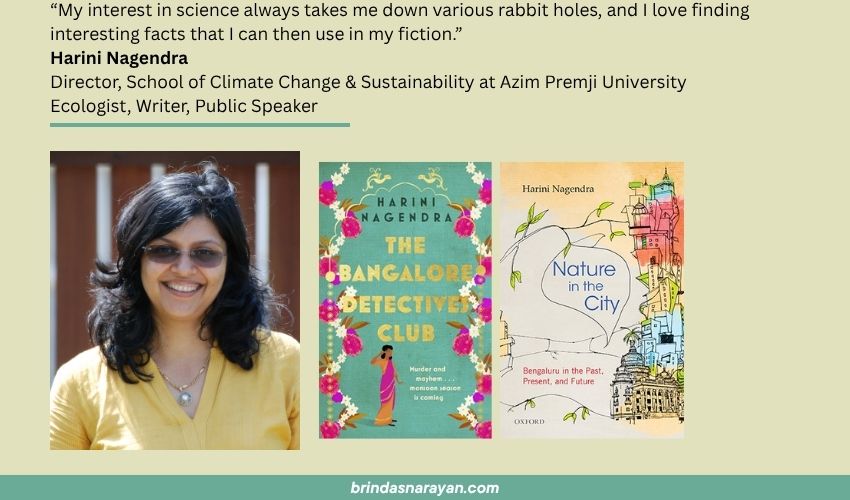
The Life of an Ecologist and Novelist
Reimagining a City Across Time
Harini Nagendra resurrects Bangalore/Bengaluru in multiple ways. She resurrects it through her vivid detective novels, which bring the city’s past to life. She resurrects its contemporary multiplicities as an academic and researcher, as the Director, School of Climate Change & Sustainability at Azim Premji University. More significantly, as an ecologist, she resurrects its more salubrious futures.
Shaped by Parks and Trees
Her brushes with nature started early. In childhood walks with her bureaucrat father in Delhi, she not only soaked up Mughal tombs and spotted deer, but also sprawling fig trees, evergreen neems, fiery red gulmohars and siren yellow amaltas. Sometimes, she picnicked with her family at parks. Even in their apartment complex, she often frolicked outdoors. If the grass was mowed, she would gather the cut grass with friends, turning it into a tumble-worthy haystack. “So, yeah, there was lots of nature-related play,” she recalls.
Finding Wonder Between Pages
When indoors, she often had her nose in books. Tutored to read very early by a baby-sitting older sister – “if I could read, her caretaking would be easier” – Nagendra took to Enid Blytons and adventure books, which soon enough evolved to PG Wodehouses and Agatha Christies. All along, she aspired to become a doctor, a goal that stayed with her till her 12th. Suddenly, it dawned on her that doctors contended with “human suffering on a daily basis.” As much as she admired medics, she sensed the field wasn’t apt for her.
A Fascination With Life Itself
But she was avidly curious about life, its cellular and genetic makeup, its evolutionary origins, its interplay with the environment. She chose to pursue microbiology, chemistry and zoology for her Bachelor’s. Later, at the Indian Institute of Science (IISc), where she enrolled for an Integrated PhD (Masters and PhD combined), she worked on molecular biology at first. Over a six-month project that entailed grueling hours at the lab – arriving at 5:30 am and leaving at midnight – she discovered that lab work did not sufficiently stimulate her: “I could not motivate myself to come back to the lab every day.”
A Wilder Field Beckons
Feeling somewhat despondent – “I was thinking of quitting the program” — by chance, she attended a talk by Madhav Gadgil, one of the nation’s pioneering ecologists. His lecture was mesmerizing. Meeting him later, she signed on to work with him for the rest of her Masters and PhD. Unlike other doctoral advisors, who typically handed students problems that their labs were already tackling, Gadgil merely suggested a broad area: “For instance, landscape ecology.” As a co-traveler on her academic dives, he would then hand over satellite images and recommend readings.
Some Spaces Belong To All
She would read a few papers, discover others, interspersed with long, lively to-and-fros with Gadgil. “Those deep-dive conversations were very first principles, very collaborative.” On completing her doctoral thesis, she headed to UC San Diego to work in a lab with Professor Michael Gilpin on ecology and evolutionary biology. Returning to IISc for a postdoc with Gadgil, she went back to the US for another postdoc with Elinor Ostrom, who later won a Nobel in Economics for her research on how “commons” could be collectively managed without State or private interventions.
The Human Side of Ecology
Ostrom’s theory resonated with Nagendra’s work with Professor Gadgil. When analyzing satellite images to assess biodiversity in different parts of the Western Ghats, she realized that some places were greening up while others were degrading. The “whys” often rested on social or institutional structures, “related to governance, culture or society.” She sensed, as an ecologist, she also needed to examine “the social governance side of things.” Her relationship with Ostrom, like with Gadgil, was consultative and participatory, with invigorating brainstorming sessions that sifted through ecological and institutional aspects.
Freedom To Pursue Her Curiosity
On getting back to India in 2003, Nagendra won the prestigious Branco Weiss Fellowship to conduct sustainability research in cities and forests. This permitted hiring a team for a five-year period to comb through physical landscapes as well as satellite images, archival materials, community interviews et al. In 2009, she received a Ramanujan fellowship from the Department of Science and Technology. Again, she had the latitude to conduct research in areas that intrigued her. “For a 10-year period, I was an independent scientist.”
After an affiliation with ATREE (Ashoka Trust for Research in Ecology and the Environment), she joined Azim Premji University, at first as a Professor of Sustainability and eventually set up their School for Climate Change and Sustainability.
Transiting from Forests to Cities
While still working in forests till about 2006/07, when a lot of folks started reaching out for help with urban issues – to restore lakes or tackle tree loss – she offered data and advice. Getting involved in a lake being restored near her home in Sarjapur, she found herself being tugged as a practitioner and scholar into the layers and challenges of urban ecology. At first, the transition was daunting. Indian city environments were data poor. Not many theories had been spun around urban ecology either. “So it was starting with a complete clean slate.”
Ecology Can Tap Into Ancient Bonds
One of the aspects of the city that has stayed with her is the sheer richness and diversity of local cultures. For instance, even in Cubbon Park, people worship gods and goddesses whom they believe to reside in the trees and lakes, whose presence is intimately linked to full moon nights. “People have an intimate relationship with nature in so many parts of the city. You may not look for them but they’re all around you.” She believes this deep spiritual connect with nature preserves a living landscape that might otherwise have been obliterated by developers. Of course, such sacred linkages are not confined to Bangalore. Collaborating in a study in Kochi, her colleagues found that people named trees in their backyard. As Nagendra notes, “If you look at India, it’s the most populated country in the world, but also one of the most biodiverse. This feels counterintuitive, but we somehow have dense populations who co-abide with nature with relationships of care and respect.”
A Parallel Life in Fiction
Nagendra is not just an academic and ecologist. She’s also a highly-acclaimed novelist, whose debut mystery has been featured in the New York Times “100 Notable Books of 2022”. The protagonist, Kaveri Murthy, alighted in her head, while she was digging into archival materials at her mother’s house. While reviewing a stack of printed material for an ecological history study, she encountered tidbits that had nothing to do with ecology. All along, she kept thinking of this character: “She demanded that I write a book about her.”
Story Seeds Were Sown Early
She knew there would be a man in Kaveri’s life, but she wasn’t sure yet if she would be married. That was in 2007 and the book was published in 2021, with fourteen years spent honing multiple drafts. This wasn’t her first brush with fiction, though. She had written fiction when very young, and later at Indiana University, she did a creative writing course along with her postdoc and published literary short stories. Since then most of her writing was either scholarly or non-fiction aimed at lay readers. Embarking on this novel was like sneaking back to a “first love” while also juggling her academic duties. She says writing across different genres ensures she’s never bored. “It keeps your energy going if you move from one thing to another…”
Writing Without an Agenda
Since writing wasn’t her primary career, she wrote with the luxury of not being too invested in the book’s outcome. This also permitted her to write without fretting about markets, reader preferences or publishing hurdles. As she admits: “That’s been the most fulfilling part, to write what you love and have it resonate with readers.” When her agent called to report that her book had featured on the New York Times “Best 100 books” list, Harini wasn’t attuned to how significant that was: “I said, ‘Is this a big deal?’ And she said, ‘What do you mean, is this a big deal?’”
Roots of Our Cosmopolitan City
What gripped Nagendra most when she was researching Bangalore in the 1920s, was how cosmopolitan the city was even then. “It was a melting pot, embracing diverse identities and influences from different places.” Moreover, there were records of feminism. The Mysore Representative Assembly was one of the first places that elected women into office. Local feminists were also inspired by the suffragette movement in New York, or by those championing women’s rights in the UK, Sri Lanka or nearby Madras. Even the pre-media days facilitated fascinating exchanges. Women, who were otherwise confined to domestic spaces, absorbed these cross-cultural and urbane ideas. One of the key drivers for this was that the Mysore King and Queen had decidedly progressive outlooks. The Queen was intent on driving women’s education, despite pushback from bureaucrats and others.
Habits of a Versatile Writer
Since Nagendra has to squeeze her writing into hectic days, she either writes early mornings or late nights. She needs to do it when her brain is not buzzing with academic pieces, which she has to engage with during her full-time day job. “It’s either student reports, classwork or research writing, all of which has to be scientific and structured.” Fiction requires a freewheeling approach, with fewer boundaries.
Given that her books are character-led rather than plot-driven, she permits her characters to meander through unknown terrains, without quite knowing how and when they will emerge from twisty, tangled pathways.
She’s just finished writing the fifth book in the series, and it’s going to be called “Murder in the Crocodile’s Lair” and it’s set in Mysore. There will definitely be a sixth book, and maybe a seventh or she might pivot to another series.
Braiding Science Into her Novels
In terms of how her scientific interests have fed her writing, she talks about discovering amazing anecdotes in archives. In the 1920s, there was a lot of interest in creating a lie detector. “They were looking for scientific lie detectors, which were originally meant to detect love. There was a machine to tell you if your boyfriend loved you or not.” In another instance, Kaveri Murthy visits the Seshadri Iyer Memorial Library in Bangalore, and finds a vacuum cleaner being used to dust off books – a machine that was in use in the British Library in London around the same time period.
The Joy of Meeting Readers
She has interacted with readers at Indian litfests or at book events in the US and Canada. Such encounters motivate her to keep at the series. She recalls one reader, who was a psychologist originally from Africa but now settled in the US. She loved that Nagendra did not subscribe to tired tropes. For instance, she did not pathologize the suffering of Indian women. Moreover, she showed that arranged marriages could also be strong and loving. As she puts it, “It’s natural for us, since we see it all around.”
She also recalls men in her own family sharing household chores, cooking, washing dishes – stuff outside the typical “man’s sphere.” Then there were the strong women she had encountered in her own family. She thinks that many Indians would have met such women: “Some grandmother or aunt who would have been a powerful matriarch, around whom everything revolved.”
She’s also gratified by readers from places like Mexico or Hawaii or Africa, who claim to have encountered similar women in their own cultures and families: “There’s a universalization to fiction that they connect with.”
But she also had some reviewers, on platforms like Goodreads, expressing disbelief in the agency of Indian women in the 1920s. They thought it wasn’t “realistic” to depict such strong women in those times. To counter this, in future books, Nagendra started introducing characters who were based on real women. Coffee Pudi Sakamma or Doddamane Sakamma, a child widow and formidable businesswoman who built a massive coffee enterprise, inspired a character called Coffee Pudi Lakamma. In the archives, she also found Kalyanamma, a journalist who ran a women’s magazine called Saraswati. As Nagendra reminds us: “Everywhere you found these very strong women doing amazing things.”
Her Message For Urban Planners
Nagendra herself is one of the nation’s strong women, whose views are worth amplifying. To a roomful of urban planners, at this point, she would suggest that cities need to prepare for the extremes of climate change. “We’re going to have heat waves, or floods, or droughts, and each one is going to hit us without warning. Moreover, they’re going to be more severe. So we have to center our cities around ecology, otherwise we’re not going to have livable cities. Right now, we plan our cities around infrastructure and fit the ecology in as an afterthought.” In general, she observes, that current planners prioritize economic growth, rather than human and ecological wellbeing.
In terms of actions that citizens can take, she suggests they express their views or concerns to local MLAs and corporators. She believes that more than social media or email campaigns, getting together in groups to plant trees, clean lakes or meet representatives can make a real difference. “Make your voice heard, tell people what you want them to do. Participate in ward meetings.”
If Kaveri Murthy could take up cudgels in the 1920s, surely us moderns can be inspired to do the same.
References