



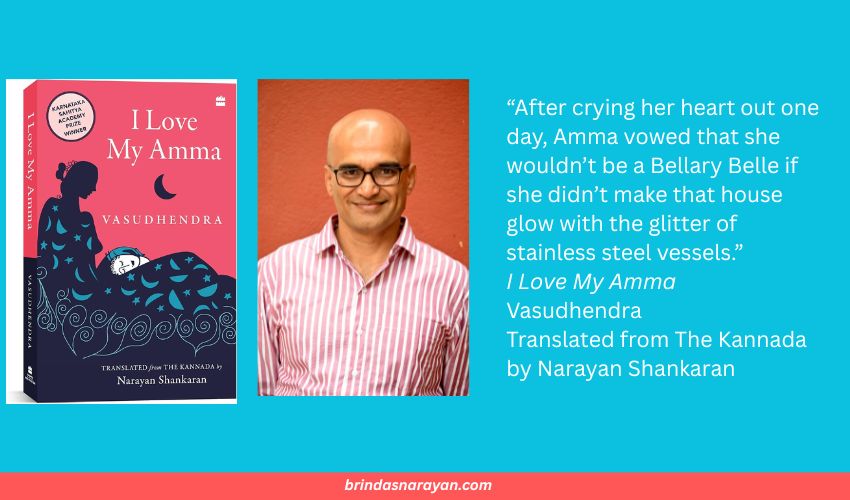
An Amma-shaped Childhood
Imprint of An Extraordinary Mother
Kannada literature has a tradition of writing essays peppered with personal anecdotes. Called “Lalita Prabhandhagalu,” these informal, whimsical essays can also weave in a friend’s experience as one’s own. But there is a sense of an underlying truth, or a compact between reader and writer that all this mostly unfolded.
After his Amma’s passing, the much-lauded Kannada author, Vasudhendra, drew on this tradition to create a series of poetic, feeling-drenched accounts of the past. In the process, he not only revives his Amma in technicolor, cinematic splendor, but also brings to life the South Indian town he grew up in, the indignities and camaraderie of poverty, the gaiety of festivals and rituals, Appa’s five-paisa lessons amidst the everyday heaving of water pots from 10-feet deep pits.
The Kannada version, “Nammamma Andre Nangishta”, sold 30,000 copies. It won the Kannada Sahitya Academy award and has been adapted into plays. One essay features in the ICSE Kannada textbook. When the author chose to work in a private firm, his Amma was furious that he was letting go of his pension. Radiating a whiff of his Amma’s buoyant outlook, he suggests with a trademark twinkle that this book might be his payback, his “pension.”
Influencer Amma Sans Social Media
Despite the hard-grind of not having enough, Amma loved stories. She devoured magazines and books, watched every film that came to their town. She would relay watched films to an audience of her own children and agog neighbors. Nothing was censored. Even to her kids, she would describe rapes and murders, heroes and villains.
Paying 50 paisa for a floor seat in their tent cinema, she was mesmerized by the iconic Telugu hit, Sankarabharanam. Watching it once felt inadequate. She was determined her kids and her cinema-averse husband would accompany her for a second viewing. On the D-day, decked in her wedding saree and ferrying special home-fried snacks, she was furious when Appa had not turned up at the tent.
After Akka failed to fetch him from work, Amma marched off to his office and berated his behavior to his boss: “Look, sir, he’d assured us that he’d come to the film with us. But now he isn’t coming.” Even the boss asked Appa to accede to Amma’s fiery request. Though Appa expressed his displeasure at such workplace drama for a mere film, Amma had the last laugh: she and the kids heard Appa humming the catchy title song – “Sankarabharanamu … Aa … aa … aa … Sankarbharanamu.” Until then, he hadn’t sung anything ever.
Amma’s Distinct Brand of Funny
Amma’s humor revealed itself on many occasions. She and Appa used to watch a Telugu mega-serial every day, in their later years. Amma would translate the dialogues for Appa and he too, was hooked. When the serial ended after four years, Appa passed away. When the rites had ended, Amma remarked: “You know what? At the end of the day, your father’s death is indeed a sacred one. Only because of his strong will could he hang on till the serial was complete.”
Chaddi Rascals Deserve Saviours
Such humor was hard-won, spawned by the on-going harshness of a hardscrabble life. As a child, the author used to avoid going to the toilet. He hated its stench. His Bellary District School had no toilets, no drinking water. So while in the classroom, he often shat in his pants. Once, when he was in Class One, other boys caught the stench of his doings and held their noses. He too held his nose to ward off their suspicions.
Then the Master asked him to stand and recite a poem. Turd bits fell out of his chaddi. His Akka was called in. She was in Class Four and was wearing a special dress that day. She was horrified by the sight and ran to summon their Amma. Who strode in with a brass pot of water hoisted on her hip and an old cloth. She hugged her child, and defended him to the teacher. “Little child, master … such accidents happen sometimes … please forgive him.”
This happened to him again, when he was in Class Seven, and on a picnic. This time, he hid in a cave so that his Master and friends would never know. Much later, his frenzied Amma and Akka found him, that too in an area that teemed with dangerous predators. Amma was unperturbed by his soiled pants, but was agitated by his narrow escape from lurking perils.
A Quiet Reversal of Roles
Many years later, when his parents were staying with him, his Amma’s saree emitted a fetid odor from the washing machine. He really lost his cool and yelled at her. Later, he would feel very remorseful. When he bought her adult diapers, she developed a rash that would not heal easily because she was diabetic.
Stainless Steel Outshines Gold
Newly-married Amma didn’t care for gold and silver but she intensely coveted stainless steel vessels. When pregnant with her first child, she persuaded her husband to buy her a steel plate. It was a “Lepakshi plate” with pits for sambhar and various curries. She was so proud of her possession. Moreover, it seemed to cement her bond with Appa, who ate on it first, leaving behind a bit of pickle. Amma ate next, on that unwashed plate, flushing while eating her husband’s leftover pickle.
Soon with Akka’s birth, many more steel vessels glittered in their rustic household. Fancier and fancier ones, etched with initials, including an Amitabh spoon – long, slender – used to scoop pickles. Each vessel was added at a cost that wasn’t easy to bear on Appa’s slim clerk earnings. Once Amma convinced a steel shop to give her two thick-lidded containers on credit. A furious Appa insisted she return them, and she had to sell them to neighbors to appease her husband. Her son accompanied her on this shame-faced mission and promised to buy her steel vessels galore, when he started earning in the future.
Every vessel lost was regretted, never forgotten. Once the author, immersed in a page-turner on a bus-ride, lost a whole carton of steel vessels. Amma said, “You tell me which moron wrote such a rotten book that kept you so oblivious to an entire boxful of gifts being stolen from right under your nose?”Later, he did buy her the promised bounty from a large shop on Ranganathan Street in Chennai.
When Amma died, he offered a rice ball to crows, as part of the Kage Pinda. When no crow turned up, their maid, Narasakka, said he should tell his heaven-dwelling Amma that he would take care of her steel vessels. That might tug her back in a crow’s form. Miraculously, it did.
A Rare Glimpse of Dr. Rajkumar
Amma’s fondness for films also extended to actors. Once Dr. Rajkumar was staying in a politician’s mansion in their town. Amma and the author headed there along with a throng of fans. Amma even lifted her “putta” on her shoulders to have him catch a glimpse of the star. Who lifted his own son, ‘Lohith’ (later known as Puneeth) to the crowd’s delight. Amma hadn’t seen the great man herself, but she had ensured that her son got a glimpse.
But later, halting at a Hanuman temple, where Amma was enjoined to sing a devara nama by the priest, they were blessed with an unexpected vision: the politician and Dr. Rajkumar entered the temple, and even brushed the narrator’s cheeks, asking him which class he studied in.
First in College, Last to Fix the TV
In another hilarious anecdote, Vasudhendra went home a hero after bagging the first rank at college. Moreover, he had been super-excited about their home getting a black-and-white TV for the first time. At the town, people greeted him with Aarthi. But unbeknownst to him, they were waiting for him to fix the TV, which now had worms wriggling on its screen.
After a couple of failed attempts to tweak the internal electronics – of which he naturally had no clue, having never tinkered with a TV ever – he begged his Amma for a reprieve. Later, it was Akka who fixed the TV. While drying clothes, she realized that monkeys had turned the antenna in the wrong direction. All she had to do was turn it back. Eventually, he won the first rank for all eight semesters.
When Tap Water Is Breaking News
Once, in a posh hall in England, at a brainstorming session, he received what felt like an emergency call from home. His Akka spoke into the phone in a shrill, excited tone: “Guess what? We have water in our taps today!” How could he explain to his British colleagues what this really meant? How could he summarize the years spent wading through 10-feet pits to catch as many pots of unmuddied water as possible? How could he explain what water-scarcity felt like to those who had always been water-rich?
A Passport To Everyday India
Vasudhendra’s book, deftly translated by Narayan Shankaran, is a must-read for many reasons. Regional literature ferries worlds and experiences and subcultures that Indian English novels can allude to, but barely portray with such verisimilitude. Written in unpretentious prose by a masterly writer, who also champions LGBTQ+ rights, it doesn’t just dredge up vignettes from the past. It describes the ongoing present for millions. Poverty can be agonizing and soul-crushing, but can also engender a distinct humor and sparkly wit. Read this not just to look, but to hear, smell, touch and most importantly, feel.
References
Vasudhendra, I Love My Amma, Translated from the Kannada by Narayan Shankaran, Harper Non-Fiction, Harper Collins India, 2026