



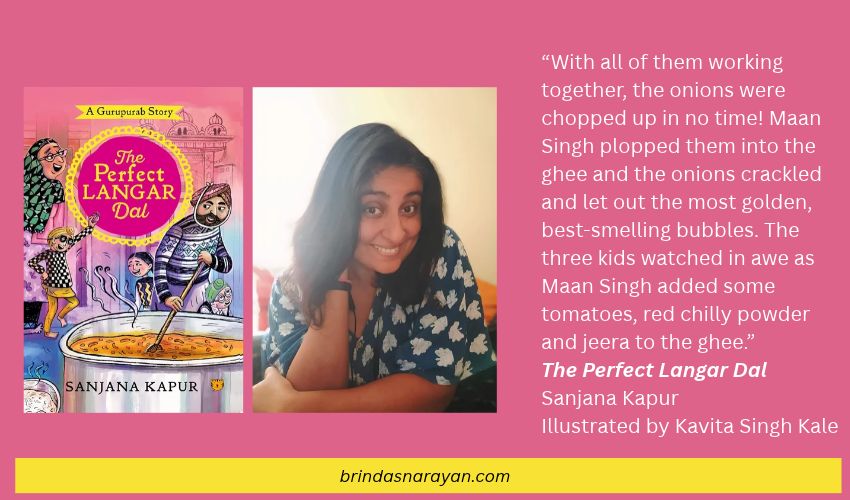
Stirring Magic Into the Langar Dal
Entering a Subculture
Kid-lit can serve multiple purposes. The primary intent might feel self-evident: to engage and entertain kids, transporting them for a short spell from the jumble of their own thoughts into a structured, narrative world. But equally, for anxious, distractible or curious adults, they can offer a break from the doom-scroll of short-form videos or Insta-reels into the relieving slow-turn of pages. “The Perfect Langar Dal” can be that kind of languid, lingering hang, especially if you would like to glean the specificities of a well-known Sikh celebration, the Gurupurab.
With a Tot as Guide
And it’s best to absorb this with the goggle-eyed wonder of little Amal, who picks up on the practices of mystifying Aunties and Uncles from his blunt-talking grandmother, Bebe. He loves his idiosyncratic, bespectacled – a detail one glimpses in the illustrations – Bebe, who at this time of year, bristles with excitement and busyness. Reinforcing how children rapidly mirror adult moods, Amal too radiates Bebe’s mirth.
Making a Patient Dal
She also has her own quirky way with stories. “Some stories took a long time to reach their ending, and you had to let Bebe take all the twists and turns the story needed to make sense in the end.” Bebe’s unhurried way with stories almost seems to hint at how a langar dal must be cooked: with painstaking patience or grating slowness. But I too, like Amal, am charging to the end, before introducing the dal-maker. Who, this year, is an expert, imported from the hallowed kitchens of the Golden Temple. Maan Singh, the cook from the Holy City, is ferried from the bus stop to the Gurudwara by the chattering duo.
A Nose For Tastes
While Bebe drives the car – yay for agentic, capable grandmothers!! – Amal is careful not to squash himself into the backseat with Maan Singh and his luggage. Instead, he cowers in the front seat, his ears alert to the newcomer’s heaving presence. Besides a large body, Maan Singh possesses a giant nose that can sniff its way through nuanced flavors. Amal, like many kids, is both fearful of and fascinated by the stranger in their midst.
A Cook With Conceits
When they enter the Gurudwara, where Maan Singh will also be residing, the cook puffs up with self-importance. In a thin, whispery voice that’s tough to hear, he declares that he needs to start on the dal right away. After all, it needs to bubble over 24 hours. With the hubris of an artist, he insists on working alone. Bebe seems affronted – maybe she had been hoping to help and also learn his secrets? – but she must accede to the veteran’s whims. She organizes for him to be given an isolated part of the gurudwara’s back kitchen, where he can stir his dal in beatific solitude.
Un-hurrying Harried Grownups
On Gurupurab, Amal relishes the smells – the floury halwa sputtering with ghee – and the rituals and the bustle. There’s also a striking difference in the way Amal processes time versus the grownups. He watches them suddenly get seized by “The Hurry” – a storm that washes over their psyches and spills into their agitated eating of breakfast – while Amal, who watches the clocks, knows their eating can be more leisurely. But The Hurry will seize them and release them as it always does: “It was no use telling grown-ups this. He rode The Hurry out in silence.”
Flattened Into Equals
At the end, the cocksure Maan Singh gets taken down a few notches, because despite his smug, meditative stirring of the dal, he has forgotten a key ingredient. It’s the kids who help him procure it and add it in time, rescuing him from his own swagger. That too perhaps is the point of Gurupurab: to realize that there are no higher-ups or lower-downs, no superiors or inferiors, no experts or laypersons. In their collective kitchen, all types, ranging from Maths teachers to tailors morph into potato-peelers, tomato-stirrers and cauliflower-cleaners. It’s a flattening and self-effacing collaboration that could seep into other places. The crowded and cluttered kitchen that Amal and his friends weave through embody a key message in the Guru Granth Sahib: “All beings and creatures are His; He belongs to all. God does not love based on one’s caste or color, He loves all, He belongs to all.”
Takeaways from Gurupurab
Written by Sanjana Kapur, “The Perfect Langar Dal” evokes the rituals and philosophical underpinnings of Gurupurab and of Sikhism. With a bonus colored section at the back, printed with photographs of important gurudwaras and basic facts about the community, it depicts how ordinary routines – the cooking of a shared dal – can serve as a recipe for living. The tale depicts not only the chaos and cheer of a community festival, but also the hilarious tussle between standing out – by cooking the best dal ever! – and fitting in. Often adult pretensions need the brutal appraisals of kids. At the end, the kids too are asked to be servers and perhaps they realize that there is more joy in feeding than in being fed.
All these scenes are brought to life by the illustrator, Kavita Singh Kale. Besides the patkas and pagris, other details like Bebe’s starry scarf or Amal’s checkered sweater, the cross-legged sitting down for the feast, the low stools in the community kitchen and the domes of the gurudwara capture an India that’s close to all but known intimately by few. Her black-and-white ink drawings burst into fitting color for the finale: the serving of food and its relished eating.
About the Author: Sanjana Kapur has penned many books including the prize-winning Who Stole Bhaiya’s Smile (Pratham Books) and Mom in a Mess (Duckbill Books).
References
Sanjana Kapur, The Perfect Langar Dal, illustrated by Kavita Singh Kale, Talking Cub, Speaking Tiger Books, 2026.