



When Medicine Doesn’t Listen
Even a Doctor’s Pain is Doubted
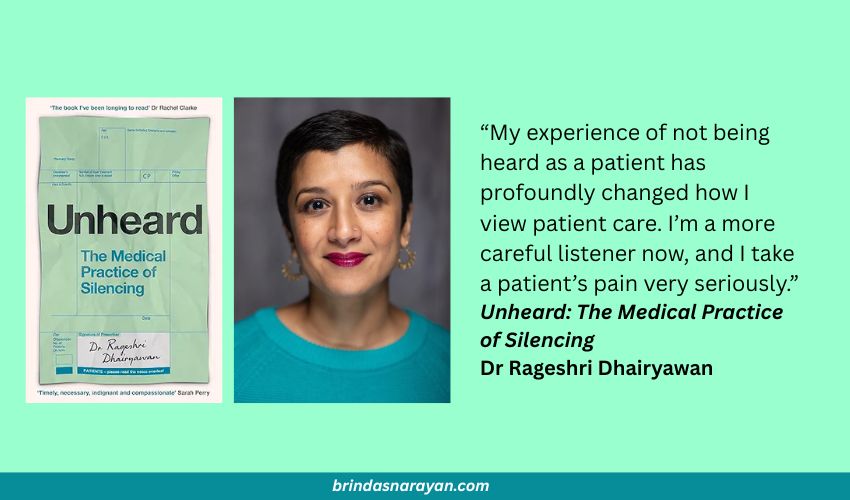
Most doctors have also been patients, at some point or the other. But few possess the reflectiveness and candor of Dr. Rageshri Dhairyawan, who starts “Unheard: The Medical Practice of Silencing” with a startling admission: “Not being heard or being taken seriously in healthcare seems to be an almost universal experience.” Naturally, such situations are exacerbated for those who don’t speak a particular language or wield the cultural savvy required to interrogate expertise and systems.
In 2013, Dhairyawan suffered extreme abdominal pain. The agony was so intense, she was compelled to seek relief on cold toilet floor tiles: “I felt as if a heavy metal shovel was scraping away at the lining of my abdomen.” Since her distress had ballooned after a recent cycle of IVF, after eggs had been extracted from her ovaries, she thought she might be afflicted by ovarian torsion. That evening her husband drove her to the emergency ward.
The next day, a scan ruled out the condition. Though she was still writhing in pain, the staff seemed to signal that she was making too much of a fuss. She had endured endometriosis earlier, and they thought her recent episode was just that: in other words, an ailment that wasn’t quite so painful. “On the ward, I kept having to plead for more pain relief, but I was repeatedly dismissed, my concerns minimized by the healthcare team.”
All this despite being a doctor at the NHS (the public health system in the UK), and a consultant with ten years of experience.
Serena Williams Faced it Too
In 2022, Serena Williams wrote in Elle about a similar experience. This, when she was already fabulously wealthy and famous. After giving birth to her daughter, Olympia, Williams felt breathless. She sensed that she had clots in her lungs, as she’d had in the past. After all, she had recently ceased taking blood thinning meds for a surgery. But the nurse shrugged off her concerns, saying: “I think all of this medicine is making you talk crazy.” As it happened, Williams was right. She had many clots in her lungs. As Dhairyawan observes, what she and the tennis star had in common “is that we were both not taken seriously in situations where we were at our most vulnerable.”
Such silencing expectedly becomes worse in the UK or US, if you’re black or brown. Though this is not covered in the book, I presume in India, low-income, non-English speaking patients would suffer a similar muffling. Which might be magnified if you’re lower caste, female or transgender.
The Challenge of Hearing Patients
From the other side of the fence, Dhairyawan admits that she hasn’t always listened as well as she should have. Sometimes, it was because she was exhausted, or at other times, because she couldn’t think of a solution to the patient’s problems. “I would like to work in a system where I feel better trained to listen and have the capacity to do so.”
When Healthcare Worsens Disparities
Besides being a doctor, the author is also a researcher and policy worker. She understands that healthier societies have to solve for health inequities. She found, in her work, for instance that HIV progressed to more advanced stages in minority/Black groups. Not only were these folks less likely to be diagnosed, they were less regular with their treatments.
Unsurprisingly, “[being] poor is one of the main risk factors for ill health and early death.” But a truly shocking and even counterintuitive finding from her research, is that aside from socio-economic factors, “healthcare itself can cause inequalities to worsen, rather than alleviating them.” For one thing, such folks face discrimination from healthcare staff. In the UK, about 23% of LGBTQ+ folks and 40% of transgenders have reported facing such prejudices.
Older patients are subject to ageism, and women to sexist or misogynist attitudes. Such differential treatment results in inadequate pain medication being prescribed, mishaps inside hospitals or clinics, and in general, emotionally distressing experiences. Since these groups are least listened to, their silencing further diminishes their trust in the system, leading to shorter life expectancies. In a 1966 address at Chicago, Martin Luther King Jr., said, “Of all the forms of inequality, injustice in health care is the most shocking and inhumane.”
Fix the System, Not Patients
And rather than advise such patients to be more assertive in their descriptions or demands, Dhairyawan notes that it’s the system that needs to listen more and listen better. After all, if such patients are encouraged to be louder in expressing their needs, they are likely to be labeled “too aggressive”, perpetuating unhealthy stereotypes that the staff might already possess about them.
Early Lessons in Not Listening
But why do patients, and especially some more than others, not get heard in the first place? Dhairyawan observes that the silencing starts in medical schools, where students are taught to cultivate a certain “hubris”. “This is also where we are taught the language of medicine, which has skepticism of patient testimonies ingrained within it.”
Doctors also don’t listen to each other. Particularly to doctors from minority communities, further exacerbating the stifling of these groups. Given the hierarchical origins of Western medicine, certain types of knowledge are prized more than others. Patient stories have not been historically heeded as much as they should have been. As Dhairyawan observes, while doctors possess both textual and experiential knowledge, patients ferry the lived knowledge of their own bodies. These two types of knowing need to feed each other, rather than deeming one superior and according it more weight.
Quiet Harms of Medicine’s Hierarchies
Professor Daniel Goldberg says patients have been viewed as “malingerers.” Especially those reporting pain. Historically, most doctors in the US and in the UK have been white/upper-class/male. This engenders a paternalistic outlook towards women/minorities/poor.
The General Medical Council in the UK found that unsatisfactory treatment fallouts were usually driven by failure to listen, failure to clarify and the dismissal of patient concerns or narratives. This is not because most doctors are inherently “bad.” Dhairyawan cites Atul Gawande, who says, “The important question isn’t how to keep bad physicians from harming patients, it’s how to keep good physicians from harming patients.”
When Testimony Meets Doubt
When patients are dismissed, they can feel gaslighted. The philosopher Miranda Fricker terms not being able to communicate one’s knowledge – because one doesn’t know a particular language or is not heeded – as “epistemic injustice.” As she puts it, “Epistemic injustice strikes deep into the heart of how we see ourselves – not being able to convey ourselves to others leaves us feeling less than human.”
The Perils of Stereotypes
In healthcare situations, doctors often use “heuristics” or shortcuts to arrive at diagnoses. This hurried judgment can prevent them from listening to patient symptoms that contradict their diagnoses. For example, if a gay man reports pain passing urine, the doctor may wrongly conclude that the cause is a sexually transmitted infection, rather than checking for a kidney stone. On the other hand, a 65-year-old woman who reports similar discomfort might have a sexually transmitted disease that she is not tested for.
Credibility Distorts Decisions
Dhairyawan suggests that those with “credibility deficits” are often under-treated or under-tested. But those with a “credibility excess” can suffer for a different reason. In their case, they might be subjected to “over-investigation and unnecessary treatment, which can in turn cause anxiety and be detrimental to their health.” Furthermore, those who are chronically ill tend to be unheard or ignored. This intersects with other social disadvantages.
Restoring Voices With Trust
When patients fear telling doctors that they’re no longing taking pills or facing severe side effects, the African American philosopher Kristie Dotson calls it “testimonial smothering.” Since they have been dismissed or disbelieved in the past, they lie to get through doctor meetings without being reprimanded. In domestic abuse cases, doctors are trained to say, “I believe you,” when a victim reports abuse. Dhairyawan suggests that a similar response should be used when patients report side effects or other concerns about prescriptions. Otherwise, you risk a long-term failure of the treatment.
In the end, doctors, like other experts who wield institutional power, cannot forget the tenets of patient dignity. As Fricker puts it, “Being understood, expressing oneself, being able to contribute to meaning-making are basic human capabilities and constitutive of a dignified life.” At a time when patients across the globe are tempted to use seemingly wise but also problematic AI tools for medical advice, doctors would do well to elevate their empathy. If not, they risk being supplanted by sycophantic and occasionally hallucinatory ChatGPT doctors who can quote the Hippocratic Oath and guiltlessly break it.
References
Dr Rageshri Dhairyawan, Unheard: The Medical Practice of Silencing, Trapeze, 2024