



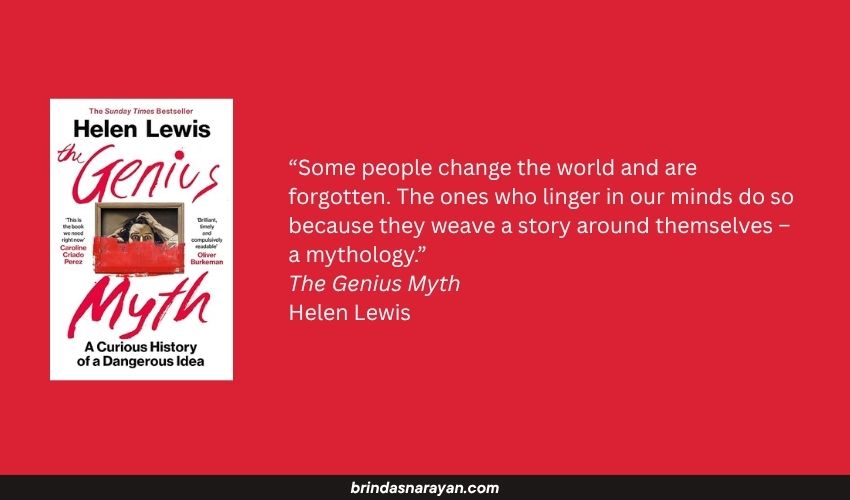
How We Invent Geniuses
What Counts as Genius?
Though the word “genius” is possibly overextended as a modern descriptor, the term still carries a mystique. Who is a genius? And yikes, let’s not draw AI into this discussion. Arthur Schopenhauer tried to lay down what the term implies in 1818: “The man of talent is like a marksman who hits a mark others cannot hit. The man of genius is like a marksman who hits a mark they cannot even see.”
Great Minds Across the Ages
Who comes to mind, in the West, when we use the word genius? Shakespeare, Da Vinci, Einstein, Bach, Mozart, Picasso, to name a few. Among global contemporaries, Musk and Taylor Swift, though it can be problematic to conflate genius with wealth and fame. In India, Tagore, Ramanujan, Subrahmanyan Chandrasekhar, Gandhi, C.V. Raman, J.C. Bose and the likes. To be termed a genius requires public acclaim, even if the kudos arrives posthumously. As Lewis writes, “You can’t be a genius without followers, fluffers, fans – guardians of the flame.”
The Cult of the Individual
She suggests that there is something inherently right-wing in the notion. After all, a genius implies an individual, a lone hero rather than a collective. Less attention is paid to the “scenius” that produced such blazing achievement: for instance, Florence in the 1500s or the Silicon Valley after World War II. We applaud the Nobel prize winner, but disregard the university that facilitated the research, the lab assistants, the long-suffering spouse (it’s usually a wife), the neglected children.
Ignoring Supporters and Systems
Lewis notes that many geniuses are like queen bees, fattened by acolytes. We tolerate the costs extracted by geniuses, excusing them as a necessary element of inventive thinking or action. The sad truth is that “[more] often, the suffering is borne by the people around the genius.” We falsely assume that a genius in one domain can opine on or intervene in others. More recently, we have witnessed Musk get involved with the running of the government, and the disastrous fallout.
Earlier, genius was thought to come from the outside, maybe granted to one by a divine force. After the Renaissance, it was believed to be the characteristic of a few. As the author puts it, “We call some people special to demonstrate what we find special. And, in turn, we give those people latitude that is not extended to ordinary mortals.”
The Makings of Shakespeare’s Aura
But these immortals achieved such an aura, because we collectively bought into their myths. Take Shakespeare, who died at 52, in 1616. Though he was relatively well-regarded and well-off then, he was to achieve worldwide renown and a god-like status only later. This wouldn’t have happened if folks hadn’t put in the effort to preserve his writing and laud his works. Two of his actors – John Heminges and Henry Condell – compiled his first folio. When they were performed, they were repeatedly transformed. Treating them like clay, rather than stone sculptures, they were molded to audience tastes.
In 1709, Nicholas Rowe created a 40-page document about Shakespeare. At that time, his bio was still sketchy, with doubt being cast on who really wrote the plays. Though such doubt persists to date among a few, “bardolatory” or Shakespeare worship took off in 1769, after a 3-day festival was organized by a David Garrick. At the fest, like at modern branding events, even his merch was sold.
When Geniuses Morph Into Brands
And that is partially Lewis’ point. That geniuses become personal brands, because of a certain marketing savvy, their own or that of their followers. Einstein “left his copyright to Hebrew University in Jerusalem” and they have since made $250 million by licensing his image. Brand extensions have included Baby Einstein videos, once marketed to parents as brain-boosting tools, but later debunked by academics and users.
Brands Emerged from Stories
Brand building requires forging stories. Giorgio Vasari, who was a “good artist” but possibly not a brilliant one, devoted his smarts to writing about the greats. “The Lives of the Most Excellent Painters, Sculptors, and Architects” portrays the lives of Renaissance artists at a time when they were not considered worth writing about. In that era, only aristocrats were written about. Many artists engaged in hard physical labor to produce their works. Even if creative, they were uneducated. Yet, Vasari had the foresight to recognize that these behind-the-scenes glimpses would accumulate worth over time.
He knew the significance of anecdotes. Like how Brunelleschi won his bid to build a dome on the cathedral in Florence, by being the only one to make an egg stand on the floor. Or how Michelangelo was so devoted to his art, he didn’t care about wine, food, clothes or injuries to his eyes and muscles. Or about Leonardo being a “scatter-brained polymath” who attempted to do too much, hence leaving many works unfinished.
The Myth of Early Brilliance
One of the takeaways from Vasari’s Lives has been that genius shows up early. This is a perception that lingers today and it’s not true for many domains. While some domains like mathematics typically require youthful brainpower (most mathematicians arrive at their world-changing discoveries by their early 30s), many others find people completing their greatest works in midlife or even later. Some people even stumble late on a domain.
The Troubling Origins of Intelligence
Francis Galton was a cousin of Darwin’s. He exuded a rabid curiosity about everything, but failed to feel anything or connect with other humans. He believed, without a doubt, about “European superiority” and wrote a book titled “Hereditary Genius”. Unlike the romantics, he wanted genius to be “dissected, exposed, explained.” He coined the term, “eugenics”. In his novel, Kantsaywhere, breeding licenses are given to a “deserving” few.
He made lists of illustrious men – judges, scientists, artists – and tried to trace how well their progeny were doing. Galton believed certain people were inherently gifted or born great, disregarding networks, the environment, and resources. From such questionable origins, we reach the problematic contemporary belief – which Lewis states as: “That geniuses were people with a ‘genius-level’ IQ.”
Lessons from Terman’s Termites
IQ tests themselves had ironic beginnings. They were created by Alfred Binet and Theodore Simon in France, to identify “less able children.” But eventually, they were used to sieve the gifted and the super-smart.
Lewis Terman, a young psychologist in America, was drawn to IQ tests. Since he was at Stanford when he modified the Binet test, it was accorded the name – Stanford-Binet Test. He believed too in the racial superiority of white men.
He created a list of 1000 kids that teachers identified as “gifted” with IQs of 135 or more. The aim was to track their lives and report on their performance. These kids were called the Termites. A reasonable number achieved “eminence” but perhaps no more than expected in any similar cohort of 1000.
Two boys who did win the Nobel Prize in Physics – William Shockley and Luis Alvarez – had also been tested by Terman. But were rejected from his list because their “IQs were too low.”
In general, his Termites were:
- Physically fit
- Likely to go to college
- Earned more than average
In the end, Terman’s study proved that “genius [cannot] be spotted in childhood.”
Shocking Secrets of William Shockley
Though he hadn’t passed Terman’s IQ tests, William Shockley too bought into the idea of eugenics and of the higher intelligence of certain races.
Growing up in California after World War II, when the whole Valley pulsed with the idea that “progress came through technology,” he attended UCLA and transferred to Caltech in 1928. Moving East to MIT, he completed his PhD, and joined Bell Labs. His workplace was another scenius. Nine Nobel Prizes were awarded for work done at Bell Labs.
But here’s a shocking truth about Shockley. His juniors had invented the “transistor” and because he threw a huge tantrum, Bell Labs featured his name and picture in publicity materials. In the second half of his life, he became worse. He suggested that the mentally deficient should not reproduce, and publicly pondered if blacks were less intelligent than whites. He even deposited his sperm to a “Repository for Germinal Choice.”
Superstar IQ and Humdrum Life
The person with the highest recorded IQ score is a relative unknown. Her name is Marilyn vos Savant, and her IQ was estimated at 228, by a test conducted in 1956 at Missouri. She was just a little girl then but later on, she went on to have a relatively ordinary life. Apart from briefly studying philosophy at Washington University, solving puzzles, becoming a member of a high-IQ society and writing essays, she wasn’t known for much.
In 1985, her fame skyrocketed when The Guinness Book of World Records published her childhood IQ score. She also met her third husband then, who was considered a genius for inventing an artificial heart. Isaac Asimov gave her away at the wedding. She later wrote books on how to raise your IQ or think more effectively and penned an advice column. Without having done anything distinctive, she was famous for a long-ago measure.
Mensa As a Society for Losers
Mensa has a similar dubious history. Forged at a time when many folks did not attend college, it might have helped to draw nerds together. But eventually the society often became a target of satirists, some of whom might have been insiders in the “elite” organization. As one writer member put it, it could have been called “brain-proud Quarrelsome Underachievers Limited.” Most achievers with high-IQs rarely have the time or inclination to join these societies. As Stephen Hawking put it, when asked about his own IQ, “People who boast about their IQ are losers.”
When Two Got There First
Often we think of ideas being engendered by a single person. Yet, people arrive at the same idea or invention, at the same time. Usually, they don’t know each other or of each other’s work. The sociologist William F Ogburn and Dorothy Thomas call this the “multiple problem.” Some multiples include:
- Telephone – Alexander Graham Bell & Elisha Gray
- Calculus – Isaac Newton & Gottfried Leibniz
- Evolution – Charles Darwin & Alfred Russel Wallace
Ogburn & Thomas wonder if those discoveries were “inevitable”, an outcome of history and the state of knowledge, at that point. The zone in which inventions happen is called the “adjacent possible.” We also, notably, recall only one of the names. Those individuals may have hacked “storytelling,” the kind that boosts publicity.
The Ones Often Excluded
Lewis also dwells on how women have often been the quiet enablers of many a genius. For instance, Sofia Tolstaya, the wife of Leo Tolstoy, wrote: “A genius must be fed, washed and dressed, must have his works copied innumerable times, must be loved and spared all cause for jealousy, so he can be calm.” She jotted down her thoughts in letters and diaries for him to read and glean a woman’s interiority. She copied out his work. A novella she had written earlier, “Natasha”, might have inspired the character, Natasha, in War and Peace.
Applaud the Acts, Not the Person
In this thought-provoking book, Lewis suggests we acknowledge that geniuses are flawed human beings, as ordinary as any of us. Instead of elevating them for perpetuity, we ought to acknowledge their “acts of genius” rather than investing their whole persona with an undeserved halo. Given that Tolstoy became increasingly eccentric over time, Lewis writes: “War and Peace is an act of genius. Leo Tolstoy was a demanding aristocrat who went very peculiar indeed”.
References
Helen Lewis, The Genius Myth: The Dangerous Allure of Rebels, Monsters and Rule-Breakers, Johnathan Cape, Vintage, Penguin Random House UK, 2025.