



Meeting Wild Creatures & Their Protectors
An Early Passion for Nature
Many kids do not stumble on childhood passions or inklings. Tara Gandhi, a renowned conservationist and author of “Gentle Sharks, Glowing Worms” was one of the fortunate few. Even as a little girl, she knew what she wanted to be: a zoologist. After all, when her friends abhorred insects, she was drawn to “creepy-crawlies.”
Besides, there was the genial influence of two grandfathers. One an entomologist, who had her peer at “glassy bowl” bug eyes or bristly antennae. The other, an orchard owner, who had an affinity for trees and plants. From early on, Gandhi learned to identify a dizzying variety of trees, fruits and birds. And to relish the flash of parrot greens against the powdery pinks of the shaving brush tree.
After a degree in biology, she studied ornithology under the “Birdman of India”, Dr. Salim Ali. “Though he was a great scientist with vast knowledge of his subject and much more, he always had a sense of wonder and said that nature is the best teacher.” Bird study taught her to attend to the big and small. To food choices and flight paths, the makeup of nests, the behavior of fledglings, the effect of environs. All along, she was wading through terrains that elude cubicle-dwellers. Trampling across carpets of color or dry forest floors, she soaked up “wild elephants bathing in a river or a pattern on a butterfly’s wing.”
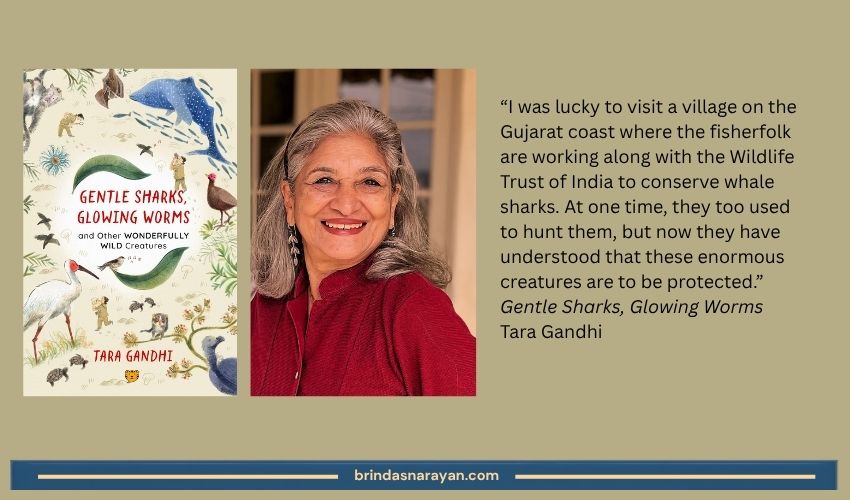
The essays in this book were penned as articles for a children’s magazine and depict her encounters with uncommon species. Like with a spotted and striped whale shark near a Chennai shipping port, which unlike the great white shark – featured in the memorable Jaws – will not chomp through humans. The whale shark slurps up water which it filters for nutrients like shrimp, plankton, algae. Given their dwindling population, even kids in fishing villages are trained not to trap these docile giants.
Blue Chakras on the Beach
Another time, while walking along a Chennai beach, she was intrigued by bright blotches of blue, as if someone had tugged a leaky can of paint across the sand. Peering closely at the circles, she noticed turquoise threads emerging from concentric circles in the middle. These were “blue buttons” or “Porpita porpita,” each one a colony of polyps. Though endowed with stinging cells at the end of each tentacle, they are less perilous than their close kin: venomous bluebottles.
Rescuing Turtle Eggs
One night, she was woken at 2 am by a conservationist friend who urged her to scurry to the beach. Apparently, an Olive Ridley marine turtle was laying eggs. After the process, the creature would return to the anonymizing depths of the ocean.
That night, she missed the egg-laying creature, but she returned the next night with her young college-student friends from a turtle conservation group. They scoured the sands for tyre-like tracks that might lead them to a nesting turtle, which apparently digs a deep hole with flippers to harbor its ping-pong shaped eggs. Each time, a turtle lays about a hundred eggs. On completing its high-yielding nesting, the turtle returns to the water and a couple of months later, baby turtles emerge and head straight to the waves.
As intriguing as the shelled reptiles are the young folks who protect them. The turtle lovers intended to retrieve laid eggs and ferry them to a safe hatchery. At the beach, eggs were likely to be eaten by stray dogs or plundering humans. Just accompanying them on their moonlit trek, Gandhi felt exhausted and wondered how these students would attend college the next day. They fended off her concerns with enviably light-hearted plans to sleep through classes. Surely the saved marine turtles would applaud their nightly romps and disregard for classroom theories.
Interlopers at School
Once while walking through the “thorn scrub jungle” on their school campus, two students spotted a grey, furry animal. One was a nature photographer, so she had snapped up the animal along with pics of birds and bees. While being observed, the single furry ball had unfurled into not one, but two of these rarely seen animals.
The lemur-like, obscure creatures had thin limbs. Seeing them later on a slideshow, Tara excitedly identified them as slender lorises. But in Chennai? They weren’t native to the humid city. Accompanying the girls the next day, she spotted not two, but three. Called “kaadu papa” in Kannada, the nocturnal slender lorises have whorly eyes, round ears and pointy snouts.
When she alerted the Madras Naturalists’ Society, other wildlife enthusiasts were keen on sighting the lorises. With necessary permissions, they combed the school campus in the wee hours, covering torches with transparent red paper to shield the creatures’ sensitive eyes. Since staff and students also resided on campus, they once had an amusing clash with a teacher who distrusted their nightly jaunts with backpacks and torches. Eventually, their searches yielded about 20 lorises whose sudden appearance in that location stayed inexplicable.
Grounds Lit by Fireflies
Some encounters have required travel to other places. Like to the Nilgiris, known as the “blue mountains”, when covered once in 12 years by blue kurinji flowers. In that rare period, the hills are blanketed in blue, offering a captivating vista.
Heading to Coonoor to glimpse the slopes at their bluest, she saw something glittering on the grass. It might have been a glow worm, the female of a bioluminescent firefly. When they fly, fireflies emit a bright light from an organ in their abdomen like a vehicle with a headlight. When millions sparkle on the grass or ground, it’s breathtaking. Inside quiet, dark forests, they flash together, forging a phenomenon that draws photographers and nature lovers.
Living For and Off Forests
She travelled to the Great Nicobar island to look for long-tailed macaques. But as much as they are adored by wildlife enthusiasts, the monkeys are not loved by local plantation owners, since they feast on the coconut and areca estates. While there, she bumped into shy Shompen tribals ferrying spears and a dead monitor lizard. The guide reassured her that they would not harm others. They merely avoided human interactions as they persisted in their hunter-gatherer lifestyles, living off the forests in a symbiotic give-and-take.
Saving Winged Scavengers
She stayed at a house near the New Delhi Ridge, the end of the Aravalli mountain range. Their garden was filled with multi-hued flowers – marigolds, zinnias, hollyhock – birds (orioles and barbets) and animals (like monkeys and snakes). Their gardener had the skill to evoke a storybook feel to their garden. He begged to chop off the Arjun tree near their gate, where vultures nested, showering the garden with foul-smelling bird droppings. But Gandhi, who appreciated vultures for being dutiful scavengers who cleared cities of dead bodies, would not allow the tree cutting. This was in 1985, when vultures were a common sight.
But in five years from then, vultures became almost extinct in India, their population declining by 99%. A strange disease spreading among these white-rumped vultures was first spotted by Dr Vibhu Prakash, an ornithologist. Later the root cause was ascertained to be Diclofenac, which had been fed to cattle. This drug caused kidney failure in vultures. Certain organizations – like one at Rajabhatkhawa – created vulture breeding centers to counter the decline.
Freeing a Trapped Bat
Sometimes the creatures alight at window sills. One day, in her apartment, she found a fruit-eating bat had snagged itself in the netting intended to thwart pigeons. She called a loyal conservation friend, who dispatched team mates to rescue the creature. Soon two teenagers arrived, with a ladder and a cage, and one very gently snipped off the netting to ease the bat from its plight. They planned to shelter the bat till it regained its strength before releasing it into the wilds.
While these snapshots might cause trepidations in many – after all, planetary losses feel immense and almost impossible to reverse – this book also offers hope. For every major force that works against a greener future, many folks – across ages – act to conserve species, to protect baby turtles, heal wounded bats and revive dying vultures. We can’t underestimate the impact of Davids – whether they be fishermen or teens – working in concert to counter extractive Goliaths. As Gandhi herself suggests, if you as a reader want to act, get involved in a local lake cleanup, in the protection of a particular species, or with any other green group that appeals to your sensibility.
About the Author
As a nature conservationist, Tara Gandhi has penned many books, papers and articles. She also surveyed wildlife protected areas, with a focus on the Andaman & Nicobar islands and Lakshadweep. She is the Vice-Chair of the Wildlife Trust of India and belongs to many other committees including the Madras Naturalists’ Society and the Indian Institute of Technology (IIT-M).
References
Tara Gandhi, Gentle Sharks, Glowing Worms and other Wonderfully Wild Creatures, Talking Cub, Speaking Tiger, 2026.