



Sikh History Beyond Dates & Deeds
What Daadi Remembers
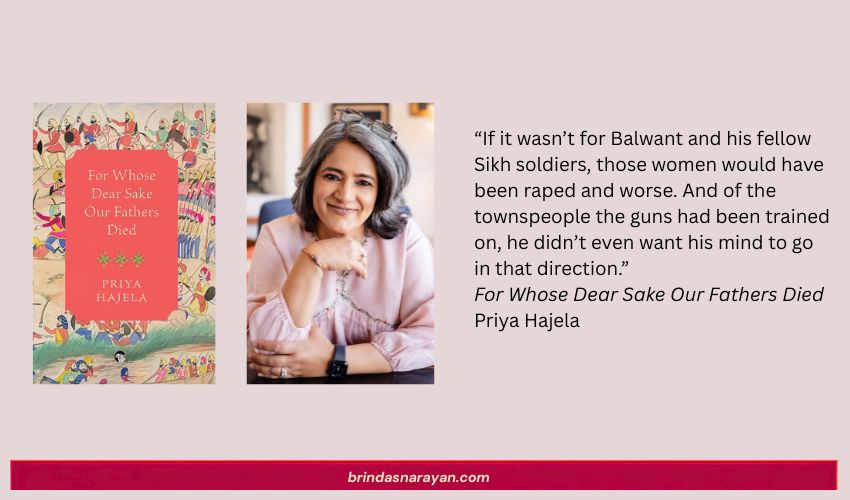
The more moving stories are often personal ones. Especially those dredged from memory and conversation snatches, relayed by a Daadi to a cozy circle of grandkids and kids. In For Whose Dear Sake Our Fathers Died, a multigenerational novel by Priya Hajela, Beant Kaur, the grandma, embodying the ‘limitlessness’ of her name, taps into the vast store of remembrances, starting with the hardscrabble origins of her bearded grandfather, Balwant.
Untangling Collaborator Myths
One of her motives is to amend the unfair notion that Sikhs were British collaborators who thwarted the 1857 uprising. As Beant suggests, nothing is black and white. In wars and violent upheavals, as in peace times, loyalties are divided and people tugged by their own personal interactions and histories. Moreover, if the colonized mirror the violence of colonizers, as Gandhi astutely observed, aren’t they also culpable?
Good Folks on the Wrong Side
Take, for instance, the tragic end of Henry Lawrence, the founder of the famed Lawrence Schools, Sanawar, Lovedale and Lawrence College Ghora Gali in Pakistan. Shot in the thigh inside his office, he bled to death on July 4th 1857. As Beant puts it, “It was a deliberate shot, targeting a man who had always championed the native, built infrastructure, and supported self-rule.” Though Lawrence was complicit in propping up British rule, he was possibly less heinous than others. At times of battle or armed rebellions, distinctions between the good, bad and ugly blur.
Betrayed By An Army
The work also recalls how brutal the uprisings were in 1857. Triggered by upper-caste revulsion towards biting beef tallow-coated paper cartridges, dissent spread from place to place. The British were terror-stricken. “The very discipline they had drilled into their sepoys was now being turned against them with devastating precision.”
The Savagery Of 1857
The attacks were barbaric. At a church service in Meerut, hundreds of British families were slaughtered – men, women, children and even the pastor. In Allahabad, senior officers were hung from trees while wives were made to watch from chairs, with hands tied at the back. In Kanpur, Nana Sahib’s personal assistant sliced off the heads of 200 women and children, with a sword. At one point, his sword broke and he paused only to rearm himself.
Tugged by Conflicting Loyalties
To understand why Sikh soldiers did not join these grisly attacks, Hajela amplifies the story of a particular soldier, Balwant. Whose father, Iqbal, had served in the Khalsa Army of Maharaja Ranjit Singh, in the Fauj-e-khas, an elite unit. In February 1846, when the British attacked with cannons, the rest of the Sikh army retreated. But Iqbal’s contingent of 500 defied orders to stay back and fight. Iqbal died fighting fiercely from a tree.
Loss Set Him Wandering
Balwant was only 14 then. He left home after “two unhappy years,” while his mother married an uncle, and became besotted with her new husband. The angsty runaway hung with boys, partook of langar, slept with horses, turning into a vagabond.
Aiming to Join Brasyer’s Elite
When Punjab came under the British with Henry Lawrence as Resident, Jeremiah Brasyer was charged with recruiting for the army. Brasyer was clear that he didn’t want traitors from the Anglo-Sikh war. He knew, shrewdly, that those who had betrayed their own would also betray the British.
Keen on being recruited by Brasyer – what other aim could a drifter possess? – Balwant aimed to master English. Stumbling on two American missionaries who had opened an English school under a peepul tree, Balwant and his friends settled to study with them. Gradually the other boys dropped out. But Balwant persisted. To fulfil his goal – to wow Brasyer with his conversational skills – he knew the peepul tree classes wouldn’t cut it. He would need to immerse himself in the language.
Learning English By Living It
One day, he followed one of the American teachers, who headed to an old tomb in Amritsar, where he lived with water from a pond, and a few vessels to cook. Balwant begged to stay with him, to cook for him and perform his other menial chores in exchange for ongoing English lessons. Eventually the American acceded, and Balwant moved in, despite facing taunts from others for being gay. As it happened, he wasn’t.
Swaying Brasyer With Fighting Skills
His desire to dazzle Brasyer was fulfilled by an incredulous chance encounter. While overcoming his stepfather in a public brawl, he was spotted by Brasyer, who lurked around the region to identify reliable fighters. Invited to a wrestling match with Brasyer – in which the young Punjabi overcame the Englishman – he was recruited into the Ferozepur Regiment. In the unit, which now consisted entirely of Sikhs, Balwant evolved into a recruiter and trainer.
Wrestling With Tough Choices
During the 1857 uprising, folks like Balwant were torn between their fealty to the Bengal Army versus the East India company. While they felt loyal to their leaders – to Brasyer, to Henry Lawrence and his brother – they knew that the East India Company didn’t view them as equals. While putting their lives on the line, they contended with guilt and ambivalence.
The Colonizer Wins Hearts
When a soldier appraised Balwant of rebellion in their regiment, Balwant warned him to stick with Brasyer. After all, they were known as “Brasyer’s Sikhs.” Yet all along Balwant was fearful. Telegrams arrived and news spread. Brasyer quickly squelched uncertain thoughts by addressing them upfront. By reminding his unit about who had saved their children and families.
More than anything else, Brasyer knew their language, their beliefs, their values. He was among a “handful who believed in learning as they ruled, in embracing the culture and the people as humans worthy of understanding and friendship.” Calling out their Gurus, he spoke in their lingo, persuading them that they were fighting for their cause. For instance Brasyer said, “Wahe guruji ka Khalsa” to which they responded with an instinctive, “Wahe guruji Ki Fateh.” His “Jo Bholo So Nihal” received a resounding “Sat Sri Akal.” Eventually the Ferozepur contingent ended up fortifying the Allahabad fort, where much ammunition was stored.
A Ploy to Rescue Hostages
Balwant dreamed up an ingenious plan to rescue the group of British women who had been tied to chairs, whose husbands had already been hung to death on a banyan tree. By distracting captors with cannon fire, Balwant and others ran against confused crowds and herded the women back to the fort. At least they prevented their rapes and deaths, but in the process, the guns and canon fire might have killed other locals. All skirmishes fostered new losses.
The British eventually responded with ruthlessness and fury, hanging 800 men and boys on makeshift gallows. This violence felt unsettling to Balwant and others. “Because when it came down to it, weren’t all Indians dispensable to the British?”
Bringing Sikh Stories To Life
Moving through time, from the Anglo-Sikh wars to the 1857 rebellion and the later Komagata Maru voyage – wherein Sikh passengers were shipped to Vancouver, Canada, resulting in an arduous and tragic standoff – the book reveals the many-sidedness of these events. Just as it’s unfair to indict the progeny of any race or community for ancestral missteps, it’s lazy on our part to subscribe to common tropes and simplified histories. History is not only about the big picture, as Hajela shows us, but about little things. Reading this fictional account can inspire us to delve into family archives – oral accounts, photographs, letters – to resurrect our own complicated and compelling pasts.
About the Author: Priya Hajela is the author of Ladies Tailor (2022), a novel. She holds an MFA in creative writing from Goddard College in Vermont. She currently lives in Pune.
References
Priya Hajela, For Whose Dear Sake Our Fathers Died, Speaking Tiger Books, 2026