



From Modeling Spreadsheets to Draping Mannequins
Inside the Light-filled Boutique
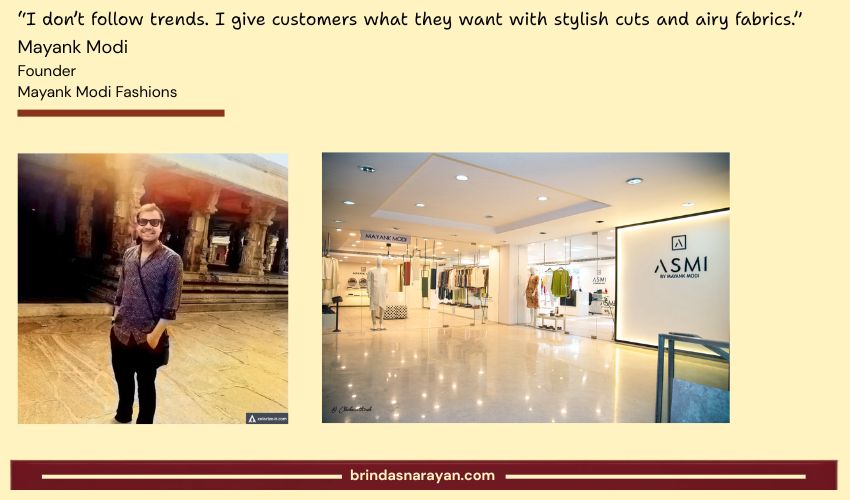
I’ve always been compelled by folks who veer off beaten paths into alter-avenues. Mayank Modi, who morphed from a corporate finance role at Hewlett Packard (HP) into a suave and acclaimed fashion designer, opens up on his journey with a matter-of-fact candor that counters the forbidding glamour associated with the sector. His brightly-lit upscale boutique on Vittal Mallya Road with soft-hued walls, wood-like floor, indoor plants, and mannequins draped in his sleek menswear or women’s range exudes a matching hominess.
Early Brushes With Swatches
On the way to a café, where the waitress obligingly lowers the volume of their background thrum, we discover that we share an alma mater. Were there any early inklings towards fashion, I ask, as we settle in with a cappuccino (Mayank) and iced, lemony tea (me). Was he drawing shirts on the sly, at Bishop Cotton Boys’ School and later at Christ College, where he had signed up for a practical, job-generating B.Com? “No, never,” he says. But he recalls an affinity for clothes and a desire to dress well. And absorbing the colors and textures of silk swatches, that his father, a VP at a textile company, ferried as sample sets.
Wanting to Do His Own Thing
But even as a teenager, he fantasized about “doing his own thing.” Maybe snag a job, at first, but turn into an entrepreneur soon enough. Right through college, he stayed a hustler. Graduating from Christ in 2007, when internships weren’t as common, he accumulated various real-world experiences including distributing pamphlets for a hardware startup. In his third year, he joined HP, hoping they would sponsor his foreign MBA soon.
Best-Dressed at Work
For the first three months, he felt at loose ends. HP had a fancy office, and Modi, donning well-fitting shirts, a tie and formal chinos from Color Plus, twiddled thumbs while awaiting concrete work. He was often the best-dressed, a professional habit he had built at Christ, where students wore formal clothes thrice a week. Modi plumbed his father’s tie collection – Hugo Boss, St. Michael’s, skinny, wide – garnered from trips abroad. Belts too, including a Hugo Boss one.
Called to Vibey Melbourne
But he could hardly contend with the tedium of “no work.” On prodding his boss to assign him something, he transferred to a division that worked with Australia and New Zealand. After two years of finance and inventory, he applied for MBA programs in the UK. Admitted to a Scottish university, he was poised to submit his resignation, when a HP manager from Australia called. Modi was invited to spend six months in Melbourne to transition financial inventory processes to India.
Forging His First Collection
Deferring his MBA, he savored the foreign stint, lapping up Melbourne’s artisanal coffees and graffiti-filled alleyways. Returning to India, he intended to go back, when his mother, who had been a homemaker till then, opened a multi-designer retail outlet, Mogra, at the Leela Galleria. Featuring, as it happened, some of the nation’s top designers – Anju Modi, Karuna Khaitan, Urmila – who all happened to be Modi’s aunts.
“Wha-at?” I say, sloshing some tea. Did he just grow up inhaling design, rifling through his aunt’s wardrobes or works-in-progress? He shakes his head with a firm “no.” None were in Bangalore, and he had very sporadic interactions. But his mother’s store – where he used to hang during lunch hours – stirred something in him. Noticing that they had no menswear goaded him into a weekend project.
Coaxing a friend to help with sketches, he scoured markets – scuttling between Ibrahim Sahib Street, Commercial Street and Avenue Road – for fabric, canvas, buttons, thread. He had a logo made too, gleaning from HP, that branding was critical. He ensured everything was of the finest quality – plush, carefully woven linen, the classiest buttons – after extensive physical and virtual research. Teaming up with a master, he launched a debut collection of 15 shirts. “It took me about two and a half months.”
Starting Up in a Garage
The side hustle paid off. All shirts were sold. Validated by customer interest, he rented a garage for 3000 INR/month, bought a manual sewing machine, hired a master and tailor. His plan was to make just shirts while juggling his full-time HP job. Heading to the garage in lunch hours, after work and on weekends, he realized in six months that he’d found a passion.
While scouting for other outlets to market his shirts, he quit HP in 2010: “I felt so attracted to design.” He also needed a larger space to house a computer, generate invoices, connect with suppliers and handle grunge processes like bookkeeping.
When the Brand Took Shape
Things were humming along, so he added kurtas to his line. Around then, his Mom noted that menswear was no longer doing well at Mogra, so she needed to take his shirts off the racks. Locating an empty store below Mogra, also at the Leela Galleria, he chose to showcase his wares at an exclusive space. It was a risk with pricey five-star rentals but his wife encouraged the plunge.
It worked: “Having your own store makes a big difference.” For the first time, clients viewed him as a brand, who could deliver a certain look and quality.
They started asking for wedding sherwanis, jackets, vests and piece by piece, Modi built his own capabilities. He hired more masters, bought more machines, expanding his Domlur factory in response to growing demand.
Launching Womenswear
Without too much forethought, kickstarting the outlet at the Leela Galleria brought in an upmarket clientele – both local and international – who have been the mainstay of his thriving business.
Gradually, women started trickling in, feeling his soft shirts, trying the smart blazers. And with them, requests: “Can you make a dress for me?” So Modi hired a womenswear master and launched dresses. He rented another empty store for womenswear, where beautifully-embroidered dresses, lehengas and blouses fluttered on garment rails.
A Setback and a Turnaround
Gaining conviction in his brand’s appeal, he rented a store at a mall in Hyderabad. Unfortunately, the mall did not take off and he needed to shut the store in a year. The sudden closure punctured his self-belief. Just then the Leela asked its stores to relocate since the hotel planned to renovate the space. Fortunately, Modi found a lovely place on Vittal Mallya Road, where he’s currently located. “I’m doing extremely well here.”
He’s also ridden other hiccups. His international sales – ordered online – were hit by American tariffs. The Indo-Pak war affected weddings. At this point, costs have spiked for everything, including fabric and buttons. He plans to expand, but cautiously. He’s also seen changes in himself. Earlier, his work was largely creative – getting into the intricacies of each design – but now he’s focused more on business aspects: “I’m going through all phases and loving it.”
Building A Community
His artistic spirit shows up in other ways. He ensures that his retail space is not merely a store. His outlet conducts yoga sessions, organizes talks by weavers, hosts fashion podcasts, coffee mornings, saree-draping classes, poetry recitals, pop-ups with other designers or partners. “We’ve built a community, not just a store.” They also host meetups for other fashion founders, offering tips, mentorship and networks.
A Constantly Evolving Brand
Collections touch on broader themes beyond clothes. A recent line pays homage to Bengaluru, to bustling Russell Market, Tipu Sultan’s Summer Palace, the red-bricked High Court and glittery Commercial Street.
He’s very clear too that his brand will evolve and change. Rather than stay trapped in a static niche, his styles adapt to cultural and customer changes. He’s watched clients too shift over time. Someone who sought plain, unembellished outfits earlier suddenly yearns for something fancy. Gen Zs prefer denims and street wear, but when he “matches their vibe” during interactions, they yield to his inputs: “To the idea that nice pants or loose pajamas can be as comfy as denims.” And because his outfits keep morphing, older clients return: “I know their tastes, I know who’s changed and who hasn’t.”
Keeping His Staff Happy
When it comes to his workforce, the same masters have stuck by him. He believes, over time, that mass tailoring will be supplanted by AI. Robots with cameras are already handling tasks at garment factories. But in his workshop, he’ll always need human masters and tailors to handle bespoke work.
He’s not averse to using AI where it helps. For instance, the elegant and spritely models on his latest Instagram reel are – a surprise for duh viewers like me – machine-generated. While much of his local business is generated by walk-ins, sales are split between local and international markets in a 70:30 ratio. He might expand his online offerings, since they don’t require customization.
Ignoring Fashion Trends
Though he posts reels on Insta, he shuns fashion shows. He believes they create a buzz but rarely deliver conversions. “I’ve always been out of the fashion circuit,” he says. “The glitz and glamour don’t drive sales.” Like in many tangible businesses, word-of-mouth is a powerful medium. He also steers clear of influencers, who generate views but no sales. “As a finance person, I don’t believe in views, I believe in conversions.”
Celebrities help. During Covid, Karishma Kapoor was snapped up in a Mayank Modi mask. Calling it the “Karishma Kapoor” mask, they sold 5000 pieces. He’s also tied up with multi-brand platforms like AZA, Ponya and Ogaan.
Advice to New Entrants
His advice for new entrants into the fashion space, especially to savvy Gen Zs, is to decamp with a laptop to a hill station, accompanied by a team of two or three. From a remote location, they can forge a brand by outsourcing the manufacturing to others and involving AI with designs. The only element to crack is marketing. The supply chain is robust enough to support niche collections: like trans, techno, party or street wear.
Lessons from the Road
He marvels at his own journey, from not knowing the difference between georgette and chiffon to his current familiarity with the minutiae of all apparel, without any formal degree or coursework. He’s learned everything by trial and error, by doing rather than textbook takeaways.
During our café conversation, he’s occasionally interrupted. From sourcing fabric to chiding an accountant, from instructing his retail staff to poring over a collar design, he’s immersed in the day-to-day of running “Mayank Modi Fashions.” “It’s not easy,” he says, with a wry smile. His absorption mirrors the state that the psychologist Mihaly Csikszentmihalyi termed “flow,” a condition that many covet but few possess.
References
https://mayankmodi.com/