



Running Toward Self-Discovery
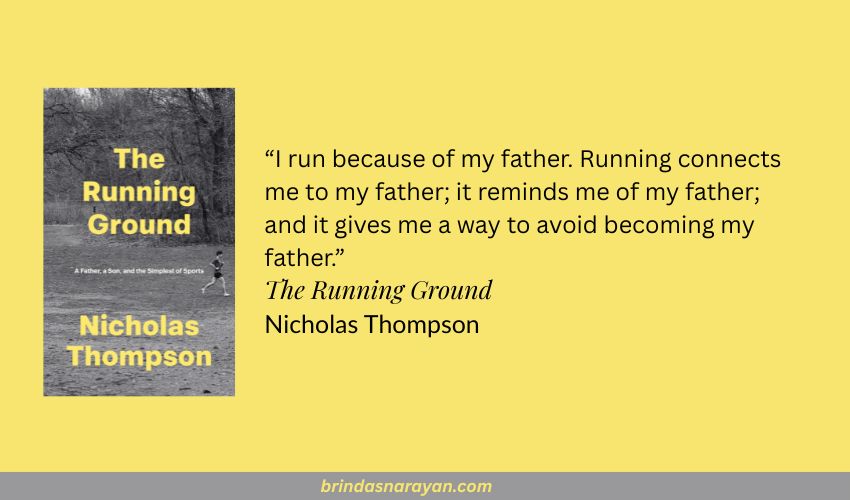
I watch runners zigzag through the leafy Cubbon Park pathways with a mixture of awe and envy. I believe my own knees are too dodgy to run. Reading The Running Ground prods me to interrogate tentative midlife appraisals of what I can do. Nicholas Thompson, who’s currently the CEO at The Atlantic magazine, is that kind of age-defying runner. Born, no doubt, with wheels beneath his feet. But who has, thereafter, cultivated a stirring, gritty, transcend-pain approach to marathons and life.
Nicholas was fortunate to start running at a very young age. Accompanying his Dad at five, he recalls lining up his little sneakers alongside the bigger ones. He raced against his sister and mother too, silently absorbing a lesson that was to anchor him through life: that his body could hurtle through space at lightning speeds, culminating in an endorphin-sparked feeling of triumph.
In high school, Thompson did not feel extraordinary enough. He didn’t seem to have standout qualities till he joined the track team. Even there, he wasn’t an instant star. Till his coach goaded his entry into the New England Prep School Championships, Thompson did not think he had a sprinter’s potential. As it happened, in that race, of which he knew little in advance, he ended up shattering school records. The race track confidence spilled into other spheres, lifting his grades and all-round performance.
He ran in college too, with less spectacular outcomes. For a decade after graduation, he ran in a more on-off, dabbler fashion. At 29, he started training seriously, with a coach and a team. He finished marathons at 2:40. He kept improving but he was also aging. So things settled into a status quo. “I ran marathon after marathon in remarkably similar times.”
At 30, he bumped into another hurdle: thyroid cancer. After the dreaded diagnosis, he tried to think of his disease as an alien invasion he could manageably fend off. But it felt too much like a part of him. The cure was torturous and frightening. Post treatment, he could barely walk uphill. The meds made him weak and dizzy. He didn’t think he could run again.
Yet two years later, he was back at a marathon, “running at the same pace.” On the trail, two voices collided inside his head. A hesitant, terrified Nick and an undaunted, positive one. It could well have been the other Nick who won. With running as with any other punishing/exhilarating activity, he observes: “Self-doubt is a smoldering fire.” Yet the optimistic, intrepid Nick prevailed. He had even shaved 13 seconds off his pre-cancer timing.
So do I intend to pound Bengaluru’s shifty pavements with the latest Nikes? Not really! But I can glean takeaways from his life and book for other endeavors, like for writing a book or for keeping at my shorter, plodding walks.
Keep Your Eyes on the Finish Line
While running, Thompson tunes out all distractions. On occasion, he absorbs sounds from his environs – the call of blue jays, the rumble of trucks. But that’s an intentional taking in to keep himself mindful of his body in space. He doesn’t listen to music since he pays sharp attention to his posture and pace and breathing and movements. At marathons, he doesn’t heed cheers and crowd shouts. He doesn’t track the time either, though he’s run long enough to intuit where he is on the 2 to 3-hour arc. He observes that energy in races is like pennies in a pocket. Squander them too early, and you’re likely to sap stores before the finish line.
Make Age Work For You
His father, who had taught him running, had warned that everything would crash at 40. At 43, Nicholas met with a bunch of elite coaches who offered to train him for the Chicago Marathon. At 44, he ran a marathon at 2:29, “making me one of the fastest marathoners my age in the world.” Later, he set another record in the 50k and another world record in the 50 mile.
He used to see athletic ability as a mountain – you start out at the base, clamber to a peak and then drop. He suggests that metaphor is flawed. Life is more like a series of rolling hills, you climb up and down, and up and down again. Even if you don’t reach the zeniths you attained in your youth, you cross new summits and gain new views, even on downward journeys.
Choose Inspiration, Not Imitation
Running for Nicholas helped him relate more strongly to as well as disentangle himself from his father. Scott Thompson had been inspiring but also a turbulent anti-role model. Emerging from a rough childhood in rural Oklahoma, Scott had a fierce intellect, a relentless drive and too many inner demons. Midlife, he abandoned his wife and three kids, when Nicholas was just seven. Despite professional success as a White House Fellow and an academic, he fell off the rails later, turning to his addictions: alcohol and sex with young men.
Nicholas averted a similar midlife crash by sticking to running and pushing himself to do better and better. With coaches too, and technology, paired with discipline and grit. Qualities that naturally touched other areas of his life – his work, his performance as a husband and father. He recalls that his own father did better on the days or times when he ran. He surmises – perhaps correctly – that Scott did not run enough. Or at least did not run with his problems rather than away from them. He did not use running as his son did: “Running is the simplest of sports. But if we look closely, it can teach us about the hardest things in life.”
Mind Over Matter and Pain
When it comes to overcoming pain, Thompson realizes that the effort is more mental than physical. “I learned that pain has physical causes but that it’s mostly a mental process: we slow in races less because we reach our physical limits than because our minds get scared.”
References
Nicholas Thompson, The Running Ground: A Father, A Son and the Simplest of Sports, Random House Inc., 2025