



When AI Storms Colleges
The Author Off the Page
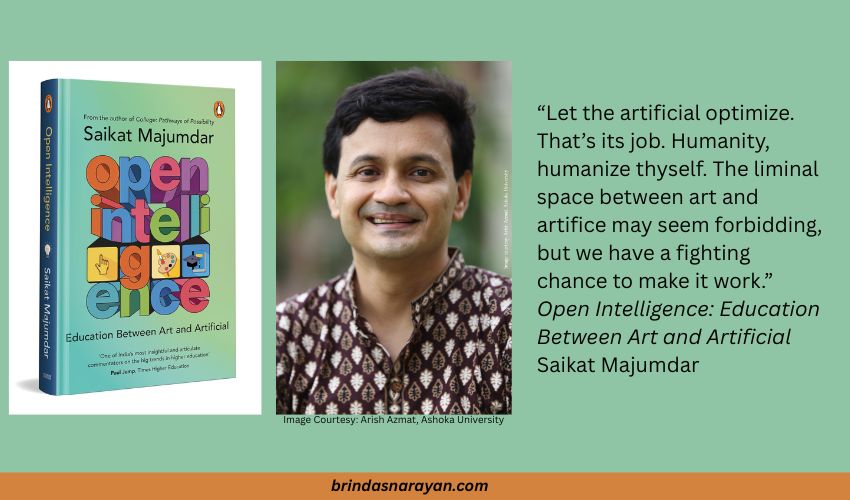
AI is poised to disrupt many domains, but perhaps none more than education. Given that bots already pervade student devices and artificial wits are being channeled to cheat on exams or produce instant longform papers, it feels urgent to engage with a higher education thought leader and practitioner. And who better than Saikat Majumdar, who currently heads the Department of English at Ashoka University, has taught at Stanford University for more than eight years, and been a fellow at Wellesley College, among his various global spells.
He’s also a parent who watches the digitally deft reshape fields with an inevitable tenuousness. Will his linguistically-gifted daughter, 15, chart a scholarly path like her parents? Can his 11-year-old son, a football zealot who possesses unorthodox skills like “juggling, Spanish, magic tricks, piano” deploy his self-taught dexterity with the Rubik’s cube – “his greatest passion yet” – within narrow streams of social success?
More significantly, Majumdar is an essayist and novelist. He can relate to the anguish of creators – artists, writers, graphic designers, to name a few – whose works have been swallowed whole by detached, planet-scorching machines. Whose skills, painstakingly cultivated over years of striving, are swiftly devalued by pattern-making lines of code. But perhaps we’re already at a stage when we have to worry about more than artistic holdings?
What AI Does to Identity
As Majumdar suggests in “Open Intelligence”, we need to obsess with the values being propagated by these self-propagating algorithms. Do they operate with the ethics of a healer, protector, peacemaker or the malevolent smarts of a mafia boss, an autocrat, a mercenary? If these machines are indeed “intelligent”, where does that leave us, a species that prides itself on its sharp, world-changing powers? As far back as 1995, Douglas Hofstadter had voiced his discomfort with AI that could craft music like Chopin or Bach: “If such minds of infinite subtlety and complexity and emotional depth could be trivialized by a small chip, it would destroy my sense of what humanity is about.”
Intelligence as a Fluid Trait
Even if we leave identity wrangles to the likes of Hofstadter, we need to contend with our own fraying skills, denuding intelligence and creeping brain rot. This naturally brings to question what we mean exactly by “intelligence.” Those who have studied its history know that this is a shifting trait, whose dimensions have been measured in collectively agreed, but also questionable ways. Greeks valued physical agility, reasoning and “virtuous behavior.” It was the Enlightenment that elevated the mind over the body, leading to contemporary settings that largely focus on manipulating linguistic or mathematical symbols.
Feminist thinkers have balked at this. As have Rudolf Steiner and Rabindranath Tagore among others. Tagore incorporated natural and sensory experiences in his learning spaces. Since then, Howard Gardner also suggested broadening “intelligence” to recognize its multiple forms. Though his “Theory of Multiple Intelligences” was published in 1983, most higher education systems do not adequately support MI. Moreover, while Daniel Goleman’s pathbreaking work on emotional intelligence was lauded by many workplaces, those tenets do not sufficiently shape schooling and college experiences. In recent centuries, according to Gardner, we value two types of graduates:
- Analysts – folks who can toss around words and numbers to make predictions.
- Masters of change – those who can assimilate new information and execute changes across teams, organizations, structures.
While AI might cannibalize many analyst roles, changemakers are still in demand. But even with analysts, organizations might need super-analysts, those who can cajole AI bots to generate novel and fitting solutions. Prompt engineering or prompt writing are becoming skills in their own right. But such writing requires an engagement with the humanities and with various domains, which are being threatened by the very technology that requires them.
Learning in the Age of AI
In such a scenario, how should education be refashioned? Majumdar believes in a multidisciplinary liberal arts approach that does not sacrifice depth at the altar of breadth. For instance, as a professor at Stanford, he found many students pursuing dual majors like CS + Literature or CS + Music. He also presented this argument to key members of India’s NEP 2020, including the mathematician, Manjul Bhargav.
Such an education recognizes that students often have multiple, divergent interests. To the critics of this “generalist” approach, he argues that transdisciplinary settings foster “multiple specialists” who can tackle complex global problems like climate change or health inequities, while possessing an adaptability that feels necessary at a time of excessive flux.
A Case For Trickier Exams
Beyond the ‘what’, the ‘how’ of teaching needs to adapt to the new landscape. As the Australian academics, Vitomir Kovanovic and Rebecca Marrone observe, when calculators were introduced in the 1970s, Math exams were made harder to leverage freed up brain circuits. The burden on contemporary educators is more acute: to raise challenges to a level that mere AI answers will not suffice. If not, students will succumb to what Kovanovic and Marrone term “metacognitive laziness.”
In some cases, professors resort to carefully proctored, handwritten exams. These, in many cases, would require the memorization of principles or facts. Such assi milation of facts or formulae is not futile, even in the Google age. As Saikat puts it, “Even if we forget all the facts later, the experience of learning through facts will remain.”
Beyond facts and formulae, education must stress what is preciously “human” in each of us, rather than trying to outsmart machines at tasks in which they are already superior.
Countering “Deep” AI with Human Shallows
Though AI models are meant to mimic the human brain, they do not come close yet to its neural complexity, its plasticity and its other “living, layered intricacies.”
We need to differentiate between ACI – Artificially Competent Intelligence – and AGI – Artificial General Intelligence. In the former, AI systems perform selectively better than humans in a few domains. In the latter, AI systems outperform humans in all cognitive aspects. According to Mustafa Suleyman, the co-founder of Google’s DeepMind, ACI is “still a long way from being fully general.” Moreover, robots have not yet advanced as much as LLMs. So it’s unlikely that we will get a competently moving “humanoid” anytime soon. Just like in the human world, clearly there are more talkers than movers.
Majumdar recalls encountering Stanford’s “Knightscope K5 autonomous security robot” in 2016, which attracted selfie takers in the mall as it wandered about. However, he also watched it knock over a 16-month-old child, then fall on the kid’s foot. Fortunately, the child was only mildly injured. But even in 2026, we may not encounter a robot that can stoop to pick up a stumbling child and murmur comforting words into its ears, as a human might, with minimal training.
In prizing AI’s skills – as of now – from human ones, Majumdar observes that machines outdo us when it comes to storing and crunching data. But storifying such data still falls short. While LLMs can be effectively deployed for regular presentations, memos, brochures, email et al, he suggests that they fall short when a leader has to forge a memorable speech, or a company has to articulate its singular vision. As a writing teacher, he understands that ingesting words is only a part of the process. The magic lies in creation, in coming up with the unexpected, in ways that can also stun the writer.
While I get why human-authored prose can be more compelling, I’m ambivalent about our superiority in crafting visionary messages. Prompt an LLM to spit out a company’s vision as a particular leader might, and the machine might comply with sly insight.
Teaching Right from Wrong
Majumdar reminds us of education’s original mission: to transmit “values” and not just skills. After all, it’s not just about humans using AI for unethical ends. But about AI using AI for unethical ends. This requires ethically-trained humans to monitor and restrain these systems, in sensible ways. We should think of AI agents as “superbly gifted children.” Since they’re already running about, doing their own things, we need to parent them in responsible ways. Geoffrey Hinton, the Godfather of AI, suggests that we should engineer AI to become our parents, caring and protective.
The Uneasy Future of Work
Assuming that education does morph in required directions, one cannot help dwelling on AI’s impact on jobs. Across the globe, students and young adults are poised at the edge of yawning uncertainties. It’s unsurprising that some commencement speakers in the US have been booed by jittery graduates.
Majumdar recalls strikes in Calcutta in the 1980s and 90s, of workers against machines that were likely to replace them. To a large extent, such displacements have always pervaded white collar settings too. Erstwhile secretaries have been replaced by “laptops”. When Saikat was in the US in 1999, he watched the Rust Belt getting emptied out, becoming “ghost towns” as jobs were outsourced to Mexico and China. The consequences of those job losses are still rippling through the US and the planet in macabre ways.
What AI Can and Can’t Do
The chief people officer at Tech Mahindra, Richard Lobo, writes in Human at Work, that potentially the receptionist or the check-in staff at a hotel can be replaced entirely by machines. Guests can swipe their credit cards and receive their room keys, and similarly deposit their keys and pay their final bills while checking out. All this without any human interaction. Citing Lobo’s work, Majumdar suggests the question is not whether they can do this without humans, “but whether they would like to?”
Of course, many guests would prefer a human check-in person to bounce off potential activities, transport options, gym timings etc. But perhaps such guests might predominantly belong to older generations. Maybe teenagers who have grown up in more virtual worlds, would be fine with a completely automated check-in. They might even favor it. After all, many of us like doing our banking online. As also a bulk of our shopping, whether it’s for groceries, shoes or clothes. Human preferences are not fixed, they are shaped and reshaped by technology.
Yet, there are times, especially when things break down, when we hanker for a human voice rather than a robotic or AI-scripted response. For most functional needs, including a hotel check-in, we might adapt quite easily to machine interfaces. But the scenario sketched out in Her, wherein the romantic partner is also a robot, is less likely to be the choice of most. At least to date, “we are still not at a point where our emotional needs are truly met by entities we know to be mechanical.”
Romancing (White, Male) Algorithms
But even that is not entirely futuristic. In his write-up, “Your A.I. Lover Will Change You,” the computer philosopher and futurist Jason Lanier observes that at AI conferences, some folks do declare that they are in a romantic liaison with a robot or AI bot.
Perhaps, the messiness of human relationships, or their non-availability throws many into the arms of a non-judgmental machine. A cloth doll called Hyodol, which has an AI robot, is being adopted by many elderly South Koreans.
No one knows whether AI will entirely take over the future, or whether it will be hemmed in by laws and material constraints. But even as AI enhances productivity, we have to ensure that we don’t suffer as a collective, with rising inequities and collapsing social orders. What is the point of more innovations and greater productivity, if gains are not shared by humanity as a whole? As Saikat puts it, “The AI revolution may be inevitable, but its impact on society is still, to a large degree, in our hands.”
But the problem is that AI is largely being shaped as Mo Gawdat warns in Scary Smart, as “a replica of the masculine geek mind.” They are built to maximize profits, destroy enemies and win a game that may have no end. We have already seen how this competitive (rather than collaborative) mindset has hurt social media users and engendered real-world violence, as in the case of the Rohingyas in Myanmar.
Being Bored Till Extinction
Nishant Sahdev, a physicist at the University of North Carolina suggests why a world run by AI would be not just chilling, but boring: “AI could lock the future into a single path. Imagine a universe run by one intelligence, one system, one framework of meaning. It may last forever, but nothing unexpected will ever happen again. No strange new philosophies. No radical art. No impossible science. No surprises.”
References
Saikat Majumdar, Open Intelligence: Education Between Art and Artificial, Penguin Random House India, 2026