



A Career Forged By Curiosity
Not Another Doctor in the Family
Born to doctor parents whose reputations were as burnished as the metal mined at Kolar Gold Fields (KGF), Guru Bhat bristled against the expectation that he would follow suit. For one thing, KGF, where he was born and raised, was a tightly-knit community where everyone knew everyone. Folks called him “Dr. Bhat’s son”, referring frequently to his father, whose arresting physique – taller than his grown-up son – magnetic persona, melodic singing and gentle ways with patients engendered the hushed-tone respect accorded to greats.
Beyond the reverence, Guru was privy to the messy makeup of a doctor’s life. His parents worked at the reputed BGML hospital, a facility set up in colonial times, to tackle general ailments and specific maladies triggered by mines. The place attracted immensely qualified medics from across the nation: “Several held coveted medical degrees from England, Scotland and beyond.”
Since the clinic’s rhythms were tempered by the bucolic flows of a small town, Guru’s family gathered not only for dinner, but also for breakfast and lunch. With a wry smile, he observes: “Talk about abscesses and pus while eating is not a good recipe for stoking passion.”
Darting Between Games and Books
Yet in many ways, he admits to “feeling the fuzzies” about his idyllic childhood. To begin with, his motley friends embodied the country’s linguistic and cultural diversity. Between thwacking cricket balls and burrowing into books, they shared a camaraderie that only colonies can foster. In an era bereft of screens, they dove into each other’s libraries, reaching for Enid Blytons, Nancy Drews and Hardy Boys, as well as a plethora of comics: Indrajal, Amar Chitra Katha, Asterix and Tintin. At one time, Guru owned a giant, shivering heap of comics that his Amma bound into volumes.
Imbibing Levity from Wodehouse
“Uncle Fred in the Springtime” provoked a distinct epiphany. It was his first PG Wodehouse. Guru was hooked by the writer’s verbal somersaults and ludicrous plots. He was struck too by the “breezy summeriness” of it all: the impish delight with which Wodehouse punctured the self-importance of feudal lords, Shakespeare spouting literates, and even self-made hustlers. Reading every Wodehouse thereafter, he imbibed a twinkly, sunny-side-up outlook “of how nothing is serious, everything is ephemeral and can be casual and fun.”
When he turned twelve however, his own life tilted in an unexpected, Wodehousian manner. His father, whom he cites as his childhood hero, was also an impulsive, “seat of the pants person”: the type who wouldn’t think twice about inviting several impromptu guests for a meal. The cost of his unstructured days, Guru notes with an adult’s hindsight, was borne by his mother. An impetuous urge to boost earnings to fund future charities, prompted his parents’ move to Libya, leaving Guru at a family friend’s home.
A Long Stay on Eggshells
Residing there for the next five years, he learned to tiptoe around this other family. While he absorbed planning principles from the “Uncle”, looking back, he wasn’t sure if his parents had done the right thing. Staying with another family entailed obligations too complex for a child to process. Guru became excessively agreeable, exuding a likeability that a future boss was to term a “flaw” when carried too far, especially in thorny leadership situations. But it seeded his self-reliance and emotional resilience, traits that have helped navigate a challenging technology career.
Self-imposed Pressure to Dazzle
Accustomed to being a top performer at school, he levied similar high standards on himself, in every environment thereafter: at his engineering college, at graduate school in the US, at his various workplaces. “It wasn’t enough for me to just be excellent, I wanted to be recognized as excellent.” Fortunately for him, the efforts always paid off. He received accolades as a top performer through college and his various enterprise stints.
From Shortcuts to Substance
His Indian college tactics, however, were different from his American ones. At the Mysore campus, he spent hours gupshupping over endless cups of chai, while plumbing past papers to predict exam questions. It was a typical desi hack that he didn’t think to challenge till he was doing his Master’s. Surrounded suddenly by passionate learners whose exploration of domains wasn’t instrumental but curiosity-led gave him pause. Clearly, he couldn’t skate through with chai-fueled chitchats and the last-minute leafing through of summaries.
Pulsing, like always, with that drive to be “seen as excellent”, he soaked up hefty tomes and the inner workings of machines. A fervor that was once directed at Asterix comics and the Empress of Blandings helped absorb the fundas of Systems Design, Algorithms and Data Structures. This knowledge-base has anchored him through an ever-wobbly technoscape.
The Luxury of a Perfect First Job
SUN Microsystems had always been a dream job for Guru. Even in his Mysore days, the first computers he fiddled with were SUN machines. He recalls how the IT administrators treated them with a contagious awe. “Imagine if I could actually work at the original SUN? The very idea gave me shivers.”
As it happened, in the US, Guru was interviewed by Jim Hurley, who held a leadership position at SUN. Clearly Guru had not only demonstrated his technical smarts, but also relayed his childlike excitement. When he eventually landed at SUN, his reputation preceded him. Folks greeted him as the whiz-kid Hurley had been talking about, suggesting he was a “Guru” like his name indicated. Fortunately, for Guru, the stint delivered on its anticipated magic.
He worked with the Solaris team, applying his academic know-how in a live, world-changing environment. He also brushed against legends: the creators of the JAVA programming language, folks who had authored his college graphics textbook. “To bump into them in the cafeteria, and realize you’re wearing the same company badge felt incredibly lucky.” With chest-bursting pride, he used to wait for folks to ask him where he worked. The aura was amplified in the first month, when on a work-trip to California, he was put up at a fancy hotel and allowed to drive a red Mustang convertible: “SUN was like the Google of today.”
A High Note, then a Hard Landing
After a few more stints in the US, he returned to Bangalore and had meaningful stints at several companies before eventually landing at PayPal. While the brand was well-known globally, the local team was disappointed that the product wasn’t being used in the domestic market.
Eventually, Guru led a 35- member team that tailored the product for an India launch. He still recalls the emotional valence attached to the event. After all, nothing resonates more in India than the fact that your chacha, chachi, mama and mami will use your company’s product. While the launch itself was successful, imbuing Guru and the team with the euphoria of a crossed milestone, eventually in three years, they had to shutter the Indian product. Reasons included Covid as well as not foreseeing the rapid adoption of UPI. Nonetheless, Guru carries warm memories of “a cafeteria packed to the rafters by a cheering crowd” and lessons from the whirlwind of a big win followed by a hurtful setback.
Even Brilliance Must Contend with Tedium
The Google Ananta campus, on Outer Ring Road, where Guru kindly invites me to lunch, sports its extravagant Googley perks: indoor and outdoor greens, nap pods, a sprawling gym, gaming and massage rooms, an Indianized gourmet cafeteria, an amphitheater with lights that change color and intensity, floors named after Indian foods, fashions, walls hung with Indian artworks. After I’m photographed by the famed ‘G’ on my way out, I’m reluctant to step back into the dusty heat outside.
Naturally, getting hired by Google India is daunting. As Guru puts it, “The problems Google solves are planetary in scale, so the work involves an extraordinary attention to detail and sense of responsibility.” Most employees are subjected to five interviews before they’re onboarded. While Google generally does not grapple with roping in the best technical talent, they sometimes struggle to hire managers who can operate in a democratic, bottom-up environment.
While a Google job might look impossibly dreamy from the outside, thriving inside its cognitively challenging environs requires, like in any other meaningful pursuit, tolerating occasional boredom. Even his own position, as a Senior Leader, entails a reasonable amount of tedious work. For instance, he has to pore over quarterly, half-yearly and annual staffing plans, set team expectations, monitor performance, ensure that no one’s covertly slacking off. Many of these tasks are not intellectually stimulating, but they need someone overseeing them with a humanistic bent.
This is offset, of course, by electrifying, cutting-edge projects. In Guru’s own words, “there is no job in the world – even a fabulous one like I have at Google – where every minute is filled with twists, turns, excitement and discovery. One must balance the rough with the smooth and into each life, some boring rain must fall. The most successful people in my experience are the ones who are immune to boredom and find ways to enjoy even mundane work.”
He observes that his rise to seniority has been fueled by the pairing of technical dexterity with soft skills. “I absorb ambient signals and subliminal cues to intuit what gives people joy, what triggers them, and what instills trust.” He’s attuned to leveraging strengths and to deploying the right person for particular projects. Such judgment has been gleaned over time, by perennially directing his gaze on others, rather than on himself. It’s an engrossment with the inner data of people in a company that obsesses with the globe’s data.
His Private Rulebook for Happiness
For the curious: a Google job gives you much, but you still have to strive for happiness. To ensure his own well-being, Guru sticks to routines. For 26 years, till he entered Google, he ate the same breakfast. Mixing his morning muesli infused him with calm. He hits the gym too, spiking his endorphins to counter stress. Like his dad, he’s an avid sportsperson, playing cricket, tennis and many other games.
He hangs with buoyant folks to have their optimism rub off. He senses that tranquility entails a tamping down of exhilaration during triumphs. As he puts it with a mid-lifer’s sagacity: “One of the advantages of having grey hair is that you know everything will pass. Things get better, then worse, then better again.” Though this might sound ironic for someone whose professional journey might evoke envy in many, he recommends “having low expectations” and “staying grateful” for the good stuff.
The Enduring Allure of History
He’s always been a history buff. If he hadn’t sprung on Computer Science, he might have been a history professor. He’s fascinated by the “stirrings of civilization, the creative fervor of Renaissance and the ominous warnings of World War II.” And equally by the morphing of hunter-gatherers into complex social beings, who spawned rich music and art traditions. One of his favorite podcasts is “The Rest is History,” hosted by two British historians with a droll and diverting take on the past.
His Words Are Always His
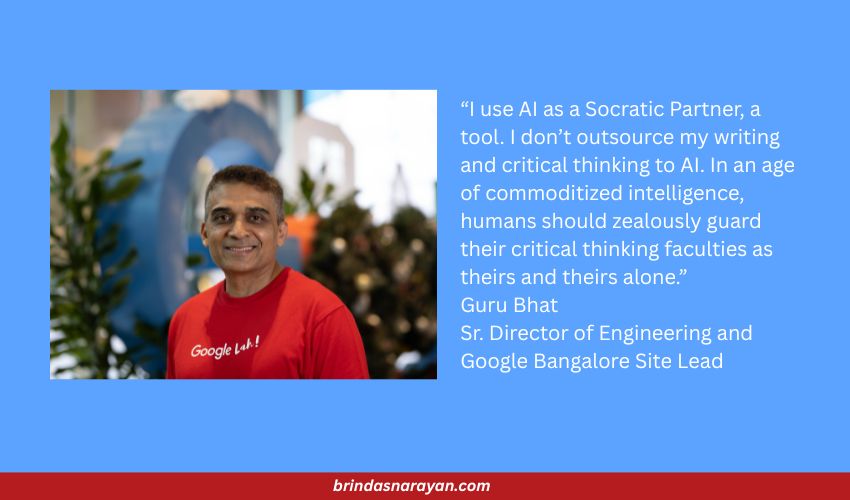
Most interestingly, and he acknowledges that this is a personal choice, he does not use AI to compose LinkedIn articles or emails. He does not outsource these tasks to others either. As he observes, “Writing is an expression of your personality. The amount of mischief or pathos you insert builds your identity.” Even in the office or in other circles, he notices folks becoming artificially eloquent on LinkedIn or social media, but stymied for words, when you meet them in person. He worries that such writing can lead to a loss of authenticity. “You feel like you really don’t know the person anymore.”
Guru himself relishes wrangling with words, composing playful, whimsical poems. To celebrate Administrative Professional’s Day, he wrote a poem for the admin staff. One of its verses reads:
“With an unusual caveat I will start this ditty
No AI has been used in writing this – not even itty-bitty
How, you ask, could I resist the charms of amazing Gemini?
Because, to express my heartfelt gratitude, I don’t need AI”
For his other work, which involves building AI infrastructure, he’s learning to use AI more effectively, roping in AI tutors to teach him. He thinks of these tools as a Socratic thought partner, to deeply understand what his team does and assess future needs.
As a Cultural Omnivore
Besides “The Rest is History”, he also listens to the “The Rest is Politics”, the Lex Fridman podcast, that ranges across a wide swathe of topics and the NPR show, “Wait, Wait … Don’t Tell Me.” Another fave is “Car Talk,” which has two brothers, both MIT alums, diagnosing defects in callers’ cars. He tunes into “Freakonomics” as well as “The Economics of Everyday Things.”
Given his abiding interest in history, “Through Line” is another go-to, which places current events in the context of their deep past. For instance, he recently listened to an episode on “Clickbait”, learning that the phenomenon started with William Randolph Hearst and yellow journalism.
Favorite web-series include “Breaking Bad” and “Better Call Saul.” He watches a lot of film noir with his wife and daughters and the occasional action movie, alone. He’s an avid reader. He’s currently reading “AI Snake Oil” by two Princeton researchers who wrangle with AI’s possibilities and limitations.
What It Takes To Get Hired
For young adults, who are uncertain about building job-worthy skills, he suggests adopting a hybrid route: to learn deeply about a particular domain, grasping fundamentals that lead to higher levels of abstraction; and master AI tools to creatively plumb or reshape the domain. He’s insistent that all work should not be blindly outsourced to AI, which has to be wielded as a cognitive partner, so that the human user retains agency and judgment.
He thinks too that work will fundamentally change and new jobs will be created by higher levels of abstraction made possible by AI. He notes that certain fields like mechanical engineering, where physical human effort is still required, are seeing a revival.
Big Takeaways from Small Talk
Then again, that undergraduate banter might have helped in other ways. Accustomed already to the diversity at KGF, he relished learning about people. He recalls, even in micro-interactions at Mysore, like with tellers at a bank, he would be invited to their homes while other students would be treated as faceless customers. Peers wondered why he received such preferential treatment. “When they were counting out the notes, I would be asking, ‘Where do you live?’ or ‘How many kids do you have?’” His interest in their lives was reciprocated by affection and an interest in his.
This is a trait that lingers into his Google days. Though his title flashes a formidable seniority, all kinds of folks accost him as they would a friend: security guards, cafeteria workers, admin staff. It’s not surprising that they know his name, but it’s telling that he knows theirs.
What a nice write-up about an equally nice person – Guru. I met him through our children who were classmates in school. It seems like I have known Guru forever and yes, he has an immaculate memory for people and names. Whenever I interact with Guru, its like we never missed a beat even if the connect happened after an extended period of time, sometimes years as both our children have finished college and are doing their own things now. I am very motivated now to catch up with Guru in person at the next opportune chance I get. Until we meet again soon….