



The Bittersweet Aftertaste of Aspirations
The Costs of Ladder Climbing
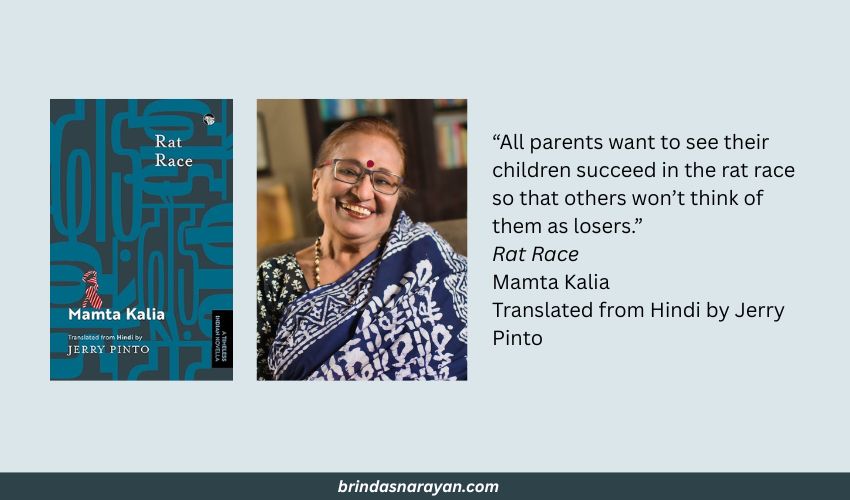
What does success entail for hordes of aspirants in the new India? What does it bestow and what are its emotional costs on families tugged by competing forces: the comforting rhythms of ancient rituals versus the gush of material goodies and new-age experiences? In “Rat Race”, the Hindi author Mamta Kalia charts a perennial ambivalence that characterizes a people in flux.
Three Letters That Recast Lives
The novel’s protagonist, Pawan, moves out of Allahabad, a fading place from a capitalist perspective. He too pursues those three magical letters – “M.B.A” – that transform the lives of many. This is now the aspiration, especially of the academically-inclined and privileged castes. Reputed institutions draw in strivers and the already wealthy, mingling brains with capital.
Starting Out at the Lesser Known
After pursuing his MBA at IIM-Ahmedabad, Pawan lands a position in Gurjar Gas, since a bout of dengue had obstructed a more sought-after MNC job. To combat his internal disappointment, he convinces himself of being in “touch with the real India, working the salt face of commerce.”
Big Ideas, Modest Plates
Ahmedabad (or ‘Amdavad’) embodies the ongoing contradictions that characterize Indian cities. The place houses the nation’s most prestigious management and design institutions, but its eating joints proffer restrictive Jain menus. The promise of future abundance – because surely an IIM-A grad will land a hotshot job? – collides with cues that when it comes to consumption, maybe less is loftier?
Lighting Up Home Enterprises
The flood of single working persons in the city also sparks opportunities for “Aunties” – women ranging in age from 25 to 55 – who rouse up meals for these too-busy professionals. Home-based catering businesses are a lateral spinoff, and ensure that younger workers, whether male or female, no longer need to cook.
Nostalgia for a Flavorful Past
Inevitably, in the new city, Pawan misses Allahabad. He can only dredge up its positives now. That’s what nostalgia does, it erases the negatives, softens the complaints. It’s the current habitat that falls short in some manner or the other. For instance, the vegetables are larger, but insipid. Tomatoes taste like “NRI tomatoes.” As the author notes, “Vegetables were the new jeans. They were becoming globalized.”
A cultural program organized at the Gujarat University campus draws a massive audience of 15,000. Bhimsen Joshi’s meditative taans are blared across immense screens, but folks wander off, every now and then, to buy crunchy Uncle Chipps and frothy Pepsis.
Pawan can’t help recalling how Allahabad’s much smaller “Mehta Sangeet Samiti’s hall” would be packed with an intensely attuned audience, all nodding their heads, all mesmerized by Joshi’s emotive vocals. Once again, a reminder that bigger is not always better. In the big city, even music performances suffer from the dwindling of collective attention. That wasn’t the case in Allahabad, which still displayed “a fine appreciation of classical music.”
Absurd Targets, Real Stresses
Newbie MBAs are often given absurd targets or impossible products. His friend, Sharad, sells shoe polish when most adults are wearing sneakers or chappals. The MD berates him, asks him to interview cobblers. Truth is the cobblers are using some cheap, street-made polish and filling the competitor’s tins with this. So it’s not like the competitor is selling either. But will the boss heed such excuses?
Marriage and kids don’t make lives easier. Rather, they impose different strains. He meets a couple who seem strung out by their hectic days. The wife, who had given up her job to raise their son, regrets her foregone career. The husband, in the process of crafting an ad to sell toothpastes, seems to meet an inordinate number of pretty models. This irks the wife, who questions the ethics of advertising. He’s emphatic that he didn’t attend IIM-A to examine the moral underpinnings of a corporate job: “I can still sell a dead rat, that’s my skill.”
Corporate Gurus Fill Modern Voids
Money helps, no doubt, in facilitating a certain ease. But it can’t answer deeper existential questions or fill internal voids. Like many others, Pawan is attracted to a corporatized Guru whose well-orchestrated program feels like a necessary reprieve. The event, systematically arranged, with a large parking area, huge tents and a flapping pandal manifests the much-bandied scale and efficiency.
While the Swamiji, who used to be an erstwhile personnel manager, talks about loving all in neutral-accented English, Pawan glances at well-heeled fellow seekers, with mineral water bottles and mobile phones peering from pockets. In the midst of chasing secular targets, they troop here for meaning. They differ from the faithful in Allahabad, who are usually from lower income groups, displaying the “simple faith” of the unlettered. But Pawan can’t convince his Dad to follow the new Guru: “These Godmen can turn bhakti into a capsule that can be swallowed.”
The Familiar No Longer Fulfils
When he returns home, on fleeting visits, he’s annoyed by little things. Reality can never measure up to an idealized past. Eventually, Pawan finds a partner with minimal parental involvement, a career woman who chooses to stay at Rajkot while he transfers to a shiny MNC job at Chennai. Clearly contemporary marriages no longer entail cohabitation. When his father expresses misgivings, Pawan urges him to relinquish old-fangled thoughts: “Everything you like seems old to me: old films, old songs, old buildings.”
Measuring the Immeasurable
Wrestling with the pangs of Pawan’s parents and other empty nesters, the book seems to ask if such separations – parents from adult children, husbands from wives – are worthwhile in the end. It takes a novelist like Kalia to tote up an emotional balance sheet, with a clear-eyed view that not everything can be accounted for.
About the Author:
Mamta Kalia, who writes primarily in Hindi, is an author, teacher and poet. She has won numerous awards, including the prestigious Vyas Samman for her work, Dukkham Sukkham.
References
Mamta Kalia, Rat Race, Translated from Hindi by Jerry Pinto, Speaking Tiger, 2026