



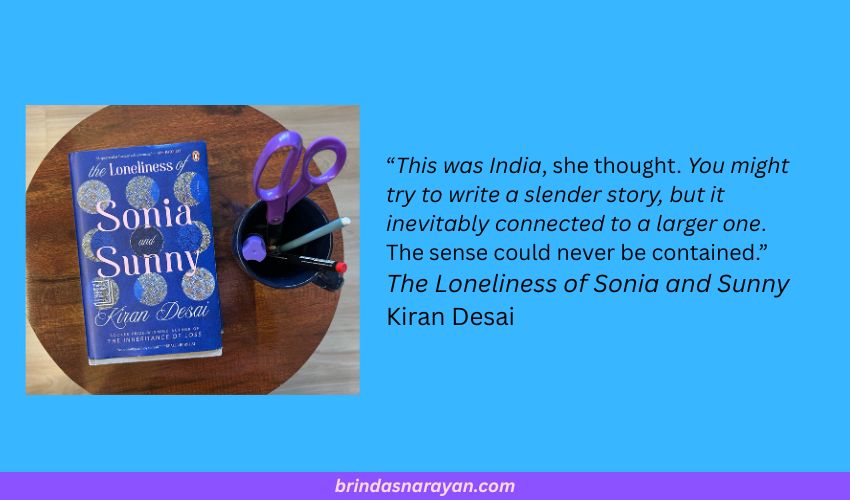
Sinking – Joyfully – into ‘The Loneliness of Sonia and Sunny’
In The Loneliness of Sonia and Sunny, Sonia Shah occasionally dwells on the joys of swimming. Of ducking underwater into a staid pool or eddying ocean, feeling one’s limbs and torso melt into a soothing nothingness. Reading Kiran Desai’s 670-page tome felt akin to being immersed in a water body, tugged by currents that keep life’s mundanities and vexations at bay. So I didn’t just read this book, I binge read it, an act that feels curiously heroic in our hyper-distractible era.
A Universe of Many Worlds
This sprawling book (and I’m not referring merely to its physical heft) roves across places – Allahabad, Delhi, Goa, New York City, mountainous Landour – and lives, tracking the arcs of modern migration and a globalized world. Big themes play out in its main characters’ lives – in Sonia’s and Sunny’s – in interconnected and disparate ways. Such weightiness is engendered by millions of observations, micro-moments that both writer protagonists – one an aspiring novelist, the other an AP journalist – accumulate in notebooks. Through them, Desai accords us with a peek into her process, into the painstaking grind that undergirds literature and art.
Depicting India’s Plurality
With an incisive and deliberately shifting eye – she’s attuned to how a narrator’s gaze can prune and alter scenes – she captures the myriad, pluralistic sensibilities that make up our nation. Bringing to mind a long-ago TED talk by Chimamanda Adichie about “The Danger of a Single Story”, Desai, in her languorous, meditative fashion, reinforces that India can never be reduced to a single anything: religion, language, culture, point of view. The allure and terror of this country will always lie in its complexity and diversity, its obdurate bulging out of various boxes.
Loneliness in Many Forms
Set more than two decades ago, and spanning 20 years, its characters respond to 9/11 in assorted ways – not just, for instance, with shock and awe, but with tinges of schadenfreude – evoking a recent and familiar history, a shared past in which readers can embed their own memories. But this is not just about how we’re all together, but how we’re differently and richly alone.
Reflecting on the varieties of loneliness, as the title suggests, it’s also a rumination on relationships. Not just romantic ones, but also other byzantine connections that we forge with each other – as mothers and sons (obsessive, Oedipal, problematic, absurd), as fathers and daughters, as friends, as exes and neighbors.
Crossing Cultural Fault Lines
Sunny Bhatia, who lives mostly in New York, embodies the contradictions of global Indians. Privileged at home, relatively indigent abroad. A champion of human rights in the US and in other foreign terrains, cunningly (or conveniently?) less so at home. Almost giving in to his Delhi mother’s fetish for a white daughter-in-law that she can show off to parochial locals, he starts dating Ulla, and feels vaguely proud of their union bouncing off the mirror. Of course, there are cultural differences. Ulla struts naked inside their apartment, and nonchalantly enters the bathroom while he showers. All this takes Sunny some getting used to, even as he wonders how much his love is play-acting and how much is real. Can they – as his friend, Satya, implies – never fight as “real” people, indifferent to their races and nationalities?
An Abusive Liaison
Some of this befuddlement – Who am I? What do I really want? – is shared by Sonia, whose relatable loneliness in her wintry, liberal arts college, propels her into the arms of a much older, self-obsessive, abusive painter, Ilan. Even as her own sense of self shrinks to a point of vanishing, he feeds off her misery and subservience to produce his paintings. Reminiscent of the “art monster” conjured by Jenny Offill in Dept. of Speculation (2014), Ilan offloads the grunge work – the groceries, cooking, house cleaning – on Sonia, while he single-mindedly pursues art and his well-being.
Match Made on Earth
In the meanwhile, their Indian families clumsily try to arrange a meeting between Sonia and Sunny. The arranged rendezvous doesn’t occur, and their charming first encounter involves a book. Sonia reads on a train while Sunny struts past, inquisitive as a fellow-reader would be, about the book’s title. (Psst, it’s Snow Country by the Japanese author, Yasunari Kawabata.) Naturally, this gives him an inkling about Sonia’s readerly sensibility. From thereon, the book meanders through their occasional trysts and long spells of separateness.
They almost seem made for each other with their cosmopolitan characters, their sentimental attachment to and detachment from India, their estrangement from all places like other jet-setting “anywheres.” Their families might possess upper middle-class airs, but heritage properties have been sold, assets dwindled and they heave the sighs of the one-time rich. Sunny’s mother, Babita, is crass about seeking status and money, exuding a kitschy Delhi sheen, while Sonia’s mother dons a bookish superiority that cleaves her marriage.
Shattering Rules, Subverting Tropes
Attuned to both averting and deploying tropes and stereotypes – the story of a younger woman abused by an older man, arranged marriages, exotic landscapes, magical realism as a feature of Orientalist tales – Desai spells out the “Rules” and then cheekily breaks them. These “Rules” are dictated by the authoritarian Ilan to Sonia (who might be an alter-ego of the author), and whose work feels like revenge against her one-time tormentor.
Though for the large part, this is a realist novel, there is a smidgen of magical realism in the form of a demonic dog that seems to emerge from Ilan’s art. But if reality carries an illusory quality, perhaps the lines separating art and life are always hazy? Sonia wonders if life is leeched of its substance for art, is anything left to be simply lived? While that is a question for writers and artists to ponder, there is another posed to readers: “when Dickens is better than your life, then why live your life? It would be foolishness not to read Dickens instead.”
One could well make the same argument for reading this vast, intergenerational saga. Burrowing into its pages is a pleasurable form of loneliness.
References:
Kiran Desai, The Loneliness of Sonia and Sunny, Penguin Random House India, 2025