



Resurrecting a Voice Ignored by History
Addressing History’s Blind Spots
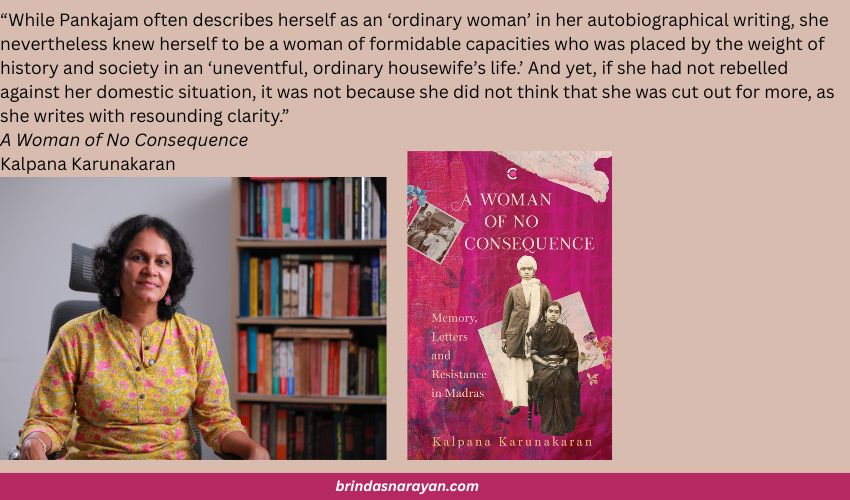
Reading A Woman of No Consequence by Kalpana Karunakaran was revelatory in many ways. As someone who was never drawn in by stodgy textbooks filled with quotidian facts about rulers and battles this felt like a shard of history that was truly compelling. An account that depicts the extraordinary timber of an ‘ordinary’ life. After all, I’ve always wondered about childhoods in those device-free days, and marriages and teenage dreams. What books did folks read? What games did they play? What were their forbidden desires? How did joint families stifle or liberate them?
Inheriting a Grandmother’s Tales
The life story depicted here, in vivid and stunning detail, revolves around Pankajam, the author’s grandmother. Though she bequeathed a trove of essays, letters and stories in a box labeled “My writings for Kalpana”, Pankajam prefaces her part autobiographical and part auto-fictional narratives with an emphasis on her own ordinariness: “I’m not a poet, a writer, a great social worker or even a society lady.”
A Poetic and Polite Restraint
Reading her pieces feels like an ironic rebuttal to her modest appraisal of her self-worth. Besides an exceptional mind and wide-ranging intellect, she possesses a psychological sharpness and metaphysical outlook. She’s also clear, in her writings, that she doesn’t intend to bare all like Gandhi did in his diaries. She’s conscious about preserving the secrets of others.
Cultivating Her Inner World
Who then is Pankajam? Born in 1911, and admitted late to school, she had already taught herself to read and write in English. Later, wrenched from formal learning before she could complete her board exams, she vows to never neglect her mind. As Karunakaran puts it, “She is acutely aware that women, consigned always to their bodies, are forbidden a life of the mind or a cultivation of the intellect.”
An Unslakeable Thirst For Books
Though she was never permitted to attend college, she retained a remarkable wonder about the world and her place in it. Hers wasn’t a normal curiosity. It was akin to the thirst experienced by the perennially parched. When she entered the bookless home of her husband, Sivaraman, she picked up anything she could lay her hands on, including engineering tracts and insurance books, the latter from a brother-in-law who ran an insurance business.
Exploring Diverse Girlhoods
Earlier, she had soaked up George Eliot, Jane Austen, Charlotte Bronte, Louisa M Alcott, tales from the Puranas and those of Sita, Sati and Savitri. She was so affected by Little Women, she recounted later that it had shaped her behavior. She thought of her own household as being like that of the impoverished March family. After all, her family too experienced financial struggles. She aspired to be like various characters in the book: “I tried to live up to the ideals in the story.” As Anne Boyd Rioux says in Meg, Jo, Beth, Amy – “What Little Women did so well was to show readers there was not one way to be a girl or to grow into womanhood, but many ways.”
Contending With Life’s Blows
Though Pankajam was a “free-spirited girl” who climbed trees, rode horses, constructed make-believe worlds, and engaged in perilous adventures with snakes and jackals, her home life was strained. Her mother, endowed with a fierce and frustrated intellect, was depressive and prone to epileptic fits. Moreover, Pankajam’s dear and devoted younger brother, Raja, died early of typhoid. All her life, she bore the scar of his sudden departure. Another younger brother passed away in infancy. This left the animated and sparky girl, who was explicitly neglected by both parents, to her own wits.
Amma Prods Her Learning
Fortunately, her mother, Subbalakshmi, was intent on getting her daughter educated. She wanted Pankajam to become a doctor. But her husband and his older brother staunchly opposed this plan. So she dispatched Pankajam to Madras to attend the Lady Willingdon School and Training College of Madras.
Education for women was confined in those days to learning a vernacular language, some English, arithmetic, “hygiene and needlework.” They were precluded from Science and Mathematics. The purpose of their learning was to become clever companions to men. Authorities were afraid of “academic pride” seeping into women, and obstructing household duties. They were expected to pass on “timeless values” to their kids, rather than pursue careers of their own.
Becoming Bolder at School
Pankajam’s school years constituted the six happiest years of her life. She became confident and a leader. Joining in class one, she was soon double promoted to class three. She loved the library and read two books each week. She thrived in sports like rounders, badminton and volleyball. She was so active in all spheres, including theatre, she was awarded the moniker “Drama Pankajam.”
Later, she would be recognized by Captain Lakshmi Sehgal, who headed the women’s regiment of the Indian National Army and was touring Madras with large crowds milling to see her. Captain Sehgal crossed a barricade to hug Pankajam, exclaiming: “Drama Pankajam.”
Not Happily Ever After
In her stories, Pankajam seemed to express sentiments that she could not have vented in real life. Like her fictional character Meena would retort to her thatha’s injunction that women ought to be self-effacing: “But one need not be self-effacing, thatha. Why can’t a husband also be self-effacing and gentle? Why is a man not asked to be dutiful to his wife?”
Despite her innocent teenage fantasies, her husband characters are a major letdown. They are intensely indifferent to their wives, selfish and greedy. And unmoved by books or lofty ideas. Moreover, the men in her stories were always cautioning women to not be too “westernized.”
In her husband’s joint family, Pankajam seems to have taken to her tasks with remarkable felicity. She loved taking care of kids, dressing them, feeding them, so they all became her fans. But she sorely missed her books. Gradually, her husband started withdrawing from her, requiring her to seek solace elsewhere.
In another story, she lays bare how horrific the marriage was. Her husband constantly had sexual relations with maids, with the knowledge of his wife. And occasionally engaged in “transactional sex” with his wife to satisfy his lust or perform his conjugal duties.
Motherhood as a Joyful Payoff
One of her elsewhere joys was parenting her five children, whom she adored as one would little deities. She read books on parenting, eager to do the best by them. She transmitted her wide curiosity to her kids. She home-schooled her two youngest children, Sundaram and Mythily till Grade Five. She was wise enough to gently persuade her adolescent kids rather than impose her will on them. All along, her husband was not just aloof, but openly resentful of any happiness she experienced. And was constantly trying to wreck it in some way.
When Drudgery Can’t Dim Her
She also engaged in other pursuits: for example, she got into bird-watching with her mother, using E C Stuart Baker’s book, The Game Birds of India, Burma and Ceylon.
She eventually visited New York, London and Montreal, a reprieve from her household duties and her intense caretaking of her ailing mother on shoestring budgets, given how miserly her husband was. In another touching short story, she shows us how the drudgery and constant work never leave the “Indian type of mother”, not even on her birthday.
Gleaning a Specific Knowledge
In A Room of One’s Own, Virginia Woolf wrote that since women writers were often confined to their “sitting rooms”, they were more attuned to characters and their feelings and to the make-up of relationships. In other words, they did not know as much about the wider world as men did. Joanna Russ, literary critic, makes the case that Victorian women did not know less, but knew other. “And if women did not know what the men knew, it was just as fair to say that the men did not know what the women knew and what they did not know included what the women were.”
Well-read and Well-loved
Despite lacking a formal college degree, Pankajam remained a wide and deep reader. Works she had read and summarized in her notes included Werner Heisenberg’s Uncertainty Principle, Surendranath Banerjee’s History of Indian Philosophy, Carl Jung’s Transformation of Libido, Julian Huxley’s Religion without Revelation, a dialogue between the historian Arnold Toynbee and the Buddhist Daisaku Ikeda. She also zealously kept up with Science, wanting to extend beyond the liberal arts curiosity exhibited by her mother. She read up on quarks and on Einstein’s theories, on black holes and colliding galaxies. She also copied poems from her favorite poets, including Tagore, Walt Whitman, TS Eliot, WH Auden and Sarojini Naidu. She writes in an epitaph, inspired by Whitman’s Song of Myself,
“I bequeath my flesh to the fire
I bequeath my bones to the dust and earth
I bequeath my spirit to the eternal spirit
If you want me, look for me in a tiny bird
If you want me, look for me in the splendor of sunsets
Look for me in the distant stars
That stand sentinel and witness to passing time
And wink at human frivolities
If you want me, look for me
In the love I left behind.”
About the Author
The author Kalpana Karunakaran teaches at the Department of Humanities and Social Sciences at IIT, Madras. Her scholarly work revolves around gender, microfinance, poverty alleviation and women’s work among other topics. She’s also currently the President of the Indian Association for Women’s Studies. As the daughter of Mythily Sivaraman, a feisty activist and feminist, Karunakaran has also authored a Tamil memoir, Comrade Amma: Magal Parvaiyil Mythily Sivaraman ( Comrade Amma: A Daughter’s Portrait of Mythily Sivaraman).
Earlier, Sivaraman had written the biography of her grandmother, Subbalakshmi. Perhaps, Mythily saw her mother, Pankajam, as being too accommodating, despite facing various intimate and systemic pressures. However, while the public facing Mythily was often agitating on behalf of Dalits or workers or women, her daughter was being raised by Pankajam. Today Kalpana appreciates the manner in which Pankajam navigated various forces and retained her voice, noting that women can choose their “feminisms.”
References:
Kalpana Karunakaran, A Woman of No Consequence: Memory, Letters and Resistance in Madras, Context, Westland, 2025