



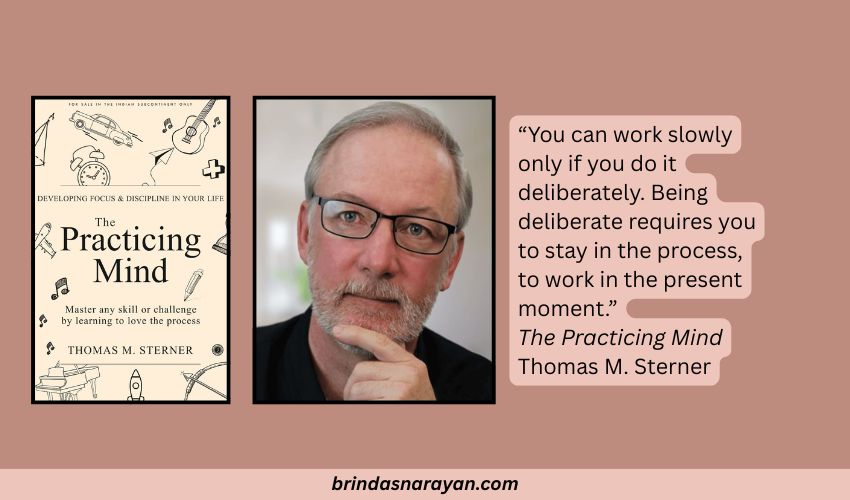
Finding Joy in Practice
Early Exits in Childhood
When he was just 4-years-old, Thomas Sterner started learning to strum the guitar, persisted for two years and then stopped. At 9, he kicked off piano lessons. This time, he stuck it out for only ten months. The grounds for his abandoning these activities might sound relatable to many, both children and adults: “…and the reason for this was that I really didn’t enjoy practicing.”
Working on Staying
Many of us would assume that such reluctance to master anything difficult is a universal condition and thereafter accept our own retreats from various endeavors. But not Sterner, who as an adult embarking on golf lessons in his early 30s, decided to attend to the “process of practicing.”
Big Pivots in His 20s
Prior to this, he had already started overcoming his childhood diffidence with taxing routines. In his early 20s, his life was already reshaped. Learning piano from a brilliant older player, he stuck with it till he was able to play professionally at clubs. He also absorbed Eastern contemplative traditions at college, and decided to become a concert piano technician and restorer.
One String At a Time
His new profession demanded intense focus. A grand piano has 8000 to 10,000 components, and 225 to 235 strings, each of which has to be tightened or loosened, so that the whole vibrates in tune. As Thomas puts it, “Working on a piano is repetitious, tedious and monotonous, to say the least.”
Thinking About Shots
But it was golf that propelled his meta tinkering with “practice.” At first, he was expectedly clumsy at the game. But he was surprised that many veterans on the course weren’t playing substantively better.
Hacking One’s Methods
When it came to his own improvement – which felt much steeper than that of his peers – after each class, he dedicated an hour to practice the techniques taught. Then, back in his car, he made notes of key points. At home, in his basement, after family time, he replayed 100 to 200 swings, watching himself in a mirror. He headed over to the course three times a week, to whack balls across uneven natural terrains. Unlike his childhood abhorrence of “practice”, such repetitions felt calming. Golf even felt necessary to contend with the strains of his intricate piano tinkering.
Do the Daily Work
Beyond learning golf, he gleaned takeaways about practice. To clarify what he implies by the word “practice”, he defines the often-used but rarely-expanded term: “When we practice something, we are involved in the deliberate repetition of a process with the intention of reaching a specific goal.” The problem with any form of practice, especially as adults who are running out of time, is we focus on outcomes or goals. Such an outlook not only depletes pleasure, it also saps our energy.
Chasing False As
It also affects school-going students, who are judged by flawed grades, rather than by lasting takeaways from various classes. For instance, Sterner used to struggle with Math, to the point that he dreaded the subject. But perhaps, all along, his grades had misled and deflated him. Later, as an adult learner who watched high-school pupils in a music theory class, he realized that students game systems to garner grades. In the process, they leave with a poor grasp of the material.
Not Just Results
Such willingness to cheat systems seeps into workplaces. In the 70s and 80s, American manufacturers were overtaken by the Japanese in automobiles, electronics and even in pianos, since the latter emphasized processes over outcomes. When a curious piano retailer visited a Japanese plant, he asked a worker how many piano plates he made each day. The worker responded: “As many as I can make perfect.”
When Satisfaction is Earned
Even if shortcuts trim the time taken to achieve something, we may be robbing ourselves of the exhilaration that follows real effort. Once, when Sterner was keen on quickly getting his first car, his Dad cautioned him: “You are going to find out that buying the car is much less satisfying than working for it.”
After the Acclaim
The larger question that we need to ask ourselves, he says, is even if we achieve enviable mastery in a domain and garner social recognition – an Olympic gold, a Booker prize, or a science Nobel – we would have to climb the next mountain, however we define it for ourselves. In the movie, The Natural, an older baseball player returns to the game after an injury, which affects him again. When he ruminates with his girlfriend about what could have been – maybe he could have broken many records – she asks, “And then?” It’s a question we often fail to ask ourselves, even as we strive for the next shimmery award or object.
Always Becoming
High performers in any domain – be it in the Arts, Sciences or Sports – know that there is no point at which we can claim to have reached “perfection.” As Sterner puts it, “Their idea of perfection is always moving away from them; it is always based on their present experience and perspective.”
Not Quite Contented
For instance, when Sterner was 19, he had made a challenging list of milestones he wanted to cross musically, in the next five years. At the age of 22, he stumbled on the forgotten list, and discovered that he had already reached those goals. But this was the paradox: “I didn’t feel any happier with my music or any better as a musician.”
Four S Words for Any Practice
In general, to improve our ability to practice anything, he suggests we use four S words – simplify, small, short, slow.
-
-
- Simplify: If we’re tackling a large task or complex project, we should break it up into smaller tasks or sub-activities. Let’s say you want to clear a massive desk drawer, you can divide it into 10 sections.
- Small: Focus on one small activity or portion at a time. With your drawer, you can tackle one section at a time.
- Short: Clean for 10 minutes every day till it’s done.
- Slow: Work at a slower pace, so you pay attention to details.
-
Life as a Practice
Such close observations and a conscious reorientation towards the process rather than to outcomes shifted Sterner’s mindset to any kind of practice: “I not only loved to practice and learn anything but found the total immersion of myself into an activity to be an escape from the daily pressures of life.” Broadening his takeaways from the mastery of specific domains – like music and golf – into life at large, he suggests that we live in order to practice.
References
Thomas M. Sterner, The Practicing Mind: Master Any Skill or Challenge by Learning to Love the Process, Jaico Publishing House, 2017/2025