



Idlis to Poha: Breakfasts of Urban India
Different Toasts for Different Folks
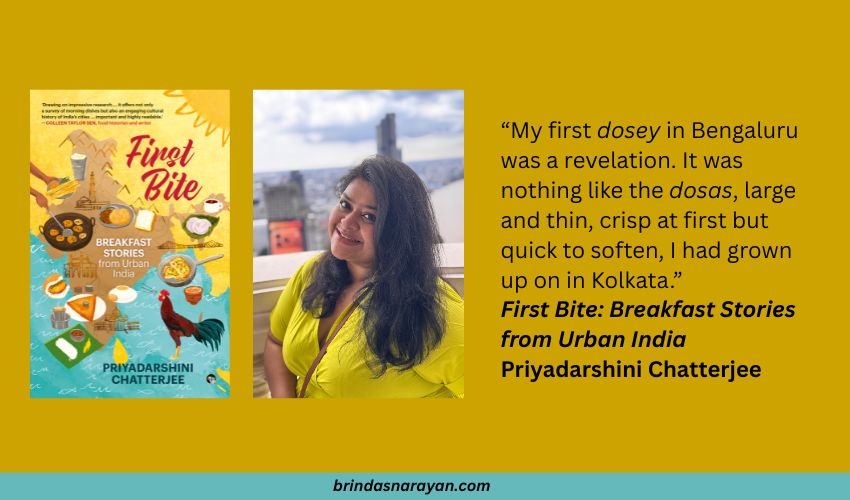
The cocktail party question used to be: are you a mountain or beach person? But we also inhabit different temporal zones. We can also ask: are you a breakfast or dinner person? The working class rarely has a choice. Farmers, construction workers and domestic staff rise before stars ebb from sight. As Priyadarshini Chatterjee writes in “First Bite”, breakfast is a “repast of the working proletariat.” As it is for joggers, walkers and other fitness freaks. At the risk of being lumped with the dull and square, I admit to being a breakfast enthusiast.
Trailing Morning Meals
Chatterjee accords us a glimpse into how fellow breakfast-eaters fortify themselves for backbreaking labor or office slogs. Since most socializing is centered around lunches and dinners, the author’s multi-city tour illuminates a meal that is seldom heeded. She doesn’t just delve into what’s eaten where, but also into how breakfasts have evolved over time, and into their sociocultural makeup: “who has to wake early, who cooks, who eats out early in the morning, and why.” The book, which entailed two years of roaming across cities and scholarly dives, charts displacement, migration, the spinoffs of imperialism and market economies, the advent of public eateries.
Parathas With No Limits
Such journeys often begin at home. Since her in-laws are Punjabi, she has always been fed a range of stuffed parathas. Besides cauliflower, aloo, radish, she has watched leftovers being flattened under rolling pins: “It’s not an exaggeration to say Punjabis can make parathas out of everything – “
Baking Breads and Communities
But in the city of Sri Harmandir Sahib or the Golden Temple, the homemade stuff is less appealing than “bazaar da Khana”. Wandering inside the labyrinthine bylanes of Amritsar, she observes cylindrical clay tandoors bake parathas and kulchas into a precise crunch or softness. In earlier times, these public ovens served as community sites, akin to flour mills or neighborhood taps. Guru Nanak had even championed the “sanjha chulha” or common oven, where women could gather and shatter caste taboos.
The Laborious Making of Kulchas
Even in the contemporary city, the tandoors are fired by 6:30 or 7 am, and run till about 4 pm. An iconic kulcha place, visited by Anthony Bourdain and recommended by the Michelin-starred Vikas Khanna, is aptly named the “All India Famous Amritsari Kulcha.” In this roadside dhaba, the flaky flatbread has four men working on it. One stuffs the dough, another pats it into discs, a third places it in the tandoor and retrieves it, while a fourth slathers it with butter and crushes the edges. The end result is a layered, textured, buttery bread, soaked in chole. The city is also known for its storied dairy tradition, for its thick yoghurt (especially slurpy lassis), milk, ghee and distinct chaa (tea).
A City of Generous Portions
As Chatterjee observes, “Amritsar is all about largesse – large-hearted people with a rapacious appetite for food flush with excess – quite like a bowl of flaming orange gur ka halwa, rich with jaggery and ghee, served piping hot on frigid winter mornings in the city.” For those who want to know, the most mouth-watering gur ka halwa is sold on a cart, wheeled by a wrestler named Gora Pehlwan.
The Theatrics of Faith
If Amritsar exudes buttery bounty, Varanasi embodies an ascetic sparseness. Of course, some of the asceticism in the Gangetic city is hilariously performative. In this place, as Chatterjee writes, “spirituality and corporeality coexist at such propinquity.” On the city’s famed ghats, amidst Veda-chanting boys and squabbling priests, a paan-chewing guide leads foreign tourists towards young, bare-bodied river splashers. On sighting the tourists, they raise their hands and shout a synchronized “Har Har Mahadev” – repeatedly on cue, till all snaps are taken. “The tourists are amused, a few of them exhilarated even.” Exemplifying how locals covertly jeer the camera wielders and Instagrammers, the guide returns shortly to pay his faithful actors.
A Kichdi of Cultures
In the temple city, breakfast, called “Kaleva” used to be relatively simple and low-calorie. Even today, many eat raw fruits and veggies in the morning, especially cucumbers. Reinforcing the city’s monastic practices, eateries are designed around specific foods at specific times. Varanasi, as Chatterjee reminds us, is not just sacred for Hindus. It’s also a Jain tirtha, and significant for Buddhists, who visit the proximal Sarnath. Muslims have been central to its famed weaving tradition.
Reminiscent of annakshetras (charitable kitchens) that fed migrants, today’s crowds gather by the Kichuri Baba Temple. Tourists, pilgrims and beggars wait for kichuri (kichdi) in leaf bowls. A myth circulates about Siva emerging in the lingam form from a plate of kichdi. Earlier, Varanasis munched on sohals (a fried snack) with mooli chutney. Now, there’s a plethora of breakfast options. Ranging from idlis to Korean kimchi to the Jewish shakshuka (eggs poached in tomato). Apparently, Israeli Jews constitute a significant chunk of the foreign population. Many head here after their compulsory military service. As The Times of Israel put it in an article, “It is almost the norm for soldiers, on leaving the IDF, to fly to India to decompress.”
But the OG Varanasi breakfast, according to Amitabh Bhattacharya, an academic and journo, is chana or Bengal gram. It’s soaked overnight and eaten in the morning with jaggery and ginger. “Being satisfied with little is a recurrent theme in Varanasi’s way of life.”
Sharing Doseys Sans Divisions
Bangalore, which spawns startups, billionaires and a host of food options, has stayed remarkably faithful to its South Indian breakfast staples. “It’s also not unusual for Bangaloreans to trek across town for their favorite dosey or the softest idlis and ‘best-in-the-world’ filter kaapi, its bold, delicious aroma an assertive nudge out of sleep.” Such easy morning camaraderie was not always the norm. Historically, caste sequestered eaters into separate spaces.
As the Kannada litterateur D.V. Gundappa writes in his memoirs, to eat at Venkanna’s, a joint run by a Brahmin, one had to show one’s vibhuti before entering: “The moment he saw us, Venkanna asked: ‘Are you Brahmanas?’ ‘Yes.’ ‘Did you finish your bath?’ ‘Yes.’ ‘Why is there no vibhuti on your forehead? There, it’s there in that box. Apply it.’”
Even as new-age Brahmins might abjure such markers, caste and other divisions linger in the IT city. Sharing a “dosey” can blur some differences. If it’s yummy enough, even the night owls might join in.
References
Priyadarshini Chatterjee, First Bite: Breakfast Stories from Urban India, Speaking Tiger, 2026