



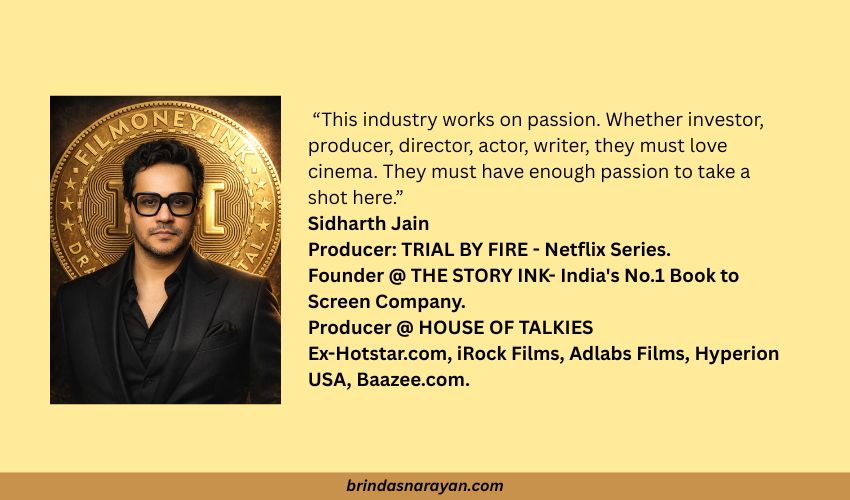
Sidharth Jain: An Alchemist of Stories
When a Story Finds Its Audience
For Neelam and Shekhar Krishnamoorthy, June 13, 1997 was a day that cleaved their lives into a Before and After. On that day, Neelam had booked movie tickets for her kids – Unnati (17) and Ujjwal (13) – to watch Border at Uphaar Cinema. After waving them off, the couple were to never see them alive again. A fire broke out at the theatre and snuffed out 59 lives, while injuring many more. Spirited Unnati, who had been headed to college soon, and playful Ujjwal, a choir singer, were among those tragically asphyxiated.
Many years later, Sidharth Jain, who had by then forged over 200 book-to-screen deals, encountered the couple after reading their harrowing account in Trial by Fire, published by Penguin India. This project felt different. This didn’t feel like his other book deals. The parents had turned their anguish and anger into an unbending purpose: to take the various guilty parties – the builders, theatre owners, various government authorities – to court. To punish those whose slipshod operations had squashed their kids’ dreams. Sidharth wanted to do more than bring the book to screen. He wanted to produce the show and ensure a fitting remake.
In January 2023, Netflix released Trial by Fire, starring Abhay Deol and Rajshri Deshpande. Interweaving accounts of other victims and families with the authors’ court battles, the series won a Best Series (Critics) award later that year. More than anything else, it held its viewers in thrall. To Sidharth, this felt like a payoff. After all, many years ago, he had plunged into the swirling currents of Bollywood, sans family connections or friends in the business. Into an industry that was famously close-knit and leery of outsiders.
Tracing the Story Maker’s Steps
Sidharth, who had grown up in Mumbai, always had an affinity for stories. As an overweight child, with an equal fondness for food, he always had his nose stuck in comics or books. After rifling through Tinkle, Amar Chitra Katha, Asterix, Tintin, Archies and Richie Rich, he was equally tugged by history and literature. Unlike his peers, he was stuck in libraries, even during short school breaks. Stemming from a North Indian business family that dealt in home furnishings, he hadn’t seen a future in stories. Like any bright teenager, he chose to pursue Science in Junior College (equivalent of 11th/12th Grades).
A Dalliance With Markets
When it came to his Biology practicals, he told his teacher that as a Jain, he was unwilling to dissect a worm or a frog. The teacher said, “Then if you want to just stare at my face, you can please go home.” Since the Bombay Stock Exchange was just behind his house, on the way home, he stumbled on share issue forms fluttering on the pavement. Intrigued by these sheets, he traced their flight path, and chanced upon a stock market trading course at the Indian Merchants’ Chamber. Enrolling for the course, he started trading in stocks at the age of 16. While also poring over books on share markets. While still at college, he turned INR 2000 into a thrilling INR 2,00,000. Enthralled by the wizardry in finance, he planned on being an investment banker.
Hooked on Lights and Cameras
But after an MBA in Finance and eight years of stock market trading, the excitement had dimmed. Attuned to the fizz surrounding dotcom companies, he founded Bollywoodauction.com which was acquired by Baazee.com. The latter was sold to eBay, granting him the money and freedom to pursue something else. Heading to Los Angeles to visit a filmmaker friend, he found himself stirred by the sights and legends of Hollywood. Making several trips thereafter, when he heard that Aamir Khan was in LA to promote Lagaan, he helped forge connections with Academy members.
Carrying Craft Across Continents
Feeling drawn to the razzle-dazzle of showbiz – “you stay in fancy hotels, you eat fancy foods” – he returned to Mumbai with a truckload of books on Hollywood’s history, on scriptwriting and production and the mechanics of filmmaking. He even conceived of a Bollywood/Hollywood project, starring Salman Khan and a Hollywood actress, and lined up to produce this offbeat international collaboration. As Sidharth puts it: “And that’s how my journey into the film business started as a producer without really knowing what it means to be a producer.”
Birthing India’s First Script Shop
Thereafter he joined Reliance Adlabs for a short stint. By 2008, he sensed that one of Bollywood’s glaring gaps was the availability of committed, full-time writers. Most screenwriters were poorly-paid hustlers who needed day jobs to pay bills. Resolving to plug the void, he started an enterprise that hired copywriters and journalists, infusing the team with the know-how he had gained from Hollywood on “development, writing structures, how to take an idea and convert that into a script.” The seed capital for the venture was granted by Manmohan Shetty, by then a well-known media veteran.
Described as “Bollywood’s first script shop,” iRock Films hired 60 to 70 writers, churning out a plethora of scripts and stories. Sidharth even signed a deal with Mills and Boon to mine their library for Indian adaptations. The team released India’s first zombie graphic novel in 2011, titled “Zombie Talkies: Bloodfest in Bollywood.”
Spawning a Cult Horror Hit
One of their well-known creative projects was Ragini MMS I, co-produced with Alt-Balaji, a paranormal film that deployed found footage to add an eerie realism to gruesome events. The relatively low-cost project – about INR 50 lakhs – generated a staggering box office return of INR 20 crores. It was also the film that launched the versatile Rajkummar Rao, who later won a National Film award and starred in the Oscar-nominated Newton.
Claiming Early Ground in Digital
After striking commercial success, Sidharth was keen on telling genre stories with a youthful bent. Traditional film studios were uninterested. Before streaming was widespread, he started toying with online options. Given how small the industry was, when word spread about his digital forays, Hotstar reached out. Being launched by Star India as a mobile-first digital platform, the team was keen on Sidharth hopping aboard. Joining Hotstar in its early days, he was part of the team that shepherded its climb to over 200 million views and to its diffusion across geographies.
From Bound Pages to Moving Pictures
After two years with the large media company, Sidharth wanted to be an entrepreneur again. By then, streaming had mushroomed across platforms and there was a thirst for original stories. Having always been a keen reader, he recognized that the nation already had rich, untapped material bound up in books. But most Bollywood producers and creative teams lacked the time or inclination to read. So Sidharth launched “The Story Ink” to scan books for adaptable narratives.
Since its founding in 2018, the company, which bears the title of being “India’s No. 1 Book to Screen Adaptation Co,” has represented more than 300 authors and screenwriters and struck deals for more than 250 books. Sidharth, however, is keen on expanding his horizons again. With cinemas emptying out, he spots an opportunity for films that can draw audiences back to their popcorn-munching days. He observes that Bollywood’s creativity was stifled by over-corporatization. After all, professionals with hyper-algorithmic or data orientations, rarely ferry the fervor that can ignite originality.
Reigniting Theatres with Hits
Keen to produce a wide swathe of stories – like that of a city boy who returns to his Bihari village to grow strawberries – Sidharth is fired up with a beginner’s zeal. Gathering funds from cinephiles and high-networth individuals (HNIs), he’s confident about surprising audiences with unexpected magic. As he puts it with a broad grin, “I’m always very optimistic about the future, I’m very overconfident all the time.” Coming from someone who landed four different jobs without a resume or formal interview, his rose-coloured view feels well-founded.
Guard Authenticity to Stay Original
To would-be storytellers or filmmakers, he suggests they explore their roots to find original stories. “If somebody’s from Kolkata and somebody’s from Patna, you’ve grown up in two different places, different environments. What the Kolkata person doesn’t have is your days in Patna, and what the Patna person doesn’t have is your days in Kolkata.” To preserve his own creative juices, he shields himself from watching too many shows or films. He listens instead to many non-fiction podcasts and watches informational videos on YouTube. As he puts it, “I like to create my own stuff and not be influenced by what’s already been done.”
References
https://thestoryink.substack.com/p/house-of-talkies