



When Gods Too Will Leave
The Weight of Many Worlds
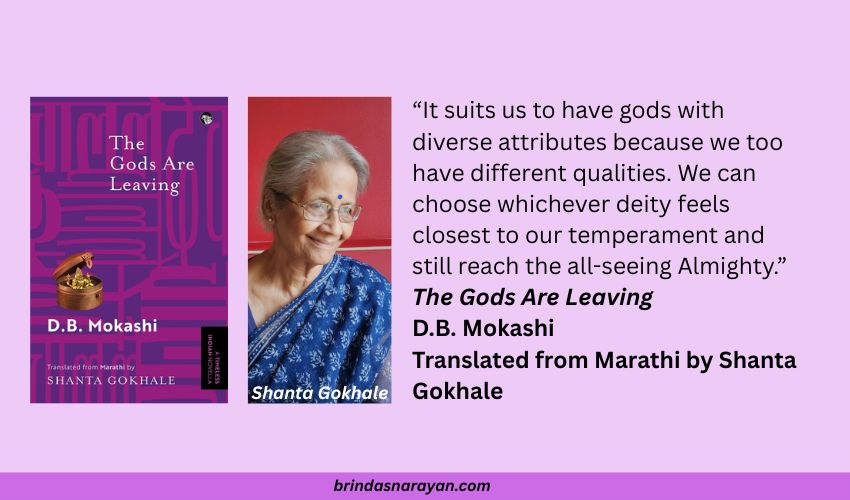
When humans migrate, what do they ferry? Sometimes nothing, sometimes trunk loads of essential goods. But almost always, their ways of doing and believing, their faith and their gods. In The Gods Are Leaving, the Marathi author D. B. Mokashi sketches a village family in transition. Originally published in 1961, the novella – reissued in a fresh, stirring translation by Shanta Gokhale – depicts the tugs between modernity and tradition, between pragmatism and otherworldliness.
Never Too Old to Desire
The Joshis had lived in Palasgaon for over 300 years. Now, however, the younger generations have fled the village home, which is occupied solely by the elderly Kaku. As a child-widow without offspring, Kaku had formed various attachments at her in-laws. At one time, to a younger sister-in-law, then to that sister-in-law’s kids. With her nephews having grown and moved to dispersed city lives, she’s aged inside an aging house. Her only companion has been the family idol, Narahari (a depiction of Vishnu in the Narasimha avatar) flanked by a cluster of other gods. But she’s worn out by the rituals, by the everyday lighting of lamps that her mother-in-law had tutored her in. “It seemed to her now that she had done nothing else but that all her life. The sheer futility of her existence rose before her, vast as the sky.” So she writes to Abba, the oldest of four brothers, to take the gods away.
When Gods Depart, Heirs Return
The gods are a central presence in the decaying home. Their impending displacement draws back the four brothers.
Four Brothers, Different Destinies
Ramu, who resents his impoverished existence in the city, is jealous that Abba, only older by two years, is much better off. Shouldn’t Abba feel obliged to help him? Despite his indigence, Ramu still has faith in Narahari, and wonders fleetingly if he should carry the god to his home. Would that alter his fate? How would he fund various rituals that the idol’s presence warrants?
Jaggu, a younger brother, is relatively blithe and carefree. While he soaks up familiar village sights, the earlier ties that used to draw him in – his parents, his friends – have vanished. When he walks into the village square now, nobody calls out. Kids stare at him as they would at a stranger. The idyllic village scenes that used to move him earlier – “the lotus flowers, the temple, the azure sky” – don’t evoke the same feelings anymore. As he walks by the home of a past infatuation, he’s surprised by the girl’s transformation. “Namu had changed – changed completely. She had become a woman. Matronly, wilted with widowhood.”
Naru, among the four, is least attached to the village. Not to his past in the place or to its decadent present. He’s bored and can’t mask his unconcern and disgust. When recounting memories with Jaggu, of somersaulting on a red dhurrie, he says: “People say we live on our memories. But by and large memories are a pain. Remembering old sorrows cloud today’s joys; remembering old joys intensifies today’s sorrows.”
He’s also quick to dispel Jaggu’s romanticized view of the past. Festivals that seemingly brought gaiety to the family and village, heightened their parents’ debt. But despite distressed circumstances, Jaggu intuits that “their father had been happier than they were. He had faith.” This perhaps is the pivotal question that the novella revolves around. What is faith? How does it take root in some and elude others? Why does it seep differently into members of a family? Jaggu wonders if his doubts also shrivel his happiness.
Archives Can’t Save The Present
Abba, the oldest, has an academic bent. He’s researching the family history, tracing times prior to their settling into this village. He plans to discover the original Konkan village from which their ancestors set out, intends to cart the gods back to their source. But the past alone cannot lift up the present. His own childhood memories are imbued with delight, diving into rivers, watching bullock-cart races, marking time with seasonal festivals. But his city-bred children are bereft of such joys. He’s not consciously granting them a buoyant, vivid childhood. “The thought disturbed him profoundly.”
Dwelling Among Liminal Greys
Writing soon after the nation’s independence, Mokashi captures shifts inside one-time village families, as migrant lives acquire distinct shapes. The four brothers no longer share the rapport of children. Their conversations are marked by awkward pauses, unspoken animosities, and memories that are shared but dissimilar. It’s Jaggu who can look at situations from multiple perspectives, blotting the lines between wrong and right. “As a result, nobody is my enemy and nobody is my friend. That is a sorry state to be in. I simply cannot see eye to eye with people who raise flags and want to run the world according to a single idea.” It’s a kaleidoscopic point-of-view that more humans would do well to adopt in our sharp-edged, divisive world.
Translation at its Finest
Beyond the narrative itself, the translation by Gokhale feels like an act of care and craft. I don’t know Marathi, but I feel like I’m hearing the cadences and rhythms of the original work. Take this passage on the flow of a typical day/night: “Tea was drunk. The afternoon was done. The evening would come. After the evening, night would come, and when the night ended, there would still be the morning to get through. None of the brothers knew what to do with the time between afternoon and morning.” The punchy beginning – like their busy city lives – ends with a languorous line that mimics the brothers’ inactivity in the dull village. One can hear their yawns and jaded silences. To preserve not only the essence, but the shape and length and bounce of Mokashi’s lines requires faith in literature and culture. It’s a devotion that might keep the gods home.
References
D.B.Mokashi, Translated from Marathi by Shanta Gokhale, The Gods Are Leaving, Speaking Tiger, 2026.