



Growing Up With God and Fear
Raised Within Doctrinal Walls
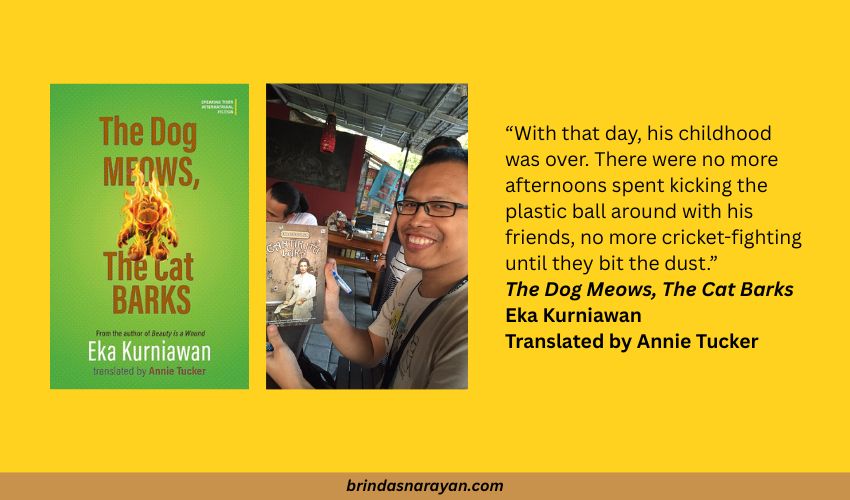
What does it feel like for a child to grow up in a fundamentalist household? Especially with an authoritarian parent who will not brook dissent or disobedience? Will everyday acts of enraged submission lead to a future eruption? Sato Reang, the 16-year-old protagonist of “The Dog Meows, The Cat Barks” offers one such account. Of being raised in an Indonesian Muslim home, with an imperious father who hovers over his enforced piety.
Thinking Forbidden Thoughts
When he was much younger, Sato did not raise questions. Like his father and grandfather and great-grandfather, he believed that it was inevitable to spend his hours “studying prayer and recitation.” But even if his speech and actions were policed, his thoughts could not be surveilled. At the mosque, he would think of all else he could do. Fun things like swim in a stream, steal fruit from a truck, ogle at wedding singers, relish pigeon races or cock fights. Clearly grownups did not think kids deserved such unholy pleasures.
Playing Pranks, Skipping Prayers
Inside the prayer house, he could barely mask his mischievous instincts. Yanking off the sarong of a boy in front, or banging his head against someone’s butt, so that the whole waiting line of worshippers tumbled into a hilarious heap. Sato wasn’t devout then. “At least not until I turned seven.”
Piety Carved Into the Body
At 7, he was led into a clinic for his circumcision. He worried a bit, but not too much. His friends, after all, had their foreskins snipped off and they seemed fine. But inside the doctor’s room, he got the chills. Was this going to hurt a lot? He didn’t know then that “infidels” did not get circumcised, that he could have opted out. Before he knew it, it was done. He was not sure if they used a knife or scissors or a heated sliver of bamboo. Then his father issued a menacing fiat: Sato was to “become a pious child.”
Insect Battles, Tiny Joys
Yet, out of his Father’s sight, his spirits surged. He engaged with friends in “cricket fights”, watching the insects thrash it out with opponents. Crickets were starved or fed chili peppers to make them fiercer. On the battleground – a tiny mud pit – a cricket would lose a limb or its antennae or its entire head. In the midst of such riveting clashes, his father would interrupt with an aggravating “Go to the mosque.” At such times, he envied boys who didn’t have to show up for prayers.
Rules That Ruled His Time
His life started feeling like that of a soccer ball – he was pushed around, kicked here and there – and he always had to give in. Asked to go to the mosque, asked to go to school, asked to brush his teeth, asked to wake up early, he had no autonomy: “The world I lived in was like a never-ending nag.”
The Thrills of Kicking Balls
Sometimes Sato and three friends kicked around a soccer ball in the prayer house yard and ignored summons to step inside. He relished his freedom, even if cursory. “The past was over, boring. The future was thrilling, mysterious, and I often contemplated it – but more than anything, I wanted to be the master of my own present, because I was right smack in the middle of it.”
The old men in the prayer house read the Quran, their voices murmuring in unison. Outside, the boys persisted with their boisterous play, crashing and kicking with gusto. The men prayed for God to open their malevolent hearts. But it felt like the Devil had already taken them.
Fun Ends With a Slash
Once, Sato’s father appeared with a machete. He punctured the ball with the blade, sawed it open. “Ever since then, Sato Reang had felt like he was a plastic ball that had been split in two.” The agony shot through him each time he saw another ball, or a prayer house or mosque. When he went home – where else could he go? – his father flung his sarong at him and asked him to pray.
Imprisoned at Home
His father would sit on the sofa and supervise his recitations, yelling “Wrong” and breathing hard, when he made mistakes, which was often. Sato wondered what his life would have been like, if his father didn’t pray, if mosques did not exist, if he didn’t have to be pious.
Each morning, he was aroused at 4 am by his father’s hard pounding on the door. What if he could sleep in like his friends till about 5 minutes before school? After following his father to the mosque in the wee hours, his days were punctuated by prayer: “Time never flowed freely – my time was torn to shreds, five times a day.” At school when other kids discussed soap operas, Sato couldn’t chime in, because he’d never watched them. Never been allowed to since they didn’t even own a TV set.
Even A Picnic Is No Picnic
One day, when his Father ferried the family to a “picnic”, Sato was super-excited. He wondered if there would be rides or outdoorsy activities. But they traveled only to a larger mosque, in another town, where other tourist buses were assembled. Sato was crushed.
Resisting the Pious Crowd
Jamal was the pious other kid who didn’t watch TV, and Sato didn’t want to be his friend. When Jamal summoned him to the school mosque, an embarrassed Sato complied, in case his refusal was reported to his father. In high school, it got worse, because Jamal was seated next to him. On Saturday nights, when Sato was seated behind his father on the bike and driven to the mosque, he heard taunts from friends: “The prayer house gang.” “The pious kid syndicate.”
Childhood Wins Are Scorched
Sometimes Sato went to the night market. Once he won a stuffed monkey at a ring toss game and planned to gift it to his little sister. But his father set it on fire with a cigarette lighter. When he wanted to get a girlfriend, as a friend pointed out, what was the point? “Something had started to burn inside my soul – though it was small, still just a spark. Had that spark come from my little sister’s stuffed monkey getting set on fire?”
How Tyrants are Bred
The end to such tyranny, unfortunately, often requires the death of the tyrant. Similar releases may be sought by victims of all kinds, whether the abuse is located inside families or inside organizations or structures. Tyrants give rise to tyrants. Given that the world is currently keeling under the diktats of a few, we would do well to delve into their psychological and social makeup. And glean perhaps that “good parenting” – is there such a thing? – is not about raising a compliant, pious kid. But about permitting a child to think its way into being.
Should Everyone Matter?
The work also raises a more profound question. Do all human beings – given how infinitesimally inconsequential we each are – have to leave a mark on the world? Why? Sato literally pisses on the idea. You will have to read it to find out how.
References:
Eka Kurniawan, The Dog Meows, The Cat Barks, (Translated by Annie Tucker), Speaking Tiger, 2026