



When a Death Reveals a City’s Faultlines
Tugged Into Menacing Currents
It’s possible that the River Thames, that slices London into a distinct North and South, has lexical links with the Sanskrit word ‘tamas’. For those who don’t know, tamas represents inertia, lethargy, darkness. Regardless of its etymological roots, the Thames embodies a mixture of dark and light. In earlier times, its banks bustled with activity. When Britain was a colony, loads of goods extracted from other countries used to land on its shores. While tea, cotton, spices and silks sailed into its ports, its perilous currents sucked people into its depths.
Even after all that colonial commerce had sputtered to a stop, or after the city’s manufacturing hub had given way to the sedate gloss of a financial capital, the river continued to tug folks in. Suicides, murders, accidents: money or its sheen could hardly thwart morbid urges.
Complex Probe of a Teen’s Death
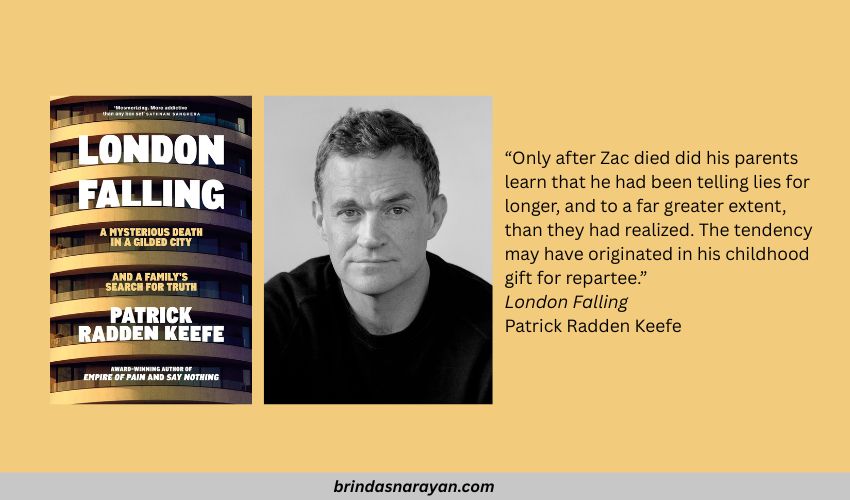
“London Falling”, a vividly reported non-fiction narrative, starts with a body plunging into the Thames. Nineteen-year-old Zac Brettler, is captured by an M16 surveillance camera across the river, as he leaps from the center of a balcony into the murk below. The apartment he jumps from, Riverwalk, is an ultra-luxury complex, inhabited by folks who keep their identities masked: Russian oligarchs, drug dealers, Middle East royals, the who’s who of an underground network with tentacles in various institutions, including Scotland Yard.
His parents, Rachelle and Matthew Brettler, are regular professionals. While Matthew works in Finance, and Rachelle is an art and culture journalist, they aren’t the kind who can afford that multimillion dollar lifestyle. So how did Zac get there and why did he jump to his death?
The Secret Lives of Teens
Naturally, when the kid’s shirtless body is found a few hours later, with his jaw broken, the numbed parents scurry into the rabbit hole of what-exactly-happened. An investigation that is both aided and not by the police and ends up being much thornier than expected. They are left in the end not just with grief and remorse, but with anger and frustration. Why is their son’s case being hushed up or carelessly handled? Besides, it’s not just about what transpired on that particular night, but also who their son was. As Keefe puts it, even Anne Frank’s father, who lived in such proximity with his daughter inside their hideout, claimed to be surprised by her diaries later. Can any parent really know what is going on with their kids’ lives, especially as they morph into autonomous teens or young adults?
Zac Fakes His Fortune
Zac was charismatic, the sort of person who got along with people of all ages. He was admitted to Mill Hill, which was considered a lesser school than the one his brother made it into. In this place, Zac could skate by with minimal effort.
In the mid-1990s, many Russians – Putin’s enemies, assorted oligarchs – had fled to London and many of their kids studied at Mill Hill. Zac was enticed by their money and swagger. “But Zac was coming of age not just in a city that was drunk on foreign lucre but in an era of social media.” He watched War Dogs and aspired to be like Efraim Diveroli, a former arms dealer and fraudster, whose real life machinations inspired the movie. To start making money, Zac sold stuff on campus – trainers, clothing, cigarettes. Around then, relations with his family had started becoming strained.
Mixing With Shady Sorts
What they hadn’t realized was that Zac had started living a double life. He presented himself as a Russian billionaire’s son, changing his name to Zac Ismailov. And hanging with unsavory characters, like Verinder Sharma, a gangster and drug dealer. Or with the flamboyant Akbar Shamji, a crypto dealer who dabbled in real estate, someone who projected an aura of wealth but was saddled with debt. Such pretensions were acquired from his father, Abdul Shamji, who tried to rebuild his empire in the UK after his expulsion from Uganda under Idi Amin. Except that Shamji’s edifice was always a house of cards, with shell companies nested inside shell companies, and trusts owning trusts, so no one could pinpoint who or what they should recover their money from.
A Grandfather With a Double Life
When Rachelle would later reflect on what else she could have done, she couldn’t help spotting bizarre patterns in her family. Her father, Hugo Gryn, a holocaust survivor, had arrived in the UK as a young teen. And hoisted himself to evolve into a highly-respected, polymathic Rabbi in their Jewish community. Later reports would reveal that he hadn’t really studied at Cambridge, as he had earlier claimed. More hurtfully, his family would discover that he had fathered a daughter with a member of his congregation, with whom he had an ongoing, covert relationship. But Hugo had died before Zac was born. How could a dead grandfather transmit his duplicitous traits?
A Mother Reckons With the Past
Besides, Rachelle grew up with “benign neglect.” She had lacked the motivation to apply to college. At 16, she was mainly hanging out at pubs, listening to punk rock bands. When was she unsure of what to do next, her parents offered no roadmap or guidance. They could have figured she was good at design and art. Instead, they suggested she learn typing. Nonetheless, she had forged a decent career in journalism. Perhaps, she assumed such distancing was inevitable or even healthful.
When Enough is not Enough
But parenting, to me, is not the core element in this narrative. Rachelle and Matthew were “good enough” parents, like most. What’s disturbing perhaps, is the unabashed pursuit of money for its own sake, that has started seeping into the city’s teenagers. And this is not just a London phenomenon, but a global one. When social media and peer influences signal that “wealth” or rather “ultra-wealth” are badges worth wearing at any cost, it can lead many other teens to pursue Zac’s path. After all, while not being immensely wealthy, Rachelle and Matthew are comfortably off. Why did this stop being sufficient for their boy? It’s no longer about what money can buy, but how your bank statement shapes your identity in unsavory ways. Paired with the Netflix show, Adolescence, the book reminds us that social forces can overwhelm well-intentioned families. Whether you’re an anxious parent or a concerned citizen, read this as a warning.
References
Patrick Radden Keefe, London Falling: A Mysterious Death in a Gilded City and A Family’s Search for Truth, Picador UK (Pan Macmillan), 2026