



Of Minds That Reached For Stars
Human Biases In Science
The history of science is littered not just with opaque, esoteric findings, but with baser human emotions. With petty rivalries, with racist and sexist biases, with lab politics, with suppressions, omissions and concealments. In other words, with material that would delight a playwright, perhaps more so than a historian. Scientists from the Global South have had to contend with another layer: imperialism.
A Revelation at Sea
Given that “Science” is thought, problematically of course, to have originated solely or primarily in the West, its Asian, African and Latin American practitioners have had to wrestle with an imposter syndrome. Few accounts illustrate this more strongly than that of Subrahmanyan Chandrasekhar, who had set out at a formative 19-years-old on a ship-borne voyage to Cambridge University. Rather than frittering his time gazing at inky waters, he turned his sights to starlit skies. And formulated what would be known – much later, too late in fact – as Chandrasekhar’s limit. At a massiveness of 1.44 solar masses, he intuited, stars would no longer submit to the trajectories of smaller stars (like our sun) that cool into white dwarfs when they die. Rather, these monstrous stars, would be tugged too intensely by their own gravities and collapse into neutron stars or black holes.
A Nobel Awarded Too Late
Many Indians are perhaps familiar that it took Chandrasekhar 53 years to be eventually recognized with a Nobel Prize for his youthful finding. Having encountered this story awhile back in Csikszentmihalyi’s book on Creativity, I had long felt this would make a compelling movie along the lines of The Imitation Game, the film on Alan Turing. So it felt particularly gratifying to see it turned into a layered play that does not shy away from its complexities, whether those be of the subject or of its characters.
Bringing Chandra To The Stage
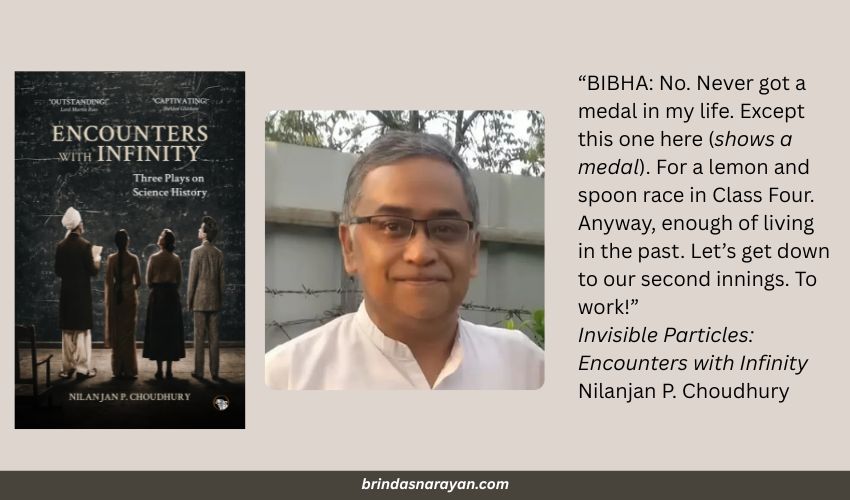
In an explanatory aside, the author Nilanjan P. Choudhury acknowledges his debt to the director, Prakash Belawadi, who brought the play to life on stage. Written in December 2015, “The Square Root of a Sonnet” was finally performed in September 2016 and “went on to have nearly a hundred shows over an eight-year period.” During rehearsals, that involved the playwright who had been cast as Chandrasekhar, the script was tweaked to ensure that the relationship between Arthur Eddington, the renowned British astronomer, and the Indian scientist was not reduced to a black-and-white villain-victim dynamic.
Physics Overtakes the Physical
The script also highlights the relationship between Chandra and his wife, Lalitha. Meeting her at college, for Chandra it was love at first sight. His first gift to her was emblematic of who he was: a book titled, ‘Atomic Structure and Spectral lines’ by Arnold Sommerfeld, inscribed with what he might have felt was an apt message: ‘To dear Miss Lalithambika Doraiswamy – yours respectfully, Mr. S. Chandrasekar, Madras, 1928.’ In an imagined conversation between Lalitha and Chandra in heaven, Lalitha observes with the wry amusement of the long married: “Did it ever occur to you, Chandra, that gifting a book on ‘Atomic Structure and Spectral Lines’ might not have been the best way to impress a girl?” One wonders though if Chandra’s first love was always physics and everything else, was peripheral, an accessory to his obsessive hunt for new theories.
An Unforgettable Put-down
As Lalitha remarks, after all those declarations of love, Chandra hardly wrote to her for six years, from Cambridge. He had contended with harrowing experiences there, no doubt, including Eddington’s public takedown of his discovery at the Royal Astronomical Society. After Chandra presented his paper – the brilliant, Nobel-worthy one – Eddington, his Professor and mentor, countered with an unexpected: “But the paper that you have just heard, the foundations of it are completely wrong.” And in what felt like one of the most hurtful assaults ever, the young genius witnessed his theory being ripped to shreds, moreover with jokes and mocking laughter. As Chandra puts it, “On that winter’s evening in January, my world had ended.”
A Doubter in the Family
For those who don’t know, Chandra was also the nephew of the Nobel-prize winning C.V. Raman. But records disabuse us of any encouragement from the latter for a nephew who possessed a standout genius. This line is based on an actual extract from Raman’s letter to Chandra: “I will never allow astrophysicists to step within one hundred kilometers of Bangalore.” Clearly the Nobel in any subject is not indicative of a recipient’s noble traits. As Chandra says to Lalitha: “There was never much love lost between us, anyway. Raman always thought of astrophysics as some kind of pseudo-science.”
The Allure of Nuclear Fame
But the play does not portray Chandra as a moral exemplar in all ways. Perhaps, no genius lacks blemishes, however lofty their achievements in particular domains. When the US was planning to make an atomic bomb to pre-empt the Nazis getting to it first, Chandra discloses his disappointment at not being included in the “Manhattan Project.” When a shocked Lalitha wonders why he would wish to collude in such large-scale destruction, he sugarcoats his ambition: “I am just a scientist. I am responsible only for my work and not for its consequences.” Chandra might have been excluded from the team for racist reasons, a situation that his less academic, but more astute wife accurately assesses.
Seeking Hidden Harmonies
In “The Trial of Abdus Salam,” another play in the book, the first Muslim physicist to win the Nobel Prize for his landmark unifying of two of the four fundamental forces – electromagnetism and the weak nuclear force – is subjected to an inquisition in heaven. Salam’s joining of these forces was foundational in forming the Standard Model of Particle Physics, and the Islamic world should have taken pride in their community member’s seminal contribution to science.
Unrecognized by the Islamic World
But, as Choudhury portrays this brilliantly through an anonymous “VOICE”, the scientist contended with tragic rebukes and criticism, especially from authoritative religious voices who accused him of heretical thoughts and actions. Though Salam tries to desperately explain to his bigoted interrogator that his work derives from the Quran, “Of the 750 surahs in the Holy Book, one-eighth of them speak of taffaqur and tashkeer – science and technology,” he is deliberately misheard or shut down. The play also highlights other pioneering contributions from the Islamic world to modern science and mathematics. For those who don’t know (confession: I didn’t), the algorithm is named after al-Khwarizmi, the founder of algebra.
A Particle That None Had Seen
Among the three plays, “Invisible Particles” is one of the most touching and infuriating. To briefly touch on the science, it’s about fathoming the origins of the strong nuclear force, which holds protons together inside the nucleus of an atom. Without this force, protons – all positively charged – would repel each other and fly apart. Which would ensure a vanishing of everything. Yet they don’t. On pondering this, the Japanese physicist, Hideki Yukawa proposed the presence of another particle, that would eventually be called the “meson.” While Yukawa’s paper stirred the scientific community, the meson hadn’t yet been detected in any experiment.
Two Women Lead the Meson Hunt
This inevitably sparked a race, a hunt for the elusive meson. Marietta Blau pioneered the making of photographic nuclear emulsions. This involved capturing cosmic rays – typically found at high altitudes – on photographic films. But just when her team might have been getting closer to something, she was hounded out, as a Jewish woman, from Vienna, when Germans occupied Austria. Her research was stolen by a partner and a male boss, while she had to settle for an unfulfilling teaching position in Mexico.
Another meson hunter was Bibha Chowdhuri, the first female postgraduate in Physics from Calcutta University. She scaled the Himalayas with Debendra Bose and they almost found a particle that resembled the meson. Their paper was published in the prestigious Nature. The particle’s mass, however, was lower than Yukawa’s prediction, so they waited, in vain, for more sensitive photographic films.
But They Are Scratched off The Records
The play highlights how the scientific work of women has always been invisibilized and how the Nobel prizes are driven – even in Physics – by politics and power rather than objective scientific merit. The play lays out the achievements of other women scientists who have been similarly diminished by scientific gatekeepers and by history. The roster includes:
- Lisa Meitner – co-discovered nuclear fission
- Madame Chien-Shiung Wu – Proved that parity is not conserved
- Hedy Lamarr – Created a radio guidance system with frequency hopping
- Emmy Noether – Made several mathematical contributions, including Noether’s theorem
- Vera Rubin – Came up with critical evidence for dark matter
Wonder As a Way of Being
Beyond exposing the hierarchies and injustices embedded into knowledge-gathering systems, these plays also remind us of a quality that no AI bot can truly feel: wonder. “Encounters with Infinity” reminds us of the infinite mysteries embedded in the natural world, in our galaxy and universe, and of how education across the globe ought to return to its original mission of inculcating awe in learners.
References
Nilanjan P. Choudhury, “Encounters with Infinity: Three Plays on Science History,” Speaking Tiger, 2026