



Mapping Hearts in Lucknow
Rewriting a City
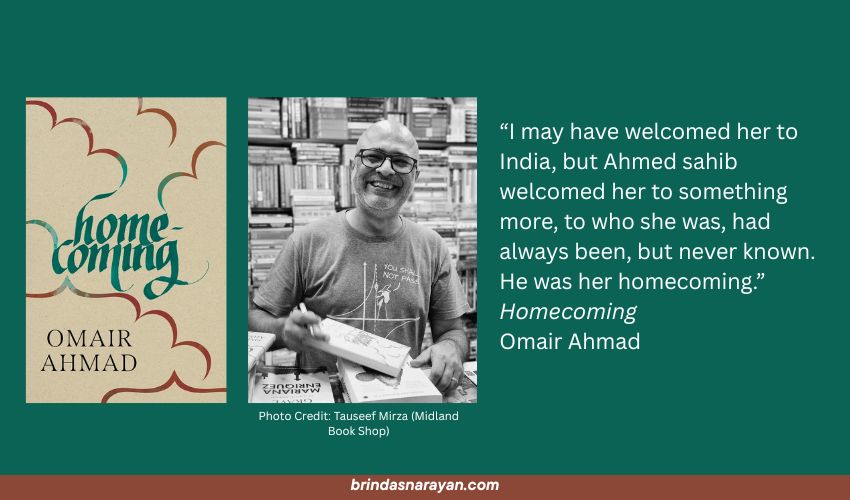
What does time do to a city like Lucknow? Not just to its monuments and crumbling havelis, to its byzantine alleyways and dusty markets, but also to its inhabitants who shape and are shaped by the City of Nawabs. In Homecoming, while sucking us into his characters’ twisty lives, Omair Ahmad also ferries us in and around Lucknow, into remnants of its past, and into its sad, alarming, protean present.
Displaced by Fear
Starting symbolically with the tearing down of a woman’s tomb, erected in 1871. Some girls were being taught there and rumors circulated about the emergence of an “unauthorized madrassa.” A lawyer who appreciated the city’s past had been asked to represent the monument. Now he too was dead. To Samina, a historian of calligraphy, who has been studying carefully inscribed quotes and verses across the living, dying city, the monument’s vanishing feels like a sign. For her to leave with the narrator, Hassan, to London, a city that will never fully be home.
Seeking an Unlikely Guide
But this slim, tightly woven novel doesn’t just center around Hassan and Samina’s love. Rather, it’s an ode to an intergenerational bond that defies conventional labels like ‘friendship’ or ‘mentorship’. It starts with the older man, Ahmed Sahib, being carted into Hassan’s dental clinic. Ahmed Sahib looks attenuated and shabby, but maybe it’s the pain. Yet he radiates a weathered abidance of everything, of the torturous instruments and procedures. At the end, he shamefully admits that he cannot pay the bill. Hassan asks him to guide him around the city instead and Ahmed promises to return.
Raised Without Roots
Hassan, whose Hindu father had forsaken his religion for Communism, and whose Muslim mother had abandoned them after bitter, acerbic feuds with her husband, lacks familial ties with the city. Or for that matter with any city. He’s indifferent to being called a “Madrassi” or a “Hyderabadi,” since he doesn’t feel any allegiance to either. All he has are memories: the one-time affection between his parents, their slow drifting into separate paths, his father’s fumbling with a family business, his alcohol-fueled dalliance with Urdu poetry. Sounds ricochet in Hassan’s head, of louder fights, of hurled glass, of “sharp barbed replies.” Ammi’s vanishing leaves a scar, a permanent wound, whose depths he hasn’t plumbed yet.
When a dapper Ahmed Sahib returns to the clinic and proffers his dues, Hassan is almost disappointed. Will he not fulfil the earlier promise, of escorting him around the layered city, a foray that feels strangely critical to the orphaned dentist? Fortunately, Ahmed Sahib intends to fulfil that end of the bargain too.
Looking for Lucknow
Their little adventure, across the dilapidated parts of the city’s historic core, include a foray into Ram Advani’s bookshop in Hazratganj. (It’s sad to note, as a reader, that this iconic bookstore, downed its shutters a decade ago, after the passing of its cosmopolitan owner.) They also crisscross into the small, a tailor that stitches shirts at a price cheaper than readymades, and into hole-in—the-wall outlets that serve lip-smacking kebabs and Chinese food. People always greet Ahmed Sahib everywhere. In that sense, Lucknow still feels like a small town.
They attend an all-night mushaira in a qasbah, a self-contained town-like community. Hundreds and thousands of poets gather there. In one of the first poems, a man says he’s a thief, betrayer, and faithless but at least he’s not a “Sarkari Mussalman.” This snarky line begets a standing applause from women in the front row.
Right through, Ahmed Sahib embodies the city’s famed tehzeeb. His unfailing politeness, so inbred, can occasionally feel like a façade. After all, can anyone, especially someone as impoverished and aged as Ahmed Sahib, remain courteous at all times? As Hassan concludes, “Lucknow was not a city of conquest, but courtesy, however hypocritical it might be.”
Voyaging Within
The physical journey is accompanied by a more significant internal one. Both men discover that they were deserted by their mothers. When Ahmed Sahib, with a gentle pressure on his arm, suggests that Hassan forgive his parents and himself, it’s like a dam has burst. “And at that I started truly crying, with the ugly hiccupping coughs of something broken within me that I had never allowed myself to acknowledge.” The conversation even prods Hassan into writing to his mother, not once, but twice. It bothers him less that he does not receive a response. The mere act of reaching out feels healing.
A Long Way Home
Moving between London and Lucknow, between past and present, the book brings to life other unforgettable characters: like the steely Begum Waheed, who stands up to her abusive father-in-law as her dead husband failed to. Or Ahmed Sahib, with his ardor for a young woman he met in the kothas, which were not merely brothels, but the epicenter of music, literature, arts and manners. Or Sam/Samina, who resurrects stories from the elegant dots, dashes, slanted lines and loops on gravestones, tombs, imambaras, and mosques. To take interest in the past is to bring it into the present, even if it requires a curated museum exhibit or a novel like this to spark interest in others.
In spite of spending two decades in Lucknow, Sam and Hassan are like interlopers to the city. But in soaking up its riches as only outsiders can, they also find an elusive, magical space inside themselves. Some might call it a home.
References
Omair Ahmad, Homecoming, Speaking Tiger, 2026