



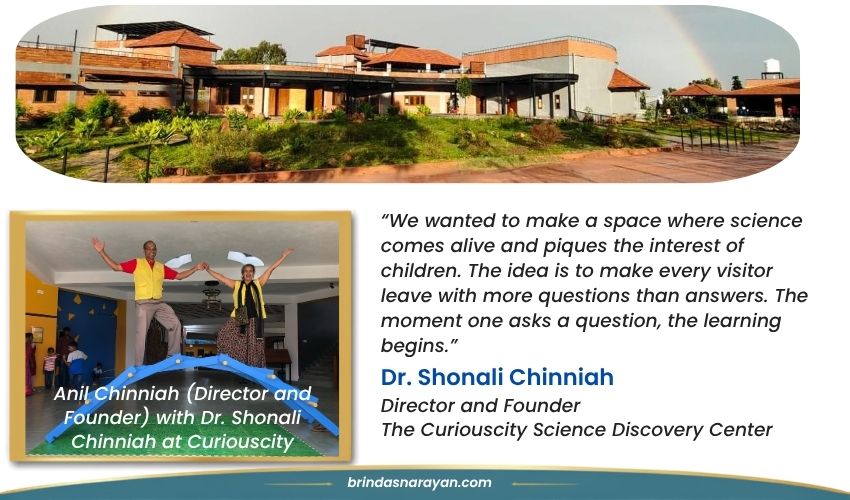
Sparking Curiouscity In Bengaluru
Journeying Into Wonder
Do you crave a break from binge-watching, doom scrolling or the ennui of malls? Would you rather dispel illusions, bend light, touch crackling electrical streaks, finger magnetic sands or solve escape room clues? Or if you’re a nature enthusiast, stroke turtles and guinea pigs, or trample across a fluttering carpet of butterflies?
You can do all this and more if you make your way to The Curiouscity Science Discovery Center, where grandparents, parents and wide-eyed little ones confront the makings of the universe and themselves.
On a lucky day, you might meet the effervescent, indefatigable Dr. Shonali Chinniah, Director and Founder of Curiouscity, and her husband, Anil Chinniah, also a Director and Founder. You might watch her ask a bespectacled 10-year-old, “Are these two squares the same color?”
When the kid shakes his shy head, glancing at his equally nonplussed Mom, Chinniah might counter with, “They’re not?”, her voice carrying a theatrical twinkle. “Shall I show you something surprising?”
The Makings of a Young Explorer
Shonali’s zealous mission to transmit the mysteries and magic of science might have been seeded early. Like her navy officer Dad, she reveled in rugged walks in the wilds. One cold winter morning, while trudging through marshy wetlands, she tripped on reeds and fell flat on her face. Her father and brother, walking ahead, turned back and laughed hysterically. Soon, her father too slipped into the sucky wetness: “I had the best laugh ever.” As she emerged from the trek, all blue and frozen, the men – jittery about her mother’s reaction – built a fire to warm her up.
Such fierce and intimate interactions with nature, plants and animals were woven into growing up. In their backyards, they raised chickens, turkeys and ducks. She watched duck and turkey eggs being slipped under the warm underside of a chicken: “This poor mama chicken would have turkeys and ducklings below her wings.”
Imbibing Her Mother’s Values
Besides her Dad, her mother too was a towering influence. Nomita Chandy had set up Ashraya to facilitate child-centric adoptions and establish creches at construction sites. Later, she created a center for battered women. She also founded the famed Neelbagh in Kolar, a rural residential school that achieved a 100% pass rate on board exams for the past 18 years with the children of migrants families and first generation learners, for which she was awarded a Padma Shri. Anil and Shonali have been doing science workshops with them every year, and financially support many children there.
Loving Biology, Hating Chemistry
Chandy’s focus on justice and equity was to linger with Shonali, even as she shifted across eight schools and many cities till middle school. In the 7th Grade, she landed at The Lawrence School in Lovedale, Ooty. Taking to the idyllic boarding school with the exuberance of Enid Blyton’s twins of St. Clare’s, she found Biology as enticing her nature rambles. But because of a deflating teacher, she dreaded Chemistry, often finding herself thrown out of class. This only reinforced a self-belief that chemistry wasn’t her forte.
Heading to Mount Holyoke
Later, while visiting Women’s Christian College in Chennai, she stumbled on a brochure for Mount Holyoke College in Massachusetts. Riveted by the glossy pics and liberal arts courses, she was thrilled to receive a full scholarship from the Seven Sisters institution.
Mastering Molecules at College
While intending to major in Biology, she could not skirt Chemistry altogether. Signing up for an Organic Chemistry course with trepidation, she failed her first exam. The professor met with her to ascertain what happened. Observing that Shonali was garnering As in all other classes, she found it confounding that organic chemistry was so taxing for her. When Shonali recounted her high school fears, the professor pooh-poohed her insecurities. Later, she passed the second exam, did exceedingly well on the third and topped the class in the final. She signed up for many chemistry classes thereafter, almost choosing to major in it.
Watching Teachers Teach
But the larger pedagogical takeaway was to stay with her: “A good teacher can make such a difference.” Right through college, a part of her always observed how things were taught, especially noting ingenious approaches to imparting science. Like how a professor set an inventive evolutionary exam that had students wade through the thinking of evolutionary biologists.
Heeding the Call of the Sea
One semester, she chose to go out to sea. The co-ed program on a ship involved six weeks onshore and six weeks offshore. The group sang sea shanties, climbed sails, learned maritime history, policy and ecology. Since she had always been sailing and swimming with her Dad’s naval stints, she was at home in oceans, ecstatic even among flipping whales and seals.
A Doctorate in Marine Ecology
Heading to Cornell for a Doctorate in marine ecology, she learned to schedule chunks of unstructured time. Studying the predatory impact of ctenephore, which are “comb jellies, jellyfish like animals,” she conducted her research off the coast of Seattle at Friday Harbor Labs, where Cornell had an association, with the University of Washington’s marine research station.
One of her most memorable moments was being asked to join her professor’s research, using high frequency sound waves to understand the sound signatures of animals in the oceans. She took several dives to the bottom of the Ocean in the Submersible “The Johnson Sea Link” and it changed her perspective of deep waters. They were not filled with fish. Rather it was vast emptiness broken with layers of invertebrates – krill, siphonophore, clione and brittle stars (this was two miles down, at the bottom of the ocean).
The Joys of Research
Most forays were on a boat. Once, when alone on a boat, a pod of orca whales followed in her boat’s wake. The orcas pranced along with her moving boat, jumping and breaching. “It was like my own private show. No phone or camera, just me and the whales. I should have been terrified, but I wasn’t. I was fascinated.”
Environmental research was fun in other ways. At Friday Harbor, which drew scientists from across the world, researchers biked together, collected blackberries, churned blackberry ice-creams and smashed volleyballs. Back at Cornell, she trampled across wintry hills in boots to conduct TA sessions.
Seeking New Adventures
After defending her doctoral thesis, she felt rather downcast. Till then she had a purpose, and suddenly it felt like a balloon had burst. Since she had been married the previous year, she opted to join her husband, Anil Chinniah, in Philadelphia and hunt for jobs there.
Choosing not to head to a postdoc, she applied to teach at a community college, or even, if she had to, to sell drugs for a pharma company. “I was traumatized by then.” On a whim, she visited the New Jersey Aquarium for a day, and spotted volunteer ads. Signing up, she was assigned to clean fish tanks, akin to the character of Tova Sullivan in the recent film, Remarkably Bright Creatures. “A Cornell PhD cleaning fish tanks,” she laughs.
Face to Face with Sharks and Seals
Like Tova, she too befriended creatures swimming inside glass enclosures, including a wary octopus that hid behind rocks till she lured it with food strings. Her fingers learned to evade biting nautilus and lionfish. Since the aquarium had a shark tank, she became one of the divers for their show. Her petite build drew the attention of kids, who wanted to dive: “When told it was only for adults, they would point at me.”
The Deep Blues or a SAP cubicle?
Relishing her dives, she applied to the aquarium’s rigorous seal program and was accepted. In the meantime, since Anil hoped to return to India, he suggested she apply for IT jobs too. She learned ABAP (SAP’s programming language) in a six-week course and was rejected from the first 10-15 jobs.
Landing an interview at the SAP headquarters in Philadelphia, she was forthright about her shaky programming skills: “I’ve done a six-week course in ABAP. But I’ve also finished a six-year PhD from Cornell. I can think and work on my own. I can follow instructions, I don’t fear computers. If that’s the kind of person you’re looking for, I’m in. If not, this interview won’t lead anywhere.”
The two interviewers stared at her, speechless for a few seconds. Then one said, “You’re hired.”
She should have been thrilled, but she wasn’t. She now had a “practical reason” to refuse the more exhilarating seal training and care role. Moreover, SAP had offered to pay her much more than the aquarium. The clincher, however, wasn’t money. She discovered she was pregnant. She couldn’t dive a few months down the line. With a sinking heart, she bid adieu to the sharks and seals and joined the tech company.
Teaching Biology in India
She stayed at SAP for nearly five years, birthing her two lovely daughters during that stretch. Heading back to Bangalore before her kids started school, she volunteered at first with her Mom’s non-profit, imparting the basics of computers, Math and Excel to kids. When the Valley School, where her daughter was enrolled, asked if she could teach Biology to 11th Graders, she agreed.
Thinking Beyond Textbooks
When teaching that class, she gleaned a few things. One kid, with a photographic memory, responded to her questions with verbatim answers. “Everything was mugged up and spat out.” Chinniah sensed the student hadn’t understood much, and perhaps, neither had many others. For the next exam, she tested them differently: “Answer this question like I’m an 8-year-old.” Required to break down a complex topic into simpler terms and abjure flashy words, many struggled.
Another time, she asked if any knew what biology research entailed. They did not. She escorted them through the IISc campus, walking them through labs and the library, then assigned hands-on research: “Collect data, analyze it, give me an output.” They could pick any topic: seeds, plants, ant behavior. Again they floundered because the system hadn’t imparted autonomous thinking. “It’s all read, learn, spit out, read, learn, spit out.”
After a year of teaching, since she couldn’t commit to a full-time position, she worked with The Belaku Trust to improve sericulture techniques and kickstart an embroidery unit.
Kickstarting ‘Curiouscity’ With Workshops
All along, as a parent, when she hunted for creative, hands-on science museums to inspire her daughters, she found a lacuna in the city. Everywhere, there were malls, malls and more malls. She started working on science projects at home, with her daughters. Since they found it thrilling, they asked if they could bring friends along. Soon, more kids clustered around her charts, rulers and beakers.
She started Curiouscity to conduct formal workshops with a like-minded couple. All challenges required trial and error and testing. For instance, one team was asked to determine if black ants liked meat or sugar better. And then repeat it with red ants.
One kid wanted to measure the current flowing through his blood. Since he had experienced a jolt when putting his hand in a socket, he knew current could flow through him. They linked up an anode and cathode, held hands in a circle and measured the current passing through. Two kids dropped their hands, but the meter still recorded a current. Clearly the current passed down their legs and through the floor. When two other kids dropped their hands, the meter reading fell to zero. At first, even Chinniah was baffled. Then someone piped up, “They’re standing on a carpet.” The carpet was an insulator. This was a viscerally-felt demonstration of grounding.
At school workshops, as a philosophy, all materials used were humdrum and compact. Kids could easily replicate or improve on experiments at home.
Nature As a Classroom
Curiouscity also commenced field trips. Once they took city kids to the Ashraya Neelbagh School for an astronomy session. The kids slept with the Neelbagh kids, shared meals and dorms. Beyond gazing at stars, they also experienced what life felt like for others in their country.
Another time, she escorted them to Masanagudi to estimate wildlife populations, where the kids had a hand at estimating everything: flowers, plants, bugs, deer, monkeys. They came up with an idea to assess which ant nest was bigger. They brought toothpicks from the dining halls and put one in each nest. The nest that was able to eject the toothpick faster was assumed to be the bigger one.
To estimate frog populations at night, they tripped to a pond with buckets. And could capture only one frog. But the pond had hundreds. One kid smartly suggested, “Can we measure their sound?” And that’s the way biologists currently do it, with instruments to measure frog sound.
Feeling and Listening to Waves
Once, while teaching blind school teachers from a Government school, they had them dunk their hands in buckets to experience waves. To explain pitch, frequency and amplitude, they gave them a range of musical instruments, like guitars and xylophones. “They were so delighted. Just because they were blind, no one had given them an instrument in their lives.”
Building An Interactive Science Center
Since conducting workshops at widespread schools entailed a lot of physical and administrative overheads, Chinniah chose to build The Curiouscity Discovery Science Center at a two-acre plot she owned with her husband, Anil Chinniah.
The Science Center, designed by the Center for Vernacular Architecture, used local materials like terracotta, mud, clay and stones. An energy management friend helped optimize the mechanics of cooling: “Only the auditorium has A/cs.” For the landscaping, she ensured native plants with minimal upkeep, that also attract bees and butterflies. “We now have more butterfly species at our campus than anywhere else in Bangalore.”
The Curiouscity Center was inaugurated in 2022. They didn’t have any money for advertising, so it was all word-of-mouth.
Curiouscity Strikes a Chord
First three weekends, they had very few visitors. Suddenly, on the fourth weekend, they received 500 visitors. “We had cars everywhere, and not enough staff or food.” Even exhibits were breaking, with kids running all over. Next day, they had 720 people. She had to literally beg folks to leave. By the next week, she scaled down entrants to ensure a better experience for all. Besides catering to weekend crowds, they have also conducted innumerable workshops for school kids, working with over 100 schools to date.
Some of the more gratifying responses have been from kids from Europe or Australia, who observe that this Center is better than ones abroad, because it’s all so interactive. She received an email from a student who had attended her workshops. Despite both the student’s parents being doctors, she was inspired by Curiouscity to pursue Science. And had recently been admitted to CERN for a PhD.
Big Lessons In Small Worlds
Chinniah was invited to a conference in Almora, where all science museum heads were invited by the Government of India. The topic was “The Future of Science Museums in India.” Many museum heads suggested the heightened use of AI and digital exhibits to draw younger crowds. Chinniah politely demurred: “We can’t keep talking about Gen Z, we also have to talk about Gen Rural.” Exhibits should reflect their local worlds too – like the flowers and birds of a hill station. Or the waters of the Ganga.
At the conference wrap-up, the organizer mentioned that “We need to think about creating science centers like Curioscity all over the country.” All those who’ve visited the center would agree.
References
https://www.curiouscity.org/