



Igniting a Million Dreams
A Room Full of Wonders
If you had walked into 12-year-old Inavamsi Enaganti’s room, which he shared with his brother, turning the door knob would have triggered a chain reaction involving pulleys, gears, levers and whatnot. Glittery confetti might have rained on your head. Or a can filled with water. But even in your shocked wetness, you would have been compelled to look around. At what felt like a museum or a quaint shop: filled with colored test tubes, which contained at one point, 75 different chemicals. These chemicals were generated from salts that Enaganti collected from school friends during lab experiments. “I used to beg them not to throw their salts and give them to me.”
Then there were rocks, collected from their wide travels as a family. And stamps and coins and physics instruments and remote-controlled helicopters. Also, magic instruments and toys. “So at least a few thousand things,” he says with a matter-of-factness that belies how differently his mind worked, even at that age. The space, filled with enchanting bric-a-brac, was inspired by his favorite song, “A Million Dreams” that has a young boy (PT Barnum) imagining how he can remake the world to mirror his whimsical fantasies.
Making Mischief, Bending Rules
During his school years at Kumarans, Enaganti was both roguish and high-spirited. He was the first, in the history of the academically-rigorous institution, to garner a detention. And not just once, but twice. Thanks to his social-activist Mom, learning wasn’t confined to school. He and his brother dabbled in many things: from farming to hands-on construction. With his Dad being a serial entrepreneur with a strong social conscience, Enaganti was raised with a can-do founder’s mindset and a zeal to impact other lives. Though as kids, they traveled the world, they also nurtured connections with their roots, returning often to visit grandparents living in two Andhra Pradesh villages. More profoundly, Enaganti was always accorded the “freedom to dream.”
He wasn’t a typical geek: “I couldn’t study, I was too naughty.” In the First Grade, asked to frame a sentence with “Monday” and “Sunday”, he wrote: “Sunday, I don’t go to school and Monday, I don’t like going to school.” He had even beaten up bullies, acknowledging that he had a “violent streak” till the 10th Grade.
Suddenly Smitten With Math
Sometime in high school, he stumbled on talented YouTubers, who goaded him to engage with Math beyond humdrum equations or prosaic problems. One was Numberphile, run by an Australian video journalist who interviewed math experts with a layperson’s freshness. Until then Enaganti hadn’t conceived of math as a language that describes the universe. But now, the study of quantities and space and change sucked him in like a gravitational force. “It opened up a new world, changed my perspective. It has been foundational to my philosophy and worldview.” He was entranced by geometric fractals, by smoky fractal flames, by paradoxes and biases. It was no longer about cracking exams or submitting homework. He burrowed down Wikipedia holes, delving into pure Math.
Gathering Accolades and Awards
But his rebellious streak hadn’t yet subsided. “I was famous for being smart and doing cool math stuff and infamous for making teachers cry.” He also won a ton of awards and accolades, like the first place at the Anime Adobe Youth Voices Animation Global contest and an All-India rank at the Indian Robotics Olympiad, the National level in the National Talent Search Examination (NTSE), a gold level in the International Award for Young People (IAYP), a brown belt in Karate.
Joining an Intense Math Institute
He also attributes his wide pursuits to his parents championing his interests. Opting not to crack the IIT, despite his father being an alum of IIT-Madras, he attempted the entrance to the Chennai Mathematical Institute (CMI), one the nation’s most prestigious math programs. With a very selective student cohort of about 200 – across its Bachelor’s, Master’s and Doctoral programs – the Institute boasts of a high student to faculty ratio. With so many smokers on campus, the Institute was compelled to create a smoking zone. Even some professors would arrive in shorts, immersed in the juggling of obtuse symbols.
Leaping Into Games and Algorithms
At CMI, Enaganti realized that math was different from his earlier wrangles. Entering the world of formalism required a rigorous engagement with its internal logic. In the process, it lost some of its platonic appeal. “It was all so pedantic and formal, the earlier beauty eroded.” Though he hung around for a three-year Bachelor’s in Math, he was “falling in love” with another domain: with theoretical computer science, game theory and AI, well before the field was hyped as it is today. Lured by step-by-step algorithms, he headed to NYU for a Master’s in Computer Science.
Co-Authoring a Book With a Scholar
Encountering Bud Mishra, a polymath Professor of Computer Science and Mathematics at New York University’s Courant Institute of Mathematical Sciences was life-altering. He ended up co-authoring a book, “The Mischief of Math: Short Stories of Clowns, Contortionists, and Court-Jesters” with Mishra and Nivedita Ganesh. The book tugs laypersons into mathematical ideas by setting up intriguing situations. Chapter titles range from “When Pigs Fly” to “Fakebook” and “Existential Overload.” Moreover, chapters are written in different styles. One reads like an HBR article, another like a theatre script, a third like a comic strip, a fourth like a David Attenborough narration. The book has been used as a text book at NYU and at Ashoka University.
Joining a Think-Tank, Sparking a Startup
Enaganti was also part of a Rx Covea, a large global think-tank that Mishra had set up during the pandemic. This experience inspired HealthBadge, a startup founded by Inavamsi, with Mishra and other stalwarts serving as advisors. The enterprise deployed math to reduce the cost of medical tests by 80%. Alongside, Enaganti ran another enterprise that organized live scavenger hunts for folks in New York City.
Not keen on jumping into HealthBadge full-time, he parked the project in hibernation and joined Professor Narahari’s “Grama” team at the Indian Institute of Science. Grama assisted Indian farmers using game theory, AI and robotics to predict crop prices, optimize crop mixes and enhance auction returns.
Building a Transdisciplinary Museum
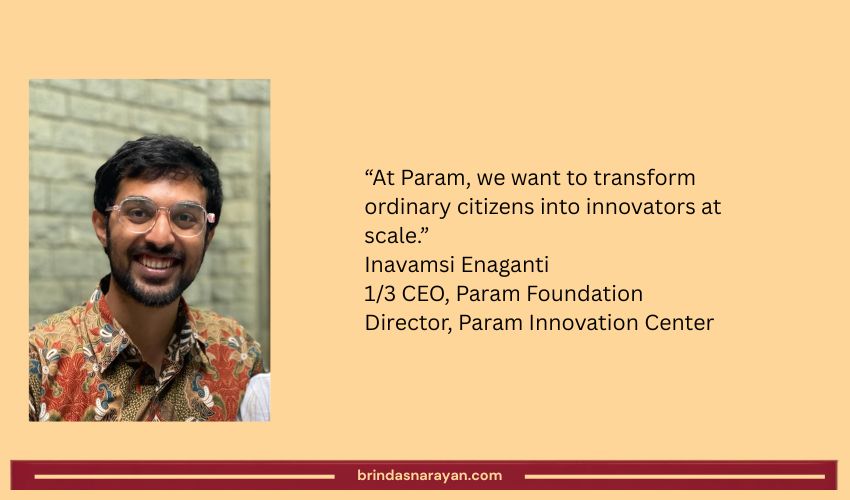
Around then, one of the trustees of Param Foundation, who had visited Enaganti’s memorable childhood room, reached out with an opportunity to help build interactive museums and science experience centers. Agreeing to commit three years to the project as a volunteer, Enaganti jumped in. In six months, he had written up a visionary concept note that compelled the board to onboard him as a Science Director. When he had joined, there was only one other person on board. Now they are a team of about 175, with Enaganti as a Director and 1/3 CEO. They have opened Experience Centers in Jayanagar and Whitefield and have created four maker spaces. They frequently conduct hackathons, host cultural productions, and publish a monthly magazine to spark curiosity in science and culture.
While he had been planning to move out of Param to start a university (yes, gulp!), the management persuaded him to stay on till the flagship center is built out at Chenanahalli. In the process of working with the organization, he has also watched his own relationship with it evolve. At first, he viewed it as a founder might view her or his startup: a child, to be nurtured and grown. But after spending three years, he sees it more as a parent. After all, he too has grown in the process. At this point, he’s hell-bent on making Param a world-class institution.
Meeting Diverse Titans Through Param
Through this stint, he’s met many luminaries: billionaires, scientists, artists and thinkers. Like Balaji Srinivasan, an American entrepreneur who also penned “The Network State,” Kris Gopalakrishnan, a co-founder of Infosys and a prominent philanthropist, Rakesh Gangwal, a co-founder of Indigo airlines. And Mohammad Alabbar, the developer of Burj Khalifa and The Dubai Mall. He’s granting Param space inside The Dubai Mall for an experience center. Another donor is according space near Times Square, New York.
Ambitions Both Big and Small
Enaganti says the intent is to build a global brand that can take on the likes of Disney. And to turn all citizens into innovators. “Take the pani puriwala,” says Inavamsi, with a creator’s gleam in his eye, “if he puts dry ice inside his puris, he can create white smoke. And turn into the most competitive chaatwala on the street.” And this is by having people realize that science and history and culture can be cool. As an example, Inavamsi met a couple who had entered the Param Science Experience Center at Jayanagar. Though the lady was a Science teacher, so far she hadn’t been able to convince her husband about why science was fascinating. But 30 minutes inside Param shifted his perspective.
As Enaganti puts it: “We make people go WOW!” But at this point, their mission too has evolved beyond the “Wow factor.” They want Param to drive self-improvement in visitors. For instance, their maker spaces can facilitate experimentation by visitors. “If a child has a pothole in front of his house, he can try fixing it with stones. But maybe that won’t work. He comes back to the maker space, and learns to add sand with stones. Even that doesn’t work. He comes back and tries cement. He keeps trying different things till he can solve his own problems.”
The idea is to make Param a transdisciplinary community space, where people attempt diverse experiments, including social ones. In turn, Param also tracks all visitor data, to optimize the experience and improve outcomes for future visits. “These centers are living labs.” The entry is free for all government school students and reasonably priced for others. The idea is to infuse the space with design and storytelling to compel repeat visits. Enaganti himself is drawn to long-running, serialized Korean light novels that are precursors to manga and anime. He hopes to bring their character-driven, gamified worlds into Param, creating a space that feels like “A Million Dreams.”
Moonshots Including Romantic Ones
Param is determined to scale across geographies, and eventually Enaganti wants to create an Experience Center on the moon. “At 1/6th the earth’s gravity, think of the experiences you can have there.” And then he explains the steps that might actually get them to the moon: “You first have to create a center underwater, and to do that, you have to start with a floating center.”
While the moon buildout might be futuristic, Inavamsi sounds moony about having cracked something thornier. He recently started dating someone: “Our first date was on March 15th and on March 18th, I asked her to marry me. She said yes.”
References