



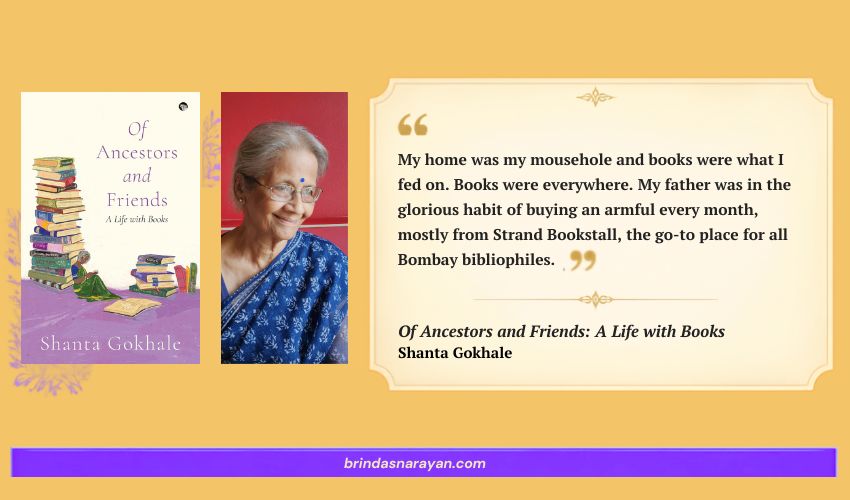
Shanta Gokhale’s Life Between Covers
Shanta Gokhale’s life is inseparable from books. She is as affected by her bookish worlds as she is by her tangible every days. Often her chosen story worlds have been more crucial to shaping her identity than a physical neighbor’s eye-rolls. “Of Ancestors and Friends” not only accords a glimpse into who Gokhale is but also feels like an intimate Literature seminar with one of the nation’s finest writers, translators and thinkers.
Choosing Her Literary Lineage
Writers, like other creators, emerge from a tradition, from a domain built over centuries. And they can opt for any lineage that appeals to them. Gokhale, who writes as vividly and sharply in Marathi as she does in English, refuses like any independent thinker, to be boxed into a particular language or culture. She deliberately chose Shakespeare as her first ancestor. After all, why not inherit storytelling chops from the OG bard?
Devouring Books Like a Rodent
Such choices have emerged from a lifetime of reading. At a panel discussion, responding to a question on whether she was special, she said: “I was a mouse. A mouse that read.” And she has been gnawing at pages from the age of 7 till 85, with an incisiveness that has bled into her novels, essays and translations.
Why Some Books Spur Repeat Reads
She also wonders, with the curiosity of an adult reader, why page-turners like A.J.Cronin’s The Citadel and The Keys to the Kingdom or the three-volume The Forsyte Saga, haven’t lingered with her? On the other hand, she has been repeatedly drawn back to Middlemarch by George Eliot: “Judging by the books I have felt compelled to return to again and again, I must have looked for the experience of passionately lived worlds, that both engaged and astonished me.”
Influenced by a Bibliophile Father
Shakespeare might have been her literary forefather, but her own father, a journalist and bibliophile had significantly influenced her tastes. She was, like him, a more discerning reader, panning the Enid Blytons at school for being too “[b]land and soporific.” But she devoured works she won as prizes, slurping warm goat milk with Heidi, steeped in Oliver Twist’s sadness or mirroring the feisty Jo March in Little Women.
Then there was her father’s habitual and even obsessive accumulation of books. While recently browsing through his collection on her bookshelf, she wonders at his instinct for what would endure: like Dostoyevsky, 1984, The Grapes of Wrath and The Catcher in the Rye. During a summer holiday in Pune, where she swam in the mornings and read for whole days thereafter, he carted an aluminum trunk load of books, including Albert Camus and Jean Paul Sartre. Having absorbed the chills of 1984, it felt ironic that in the same year, India experienced a Big Sister period. When Ramnath Goenka of The Indian Express was asked how he had the courage to criticize the government, he said: “I chose to listen to my heart.”
Divided Cultures and Problematic Myths
The trunk accompanied them to London in 1956, filled with pickles, snacks & specialty shampoos. In October of that year, in the New Statesman, C.P. Snow published “The Two Cultures,” expressing that the division between science and the humanities was harmful. Later, he expanded this into a book, A Second Look. In India, Gokhale suggests, we now contend with a third culture: myth. For example, papers claiming that our ancestors invented planes that could fly backward and between planets. Or a Minister of State who said that Darwin’s theory is “wrong.”
Facing the Chills of Literary Snobbery
Though she takes pride in her literary sensibility, she’s also faced the frosty sneers of intellectual snobs. While doing a BA (Hons) in English Language and Literature at the University of Bristol, she recalls a fraught encounter with her tutor, Charles Tomlinson. She had loved reading “The Alexandria Quartet” by Lawrence Durrell. When Tomlinson asked, “What have you been reading Miss Gokhale?” she responded with a diffident, “The Alexandria Quartet”. He visibly curled his lips and obliquely disparaged her choice with an injunction to “suffer” if she wanted to be a writer. Until then, she hadn’t wanted to write. But she also dismissed his “romantic nonsense about having to suffer in order to write.”
Suffocating in Hushed Libraries
She found Bristol less welcoming in other ways. Having grown up in the cacophony of Mumbai, she felt stifled inside its silent libraries. Where one had to flip through reference books inside the eerie hush, rather than merrily carting tomes home. She couldn’t wait to buy her own books, which she eventually did after scrimping on stuff, wearing laddered stockings and eating rare meals out. Her first purchase in the second-hand nook of George’s on Park Street was The Complete Works of Geoffrey Chaucer, a book that she still fingers with an owner’s pride: “The more ragged the book has become over time, the more mine I have felt it to be.”
Readers With Outsized Bookshelves
As a book lover – in more ways than one – she relishes both the old and the new: “New books are precious for the smell and crispness of their pages; old books for their stains and markings which connect one to their previous owners.” For those who might ask if she has read all the books she owns, she quotes Walter Benjamin’s talk, “Unpacking my Library.” In that lecture, Benjamin cites Anatole France’s answer “to a philistine who admired his library and then finished with the standard question, “And you have read all these books Monsieur France?”
“Not one-tenth of them,” France responded. “I don’t suppose you use your Sevres china every day?”
Being Shaped By Existentialism
For the folks of her generation, Jean Paul Sartre was essential reading. “In the sixties, if you weren’t reading and thinking Sartre, you were not worth looking at.” While his novels didn’t grip as much, his play “No Exit” has lingered, as has its performance in Mumbai as Band Darwaze. It’s the play with the famous line “Hell is – other people.” Gokhale concludes that it’s not so much “other people”, but your investment in their judgment which creates a hellish dependency. But you can also break free of such opinions.
She wrangles with Sartre’s arguments as a fiercely cerebral thinker would. She realizes he doesn’t have all the answers, but surely his questions are worth pondering about, since they get to the root of what bothers some or maybe many: what is an authentic life? Or a good one?
Contending With an Absurd Planet
She has read Albert Camus’ The Outsider three times. Once, when she was 19. The second time when she was 50 and her own mother had died, three years earlier, of cancer. She draws succor from the protagonist’s response to living in an absurd world: “He accepts life as it is, resists being drawn into its absurdity, refuses to despair and lives from day to day with integrity.” While Camus’ protagonist was problematic – he was, after all, a murderer – Gokhale herself offers a model for many. If we can live, as she has, with ineffable grace and an honest allegiance to one’s craft, even Sartre might doff his hat.
References
Shanta Gokhale, Of Ancestors and Friends: A Life With Books, Speaking Tiger, 2026