



A Life In Pursuit of Wonder
A Reluctance That Preceded Surrender
The Bhagavad Gita, comprising 700 verses, is embedded in the sprawling 100,000 verse Mahabharata. Arising from Arjuna’s resistance to battling his kith and kin, it’s perhaps not chancy that one of its much-loved contemporary narrators should have embarked on the project with a similar chafing.
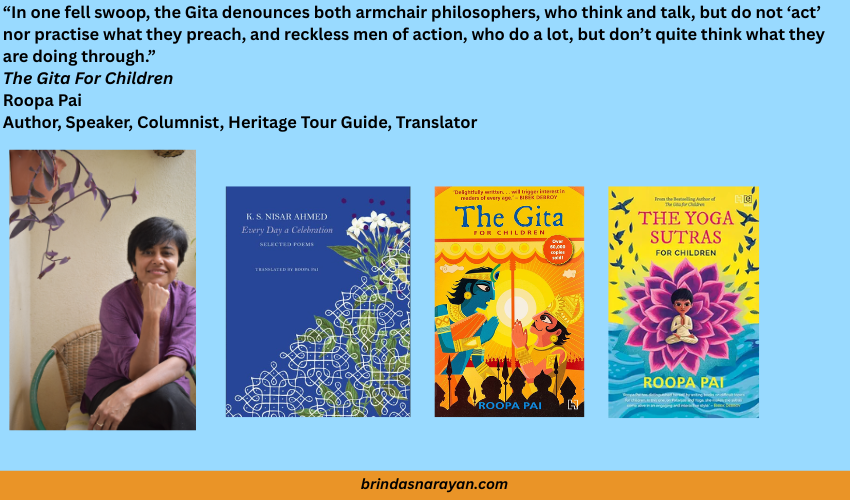
Roopa Pai, who was already established as a bestselling children’s author, pushed back when her Hachette India editor, Vatsala Kaul Banerjee, suggested she tackle The Gita next. “Why me? I don’t know Sanskrit. I have not grown up with The Gita. Unlike Egyptian or Greek myths, this is a living text that’s revered by millions.”
Banerjee, who had worked with Roopa for many years by then, responded with a phlegmatic and intentionally provocative, “Have you read it?” The writer had to accede that she hadn’t. Abandoning the idea before reading it felt like a copout.
But the conversation had sparked other doubts. As a voracious consumer of Amar Chitra Kathas, Roopa recalled skirting The Gita even as a palatable comic book. “It had huge speech bubbles and what Krishna was saying felt so abstract.” If Anant Pai, a genius at winning young readers with his seductive storytelling, hadn’t drawn her in, could she fill that impossible void?
Moreover, she was raised in a Lingayat household, imbibing the vachanas of Basavanna and Akka Mahadevi among others. “I had no brush with The Gita at all.” Read it she could, but which version should she begin with? Then she recalled Tara Kini, her cool aunt-in-law, who also taught Physics and Music at Mallya Aditi and was the founder of Sunaad, a music collective.
A Key Discovery Changes Her Mind
Tara urged her to heed her editor’s suggestion with surprising fervor. “Why?” asked Roopa. “Because it’s such a great text,” her aunt said. Then, in a typical teacher’s manner, she picked up a white board and mind-mapped chapters. Drawing circles and branches, she mentioned something that would dissolve Roopa’s uncertainty: “You do know that Krishna and Arjuna are best friends, right?”
Till that moment, Roopa had never thought of the divine charioteer and the Pandava warrior in that light. “I had always thought of them as a God and his devotee, or as a mentor and mentee.” But as besties or friends? Surely she could get kids interested in one of the most profound, mystifying, aggravating and sage heart-to-hearts between friends? At the end of her riveting session, Tara also lent Roopa some of her favorite Gita commentaries including ones by Sarvepalli Radhakrishnan and another co-authored by Christopher Isherwood & Swami Prabhavananda.
Delving into Radhakrishnan’s book, Roopa was gripped. Reading it as a literary text rather than as a religious one, it seemed to resonate at all levels. Till then she had done certain things in life without knowing if her actions had been optimal. Suddenly The Gita seemed to validate her approach – for instance, her willingness to try her hand at multiple things without caring about rewards or prizes – and also hint at a path forward. More than anything else, The Gita seemed to address her fears: “It felt so friendly, full of compassion, understanding of human frailty, of confusion…” If she, as a midlifer, felt so charged, couldn’t this help young readers more intensely? All those “could I?”s and “should I?”s fused into an unshakeable “I must.”
Still, when The Gita For Children was launched, Roopa shied away, for a few days, from public encounters and social media. Familiar fears flooded back. Though her version had been endorsed by Bibek Debroy, a renowned expert on ancient Indian texts, surely there might be a backlash? As it happened, while the author practically ducked under a table, copies started flying off shelves. In viral social media posts, readers lauded her work’s accessible style and contemporary appeal. Mainstream outlets like The Times of India gave it a whole-hearted thumbs-up, citing her droll writing and chapter titles: “In Which Krishna Shares With Arjuna A Killer App For Contentment.”
Reevaluating Home As Material
The Gita came much later in Roopa’s writing journey, a path she had chosen as early as 8-years-old. Through her idyllic childhood – raised for the first two years by doting grandparents, an aunt and uncle – and later by her parents who moved back from Pune to Bangalore, her proclivity to tell stories felt inevitable. She agrees this was a “gift” that felt as natural to her as breathing would to others.
Even as a child who couldn’t read yet, she used to recount whatever was happening to her in the third person. Morphing into a character in her own stories, her narrative eye zoomed out of the scene’s immediacy. Later, when reading Enid Blyton, she wanted to be Blyton. If something unfolded, she would jot it down, carefully choosing words. When telling the story to others, she would use her written version, rather than a cloudy recollection. Once, after reading The Diary of Anne Frank, she started out on a diary with a lock, but did not sustain diaries or journals into the long term.
Yet, for many years, she assumed that the lives worth writing about were confined to Dorset or Cornwall, where one guzzled ginger beer, munched on scones, solved village mysteries or held midnight feasts at boarding schools.
Reading Target, the iconic Indian children’s magazine, was an epiphany. Her Malleswaram life was already enchanting. Like standing on her uncle’s scooter deck, while heading to the market to buy vegetables. Or being dropped off at her play school by her mother, where a bawling Roopa was promptly scooped up by her grandfather, as soon as her mother had vanished. Or lingering at the Kadu Malleswara temple, or being fed ragi mudde and saaru by her grandmother, or cycling to Stella Maris School in a sleeveless cardigan.
Or the infinite joys of Bangalore: spooning ice-creams at the Lakeview Milk Bar, when it used to be a drive-in spot, with waiters fixing trays on car windows. Or frolicking near stepped waterfalls on the MG Road Boulevard. Or hanging by the Canara Union to catch a glimpse of the debonair Prakash Padukone. Or combing stacks at Gangarams for books and more books. Or of being loved unconditionally by so many adults, she still exudes an infectious joie de vivre.
When A Magazine Opened Its Doors
Though she headed to an engineering college after her PUC, she was keen on finishing her degree to pursue her passion: writing. In hindsight, she recognizes that the engineering slog gave her a command over data, with tackling complex nonfiction topics, with ingesting vast amounts of dry information within tight deadlines. Delving into thick textbooks to master the material rather than crack exams with guides or past-years’ papers, what lingered from that experience, is a zeal for learning, a fervor that hasn’t waned with age.
On graduating, she was eager to kick-start her writing career. Convincing her husband, Arun Pai, who had recently graduated from IIM-Bangalore to find a job in the nation’s capital, she landed up at Target’s Delhi office. Miraculously, in their small team of three staff writers, one had quit the previous week. It was also her first meeting with Vatsala, who has since then been Roopa’s editor for 33 years. She didn’t know it then, but bagging that job set her on a path she had been dreaming of since childhood.
As an aside, in workshops with children, she tells them “the universe will conspire to make it happen, but only if you know what you really want. Most people don’t know what they want.”
Though this was her “dream job”, the early working years at Target weren’t easy. Looking back, maybe she was catapulted into a gritty adulthood after a cocooned existence in Bangalore. Right through, Vatsala was an appreciative and steadying force. And there were perks: she soaked up the vast collection of children’s books at the magazine’s library, mining them for insights as a writer would.
Connecting With All Ages
When Vatsala reached out to her a decade later, Roopa already had stories inside. The Taranauts series, a sci-fi fantasy-adventure, combines Indian myths and philosophy with riddle-cracking smarts. In general with her books, adults seek her works as much as kids.
While her tone is conversational, she also infuses her writing with spaciousness and ambivalence: “I always ask, what do you think? Then leave it at that.” Readers across ages appreciate such fluidity. For her own research, she gains as much from listening to illuminating talks, whether on YouTube or on scholarly podcasts as she does from reading texts and plumbing archives.
Returning to The Secular
Soon after The Gita, in a few months, Vatsala reached out with another idea: to write about the Upanishads, the ocean from which The Bhagavad Gita had emerged like a kernel of compressed insights. Roopa’s immediate instinct was to push back. She didn’t want to be pigeonholed as a writer of scriptural texts only.
Since Economics was always a subject that had eluded her grasp, she chose instead to grapple with the vagaries of markets and human behavior, publishing the popular primer, “So You Want to Know About Economics.” Till she wrote this book, she wasn’t someone who read “The Economic Times” or understood how macro policies seeped into everyday choices. Digging into a vast trove, from ICSE textbooks to Freakonomics, she was struck by the subject’s connection to The Gita. Economics was all about meeting limitless desires with limited resources. In The Gita, it was about shielding or granting one’s attention. Given that we all have one lifetime, where will you direct yours?
In the midst of writing it, she reached out to Raghuram Rajan, who was the RBI governor then, to blurb the project. Rajan himself had put out a series of Economics explainers on YouTube that Roopa had found helpful. One particular clip, called Dosanomics – the economics of a dosa – struck a chord. But she didn’t know Rajan and she wasn’t surprised by his lack of response to her cold email. Later, when she had completed the manuscript, Rajan resigned from the RBI. She reached out again, and he responded in 24 hours. In a few days, he sent her a glowing endorsement. She draws on anecdotes like this to convince young adults to stay “optimistic and thick-skinned.”
After the Economics book, Roopa turned to history, resurrecting the life of Krishna Deva Raya, the 16th century Vijayanagara ruler, in her signature animated style.
Segueing Into The Sacred
Then she returned to Vatsala, with a sheepish acquiescence to her original suggestion: to explore the Upanishads. By now, she was also curious about what The Gita hadn’t covered. “This was much harder to write.” Even reading Radhakrishnan’s book “The Principal Upanishads” did not help. The material felt opaque, uninteresting, hard to get into. She turned to online discourses. In particular, she was compelled by the lectures of Swami Sarvapriyananda of the Vedanta Society of New York. After watching a few talks, she now had an entry into the material, the elusive “in” that authors hanker for.
Stumbling On the Yoga Sutras
Having covered The Gita and The Upanishads, Roopa was keen on learning Sanskrit. She found a cool professor from IIT Kharagpur, Anuradha Choudry, who conducted online classes. During one of those sessions, Choudry invited participants to a lecture on The Yoga Sutras. It was a one-hour lecture by Dr. Vinayachandra Banavathy, and Roopa was blown away. Unlike The Gita and The Upanishads, which are more theoretical, the Yoga Sutras offer practical takeaways. As Roopa puts it: “The Gita tells you what you must do, the Yoga Sutras tell you how to do it.” It’s especially applicable to young adults who face competitive exam situations and peer pressure. In concise 197 sutras – of one line each – the book tells you how to control and program your mind.
Journeying Deeper into the Self
While describing her author’s journey to a classroom of National Public School kids, she realized she had been “funneling in” – traveling from the wide to the narrow. Initially, she wrote about the world, then about India and its philosophy, and then about the state’s history and her city. More recently, she has translated poems by Nisar Ahmed, which draw her back to the local, to who she was as a Kannadiga and as a proud inhabitant of Bengaluru: “I’ve been going deeper and deeper and coming closer and closer to home.” To date, she has published over 30 books.
An Optimistic Take On the Future
In terms of the world’s future, Roopa is not worried in the least. She believes the next generation has it together and they’re not as digitally addicted as some adults would believe. She observes that many are consciously turning away from devices to reconnect with each other and the world. At a recent writing workshop, she was taken in by their writing and editing skills: “They caught every small error in a passage, including commas, capitals and spellings.”
In general, she is endowed with a sunny-side-up temperament. “I trust people, I trust the world and believe there’s good in all.” This is where Indian philosophy – aham brahmasmi – helps. She recognizes that one’s inner universe affects the manner in which one perceives the external world: “We are each the creators of our own universe.” It’s a worldview that also endorses boundary setting, with not allowing others to ruffle one’s peace. As Roopa puts it, “The gods have cleverly hidden it from you that you are the controller.”
The Gita can also help with goal setting. She points out, in The Gita, Krishna says, “Whichever God you worship, I will make sure your faith is rewarded.” If you seek money, you will become rich. If you seek fame, you will become famous. But you must dwell carefully on what you really want, since both money and fame are ephemeral. Instead, you should focus on something that outlasts money and fame.
Reader Responses To Her Work
One thing that Roopa repeatedly hears from her young fans is that they feel like they’re talking to her when they read her books: “They need someone who can talk in their language.”
For those who bemoan the decline in reading levels, Roopa cites a conversation with Ruskin Bond. Bond said that even when he was young, “very few children read.” Most kids, even then, did other things. As a child, Roopa remembers being among a minority in the classroom. “Others were playing sports, or hanging out, chatting.”
While the distractions might have mushroomed for non-readers, Roopa still believes that “books will find their readers.” Moreover, today, Roopa believes that there is a growing awareness of the benefits of reading. This propels parents, teachers and schools to foster a reading culture more actively than earlier.
She’s personally not a fanatical reading evangelist. After all, there are so many fruitful ways of biding one’s time on this planet, and reading is only one of them. Besides, wisdom can come to one in various ways. For instance, Kabir was an unlettered weaver. As Roopa phrases it, “Information is not knowledge and knowledge is not wisdom. One should differentiate between a pandit and a jnani.”
She succinctly captures this in the wildly popular The Gita for Children: “How can you ensure you are acting wisely? There is no easy answer to that one. But there are some hints, nudges and recommendations in the Gita, some starter-kit tips, as there are in every wise book, to help you along.”
References
Roopa Pai, The Gita For Children, Hachette India, 2015.