



An Inheritance That Endures
Discovering a Memoir In Two Parts
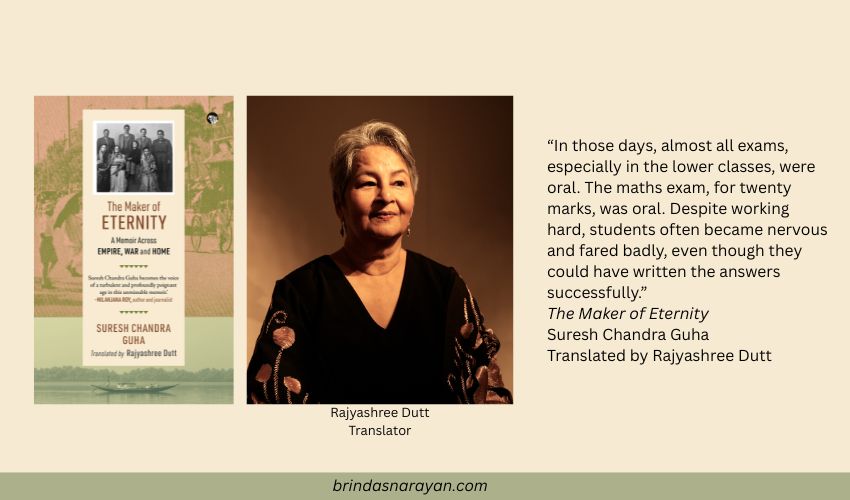
We should have been taught history through memoirs. After all, nothing really transmits the texture of various lives – especially of fascinating ordinary folks – better than diaries and letters and remembered jottings. “The Maker of Eternity” emerged from the translator’s discovery of her grandfather’s memoir, “113 foolscap pages covered neatly in my grandfather’s tiny, beautiful Bengali handwriting – which I could not read.” This eventually became a stirring family project. The grandfather’s narrative, transformed into audio tapes by Rajyashree Dutt’s sister-in-law, was translated by Dutt into English. Since the oral adventure ended abruptly in 1923, Dutt was convinced that more pages lay in wait. Miraculously, sleuthing inside a family home uncovered them from an attic trunk, engendering something rare: a first-person recounting of a life sketched in pointillist detail, ferrying us into the roughs and rewards of a bygone era.
Reading Her Grandfather Through his Pages
Suresh Chandra Guha (1899 – 1983) had lived through tumultuous, formative chapters in the histories of Bengal and Assam. Passing out of Presidency College with a first class in his Masters in Organic Chemistry, he taught the subject at colleges in Rangoon and Rawalpandi. He was displaced from both places, shorn of material possessions, by violent upheavals, the 2nd World War and the Partition. Students from his final stint at St Edmund’s College in Shillong laud his passion and humor. Even after retirement, he stayed punctiliously busy, gardening, reading books and papers, tuning into sports commentaries and more than anything else, writing about lapsed times. Dutt, who hadn’t absorbed how gritty and inspiring her grandfather was till she embarked on this project, fact-checked the work: his recollections were staggeringly accurate.
Inheriting Character from His Grandfathers
Suggestive of how patriarchal those times were, the book only fleetingly touches on women who might have shaped the author. His grandmothers and mother don’t occupy the psychological space (and pages) inhabited by the men who preceded him. Guha was clearly awestruck by his grandfathers, who were staunchly ethical in different ways. One tried to do some good work in his village by building a community reservoir, taking a loan to facilitate it. Since he couldn’t pay back the debt, he left home for 16 years, to earn his dues elsewhere. When he returned, the moneylender had died. He insisted on handing the sum to the moneylender’s son, who refused to charge interest. The anecdote highlights the intensity of shame in owing money to another, and in not settling one’s commitments. The other grandfather was “rich and generous” and uplifted many of the downtrodden.
Reflecting On His Father’s Ways
His own father, Hemchandra Guha, was the headmaster of a school. When a judge’s son was inattentive and defiant, Hemchandra caned the boy despite his father’s high position. Though his friends chided him for his action, later the judge visited the school and thanked him. He said he felt the boy was being spoiled at home by his mother, and required a beating to get on a straight path.
Even in those times, school politics hindered learning. The secretary of a school meddled so much in its operations, demotivating Hemchandra and his teachers. At the recommendation of a batchmate, he joined the post office as a clerk, where as a graduate, he was overqualified. Insulted by a jealous postmaster, who scoffed at the “graduate’s” mistakes, he sent a resignation letter to his batchmate, who pulled up the postmaster.
For a while, his family even dwelt on a boat, when his father was a postal inspector. During cholera outbreaks, they were precluded from entering some towns or villages, and nervily watched bodies being hurled into the river from a distance. At other times, their boat was attacked by pirates.
Schools Were Punitive and Tedious
During all this, Suresh Chandra Guha studied at various schools, where the infrastructure was barebones and rote learning was insisted upon. There was little emphasis on understanding. Classrooms only held boys since girls were emphatically confined to domestic spaces. Students wrote with reed pens on banana leaves and progressed to reusable palm leaves that had to be held between a hand and one’s toes while writing with the free hand – an impressive gymnastic feat, no doubt. When tested, if boys were silent or even slightly defiant, they were caned. Harsh punishments punctuated their learning, with masters often reigning over students like tyrants.
In Gauhati, he joined the Cotton Collegiate School in Class 5, which was organized and disciplined with a strict but wise headmaster. Here, he struggled to cope with his studies after a relatively slack period in Dhaka. At this school, teachers started lessons as soon as they entered, awarding tough homework assignments. His father requested for him to be held back for a year, and he had to contend with the humiliation of being with junior students. But this made him more serious about his academics. He paid special attention to arithmetic, practicing problems 25 to 30 times, till he cracked them. The tenacity derived from this experience that would linger through life.
Sparks of Rebellion Against the British
There was, all along, a growing resentment of British rulers. Word spead of atrocities by the British – a man beaten up on a railway platform, letters stolen by British workers, very violent behavior against tea garden workers. Insouciant chants of “Bande Mataram” rippled through towns and villages. Inside Assam’s forests, tribals, armed with a canny knowledge of the terrain, outwitted gun-toting Brits till roads were forcibly carved between trees. Locals inevitably fought each other too. Agitations for freedom were marred by communal riots.
Entertainment in the Pre-Digital Era
Every year for Durga Puja, a sculptor was brought in from Bengal, and made to create the asura-defeating goddess inside a bamboo frame. All kids and adults watched the process, as the goddess and asura evolved, with their nuanced expressions. During the jatra, held in a big pandal, men played women’s parts too, as women were not allowed to act.
At the Hari Sabha, close to their house, besides the Durga puja, they had other performances throughout the year. Snake charmers beguiled audiences and snakes. The writer once watched a seemingly performative tussle between a Brahmin and a snake charmer, with both flinging a pinch of dust at each other. While the cobra hissed in the basket, the two tried to outsmart each other.
Memorable Encounters in His Gauhati college
He joined college in Gauhati, where he chose to study logic, Sanskrit and chemistry. His Scottish chemistry professor fueled his lifelong dalliance with carbon-based compounds. He dabbled with playing the violin and flute, but his father broke both instruments since music wasn’t considered a viable vocation for a boy. Neither was “whistling, singing, smoking cigarettes or bidis, having a haircut with a parting for ten annas or six annas, staying out after dark – and especially chatting with girls who were not family.”
At his college in Gauhati, he met various eminent personalities, including Acharya Prafulla Chandra Ray (otherwise known as P.C. Ray). He had a childlike temperament. While many students vied to tug his carriage, he comically rode on the shoulders of one student to a lecture hall, sparking a merry uproar in the audience. At some point, Tagore visited the college too and was asked to sing a song. Tagore had apparently suggested that the request came too late, when his singing voice had already aged. Yet, his melody sounded like a “flute” but also carefully averted the high notes. At another time, the college hosted Jagadish Chandra Bose whose proposition that animals and plants responded in a similar manner to stimuli had been rubbished by many Western scientists, but was later proved to be correct. Guha realizes even in that time, the prejudices woven into Western science. Moreover Bose’s hypothesis affirmed Indian’s culture’s reverence for all living things, whether they be trees, plants or animals.
The Empire Inside Classrooms
They also had a British gentleman teaching them English, a man called R.C. Goffin, who didn’t bother to mask his racial prejudices. He disparaged his Indian students for their lack of hygiene, for spitting everywhere, for chewing paan, for doing the big job in the great outdoors. Naturally, students were miffed. Later on, an Indian professor told them that the British were even more unclean, not bathing for days on end and covering their malodor with lotions and creams and so on. One student wrote all this down in an English exam, and an infuriated Goffin marched off with the cheeky paper to the principal. Eventually, he resigned from the school and joined Oxford University Press, ferrying his biases into the reputed publishing house.
The Extraordinariness of an Ordinary Life
Beyond taking us into a vanished past, this memoir underlines the extraordinariness of its author. It would serve us well to plunder other attics and Godrej bureaus, resurrecting more such diaries and letters and accounts. Kudos to Dutt – a theatre practitioner, editor of Chicken Soup for the Indian Couple’s Soul, and a writer of award-winning short fiction and non-fiction – for bringing this to life.
References
Suresh Chandra Guha (Translated by Rajyashree Dutt), The Maker of Eternity: A Memoir Across Empire, War and Home, Speaking Tiger, 2026.