



Reading Poems As A Balm
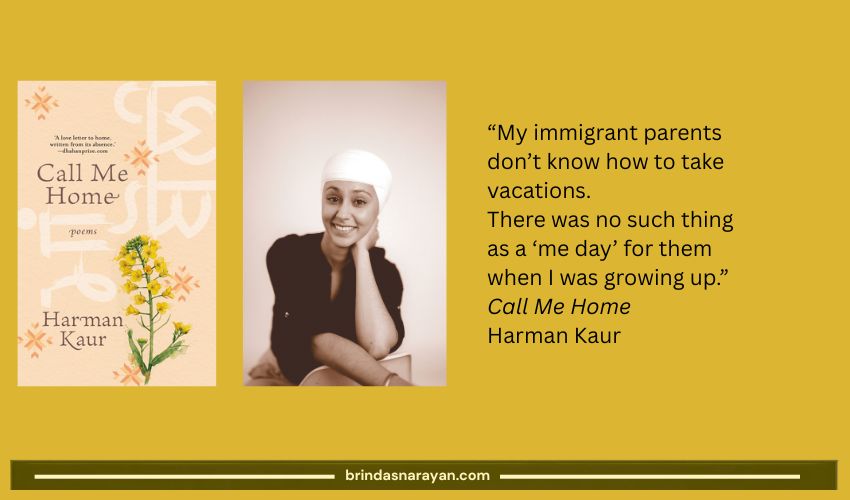
The world needs us to urgently slow down. Cognizant of the paradox in that hurry, I’d like to offer a quick-fix means to stop our brains from whirring with AI-lit posts and machine-made mediocrity. Read poetry. Read “Call Me Home” by Harman Kaur to summon the running-stitch moments that thread our narratives and embroider our senses of self.
Charting Immigrant Plights
Ranging from the shame experienced by a migrant for speaking a mother-tongue inflected language to the suppression of a father’s sorrow or the venting forth of a “mother’s rage”, Kaur gives voice to invisibilized losses. What does her mother, an immigrant from Panjab to Canada, miss most? “I miss being understood.” Just as she feels at sea in the new land, the father too wrestles with his longings. He’s torn between “Panjab”, which is named, and the unnamed “new country” that feels generic and alienating. The absent past is filled with specificities, like wheat roots (“kanak”) attached to fields (“khet”). The new country offers featureless roads that lead to god-knows-where.
Migrants shrink in the new terrain. Old qualifications are disregarded and they’re underemployed. A surgeon becomes a barista, teachers and engineers drive trucks.
At the end, when a child looks back, were all those parental sacrifices worthwhile? To produce another fragile entity who has to power through a perilous planet. As she phrases it in intentionally broken lines:
“even glass
forged from fire
breaks sometimes.”
And right through, her parents never take holidays or days off. When she grows up and can pay them back, they shun her gifts and indulgences. They retreat from her apologies and guilt. Perhaps they know that nothing can compensate. Some equations can’t be settled with sums.
The Geography of Pain
Pain, whether it’s emotional, physical or mental, is not the prerogative of migrants. It can come to anyone, in any form. Riding its cratered, bumpy surface requires a cognizance of its complexity, the impossibility of its banishment.
You can “numb” yourself, but past hurts will resurface, and with them, the regrets. Just as anesthesia fades after a surgery and we return to searing consciousness, these wounds dwell in our bodies. Even if the mind tries to relegate them to yesteryears, the body remembers. Memories seep into the poet’s lungs, surfacing with each breath, exhaling themselves into the present. Repressing pain cannot help, while acceptance can.
But in the meanwhile, we would do well to notice the love that lingers:
“You will take it for granted because
it is always present
And this is how you will lose it.”
You are what you repeatedly attend to. Ignore your relationships, and they will slink away, like unfed strays.
The Specificities of Womanhood
While men are no strangers to pain, women experience it in rhythmic intervals. And yet we encounter women hurting other women, despite having borne the humiliations and slights, the “blood-stained sheets” and the “throes of first-time motherhood.” Despite the saas having been a bahu, she forgets.
Then again, they are both victims of patriarchy, subjected to the male gaze. “The Imagined Woman” evokes the contradictions of male fantasies. They want their women modestly dressed, but also paint their idylls on canvas bodies. Even if they claim or possess them, “they do not know her secret.”
The poet seems to imply that girlhood is more idyllic than womanhood, but this feels like a sentiment that may not resonate with all. Not all would agree that
“Little girls should be allowed to remain little girls
for as long as possible.”
But in a broader sense, perhaps we need to sustain a child’s outlook to remain engaged with ongoing planetary shifts, to keep our hope and wonder alive rather than slip into grownup jadedness.
Time As an Equalizer
Regardless of whether you’re male, female, human or animal, you share this: 24 hours in a day, 365 days in a year. Sometimes birthdays are melancholic reckonings of how little you’ve done, of how much further you need to travel. Of wasted time, of “nothing to show”, of how you will not be leaving a mark on anything.
“Another year has passed me by.
I am alive. That is all.”
Maybe the poet intends to ask why that isn’t good enough. After all, many of us might have dreamed of future greatness, till we realize that no one cares about our significance. The poet too feels like “An Effigy for Nothing Important,” with no devotees hauling offerings to her goddess feet.
Ruminating On Other Paths
Despite all the new-age messages to remain yanked to the present moment, the mind slips back. Sometimes you dwell on exes, on past what-might-have-beens. They appear like ghosts, peopling your mind. Do you appear to them too? “Or was I never even worth keeping as a memory?” Is being remembered so important? Do we need to dwell forever in other minds to feel like this life had meaning? Maybe so, because even if an Old Man God drenched her in angry rain,
“but I would joyfully accept this as a sign that
I am not some forgotten thing
among billions of others.”
Others Have it Better
It’s “others” who feed your joy and despair. Often, there’s a sense, exacerbated by social media, that others have it all. This seeds a constant yearning to escape. A vacation to escape the mundanities of work, sleep to escape everyday annoyances, or death as a final fleeing.
“We all have a packed suitcase
hidden in the darkest corners of our minds.”
But till your journey is done, you might want to stop time as poets do, by obsessing with line breaks and punctuation marks, by choosing words and actions that reflect your complex being. Rather than yielding to the homogenizing diktats of ChatGPT, read these moving, human-crafted verses with care.
References
Harman Kaur, Call Me Home: Poems, (First published by Central Avenue Poetry, Central Avenue Marketing Ltd.) Speaking Tiger, 2026